Privacy isn’t about hiding everything. It’s about choice. | Credit: Veronica Cestari /CCN
Share
Key Takeaways
People must value privacy again. Digital systems removed the natural friction that once protected it, and rebuilding that protection requires deliberate design.
Optional privacy fails at scale. When only a minority opt in, anonymity weakens for everyone.
In multi-asset blockchains and DeFi ecosystems, privacy is no longer limited to single transactions. It now concerns portfolio exposure, trading behaviour, and metadata visibility.
Pavel argues that privacy must be built into blockchain architecture by default. If it remains an exception, surveillance will continue to outpace safeguards.
Privacy didn’t disappear because people stopped caring about it. It disappeared because the systems around us stopped making space for it, treating privacy as an option rather than a fundamental.
For most of modern history, privacy was enforced by friction. Information was hard to collect, harder to store, and easy to lose. What you did in one place rarely followed you elsewhere.
That limitation acted as a natural boundary.
Digital infrastructure removed that boundary almost entirely.
Every interaction now leaves a record. Not just the obvious ones, like payments or messages, but the small ones, too.
How long you paused.
What you hovered over.
What you didn’t click.
Over time, these signals became more valuable than the actions themselves.
Behavioral Surveillance in the Digital Economy
The shift became visible to the public in 2010, when Target was found to be predicting pregnancies based on shopping behaviour.
A teenager received maternity coupons before she had told her family she was pregnant.
The model didn’t know her name or intentions. It didn’t need to. Patterns were enough.
At the time, the story felt shocking. Today, it barely registers.
Fifteen years later, prediction has moved far beyond retail.
In 2025, major platforms can infer health conditions, relationship changes, financial stress, and political alignment from passive data alone, without a single explicit disclosure.
In some cases, systems flag life events before the people involved have consciously processed them themselves.
Privacy Is Back in the Conversation, but for the Wrong Reasons
Recently, a surge in interest around privacy coins, including Zcash, has put the word “privacy” back in headlines within the blockchain ecosystem.
Prices move. Influencers comment. That draws attention. But that’s not the real story.
Builders have been working on privacy technologies for well over a decade. The recent buzz doesn’t mark the beginning of privacy in crypto. It just brings the conversation back into view.
If you dig deeper, you see something important… most people talking about privacy today don’t really understand what it means in crypto or why it matters.
Privacy Was Meant To Be Core, Not Optional
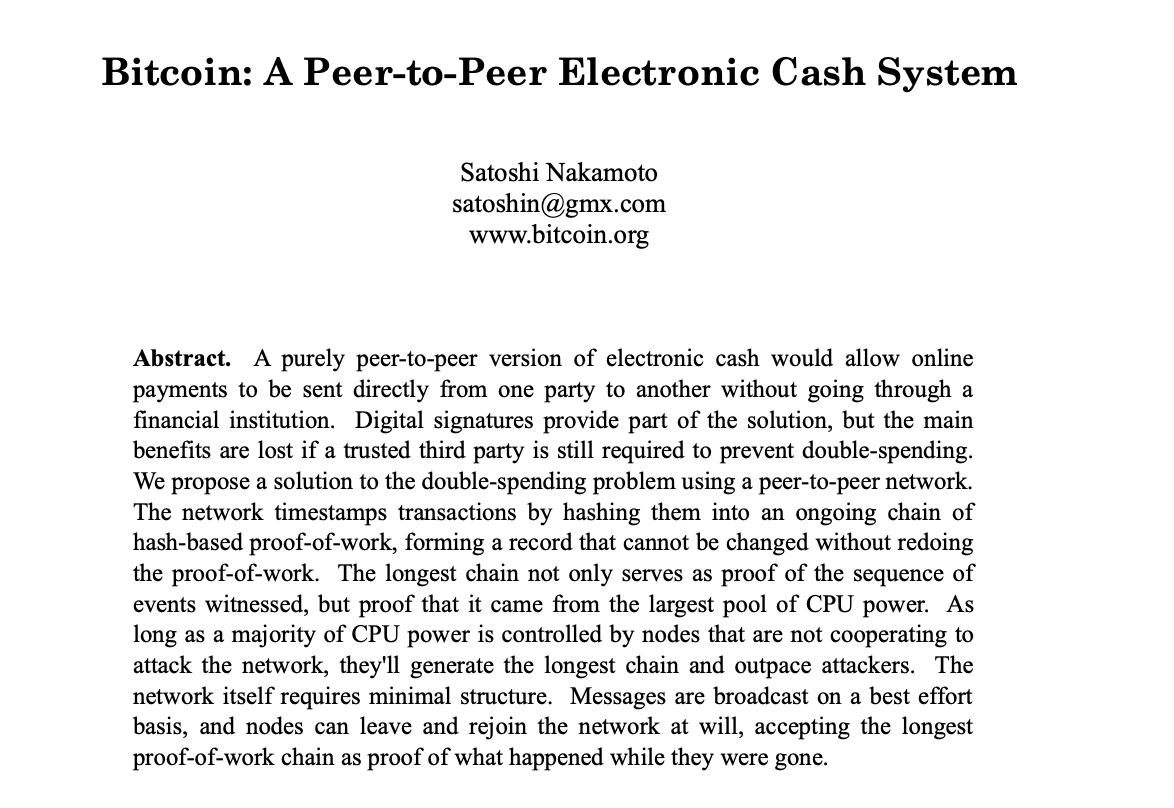
The word cryptocurrency literally means “hidden” or “secret” money. However, Satoshi outlined the challenge of wallet tracking in the original Bitcoin white paper.
He also argued that crypto would be more powerful with strong privacy.
Bitcoin whitepaper by Satoshi Nakamoto | Source: USSC
Privacy isn’t about hiding everything. It’s about choice.
Think about how public companies release their financial data only at certain times.
They have control over when and how information becomes public.
Individuals and organizations deserve the same control.
What We Learned From Monero and Zcash
Monero and Zcash are often cited in privacy discussions, but they took very different approaches.
Monero hides almost all transaction details by default.
You don’t need to worry about whether you are private or not, you just are. That makes it strong, but still lacks more complex features beyond simple cash-like transfers.
Zcash uses zero-knowledge proofs (ZKP) to allow privacy, but only if users opt into it. Most don’t.
That weakens privacy overall because the anonymity of everyone depends on enough people using the private option.
This is the core issue: when privacy requires extra steps, most people just don’t take them.
Even proposals that aim to add privacy to existing chains usually make it optional. That’s not enough.
Optional privacy becomes unused privacy, and that weakens protections for everyone.
Privacy Breaks When It Requires User Action
Across digital systems, it is increasingly clear that privacy fails when it depends on user action.
Most people do not opt into additional protections, especially when doing so adds friction or complexity.
This is not unique to blockchain.
It mirrors patterns seen across Web2, where consent banners, privacy settings, and disclosure controls exist in theory but its deceptive design means it’s rarely used in practice.
Huge consent banners that block your screen, dark patterns to trick you into clicking yes, and time-consuming opt-out processes make refusal the path of greatest resistance.
Over time, convenience wins, and the collective result is a steady erosion of anonymity for everyone.
Pavel believes privacy must be the rule, not the exception. | Image source: Pavel Nikienkov
Why Optional Blockchain Privacy Fails at Scale
Blockchain privacy has largely followed the same trajectory.
Many networks offer optional privacy features, but usage remains limited.
When only a small subset of users take extra steps to protect themselves, anonymity sets fragment, metadata becomes easier to correlate, and privacy weakens even for those who actively seek it.
Systems designed around “good privacy hygiene” assume a level of user discipline that rarely holds at a meaningful scale. This dynamic becomes more pronounced as blockchains evolve beyond simple value transfer into multi-asset environments.
Privacy Risks in Multi-Asset Blockchains and DeFi Ecosystems
On Ethereum, the tokenization pioneer, ERC-20 tokens are now collectively worth more than native ETH itself, with 51% of the network’s secured value allocated to tokens versus 46% to the native asset.
As such, its stablecoins now settle billions of dollars in daily volume, wrapped assets allow Bitcoin holders to participate in decentralized finance (DeFi), and governance tokens shape how communities coordinate and allocate resources.
If tokens represent such a massive share of blockchain value and economic activity, privacy stops being a transaction-level issue.
It becomes a question of portfolio exposure, trading behaviour, and on-chain visibility, including risks such as Maximum Extractable Value (MEV), arbitrage bots front-running orders, and the public broadcasting of financial behaviour.
But the significance goes beyond financial privacy. When privacy veils tear, whether through loyalty cards that map your life, algorithms that predict your child’s future before you do, or platforms that quietly assemble your digital autobiography, what’s lost isn’t just transaction data.
Privacy by Default: The Future of Blockchain Design
As digital systems expand across assets and platforms, the conditions under which information is revealed matter as much as the information itself.
In multi-asset, cross-chain environments, confidentiality determines whether users retain control over when information is revealed or whether disclosure becomes the default.
Mechanisms such as auditable wallets illustrate how visibility can be conditional and contextual, rather than permanent.
The distinction matters because, as participation increases, patterns emerge even in the absence of explicit intent to disclose.
And as mainstream networks continue to experiment with partial or opt-in privacy, the structural limits of those approaches become clearer.
Privacy that exists as an exception struggles to hold in systems where surveillance scales faster than safeguards.
If the veil is to be repaired, regulation alone will not resolve the underlying issue; rather, it is through how systems are designed that privacy is treated as a baseline rather than an exception.
Disclaimer:
The views, thoughts, and opinions expressed in the article belong solely to the author, and not necessarily to CCN, its management, employees, or affiliates. This content is for informational purposes only and should not be considered professional advice.
About the Author
Pavel Nikienkov
Pavel Nikienkov is the founder of Zano, a privacy-focused blockchain project designed to enable confidential, peer-to-peer digital transactions. He has spent much of his career working as a project manager and product owner in software development, applying nearly a decade of experience to the strategic direction and operational execution of privacy-oriented blockchain technology.