World Cup betting losses are growing. | Source: CCN.
Share
Key Takeaways
More than $1 million was lost in a week.
Still chasing a multimillion-dollar payout.
Could swing from a $1.12 million drawdown to a huge profit.
A Polymarket trader known as “Athelstan” has lost more than $1 million on a string of failed World Cup prediction market wagers, even as he continues to hold several high-risk positions that could return millions if one of his chosen teams wins the competition.
The losses span match winners, goal totals, and spread bets tied to international friendlies and World Cup-related fixtures.
The massive bets come as prediction markets face renewed legal pressure in the US, with Kentucky announcing lawsuits against Polymarket and rival platform Kalshi.
Trader Racks Up $1M World Cup Bet Losses So Far
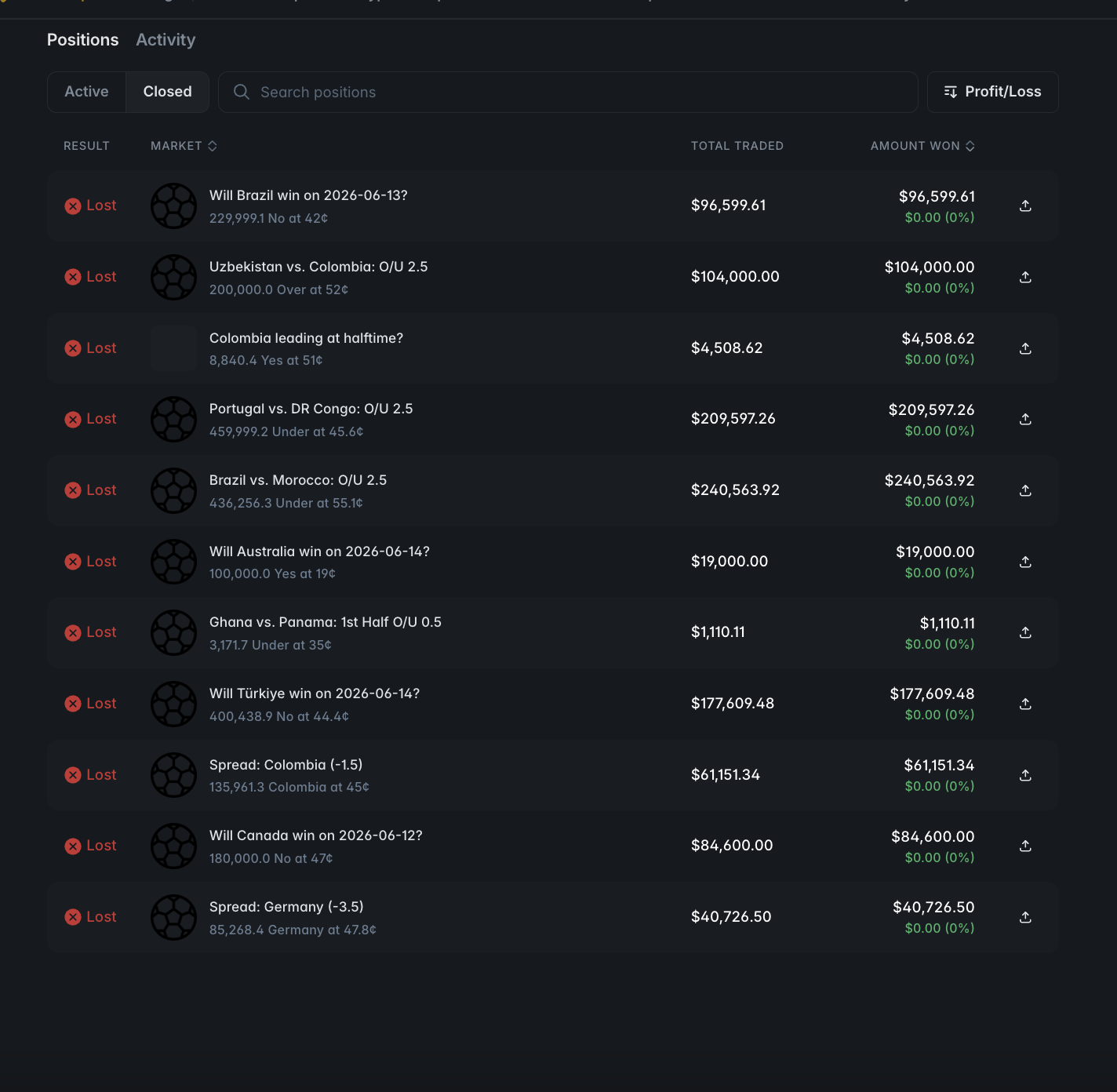
Publicly visible trading records show the mystery trader, who made his account this month, has accumulated about $1.04 million in realized losses across a string of soccer markets over the past week.
The largest single loss came on a wager that Brazil and Morocco would combine for fewer than 2.5 goals, costing $240,563.92.
Another $209,597.26 was lost backing under 2.5 goals in Portugal’s match against DR Congo.
Polymarket trader “Athelstan” has racked up massive losses. | Source: Polymarket
Meanwhile, a position against Turkiye winning on June 14 resulted in a further loss of $177,609.48.
Other unsuccessful bets included:
$104,000 wager on over 2.5 goals in Uzbekistan’s match against Colombia
$96,599.61 position that Brazil would fail to win on June 13
$84,600 bet against Canada winning on June 12.
Additional losses came from spread bets on Colombia and Germany, as well as smaller positions involving Australia and Ghana-Panama first-half goals.
Editorial Disclaimer: Loss data cited in this article was provided by Polymarket and may not be independently verified or fully accurate at the time of publication.
Still Swinging
Despite the seven-figure setback, Athelstan remains heavily exposed to the World Cup winner market, where a single successful outcome could erase all previous losses and leave the trader deep in profit.
The trader currently holds roughly 13.3 million shares across five countries: Brazil, Colombia, Belgium, Morocco, and Senegal.
Those positions are presently worth about $381,000, down from an estimated purchase cost of roughly $459,000.
Brazil represents the trader’s largest active position, accounting for more than 3.5 million shares.
Colombia and Belgium are the next-largest holdings, while Morocco and Senegal make up smaller but still significant bets.
🚨BREAKING: Someone named “Athelstan” just put $460k on England NOT to win their match vs Croatia
— Polymarket Sports (@PolymarketSport) June 17, 2026
Because outright winner contracts settle at $1 if successful, the potential payouts dwarf the trader’s current losses.
A Colombian World Cup victory would generate a payout of almost $3.8 million, while a Brazilian victory would return roughly $3.5 million.
Belgium would pay about $3.2 million, Senegal would pay nearly $1.9 million, and Morocco would pay approximately $867,000.
Even after accounting for the trader’s realized losses, any victory by Brazil, Colombia, Belgium, or Senegal would leave the account comfortably profitable overall.
Morocco represents the closest outcome to break-even, but would still likely leave the trader ahead by more than $400,000.
If none of the five teams wins the tournament, however, the remaining positions would expire worthless.
Combined with the losses already booked, that would push the trader’s total losses to nearly $1.5 million.
Regulatory Pressure
It comes as Kentucky Attorney General Russell Coleman announced on Wednesday that the state is suing Polymarket and rival platform Kalshi, accusing the companies of operating illegal sports betting businesses without state licenses.
“Kalshi and Polymarket are operating illegal sportsbooks in Kentucky and breaking our laws,” Coleman said in a statement.
According to Kentucky’s complaint, the platforms allow users to trade contracts tied to games while avoiding the licensing and tax requirements imposed on traditional sportsbooks.
The state said sports-related contracts accounted for roughly 70% of Kalshi’s trading volume during a sample period in 2025.
Kalshi and Polymarket are operating illegal sportsbooks in Kentucky and breaking our laws. These multi-billion dollar corporations and their legal fictions don’t pass the sniff test.
— Attorney General Russell Coleman (@kyoag) June 17, 2026
Kentucky also argued that Polymarket markets many of the same products offered by licensed sportsbooks, including moneyline bets, spreads, totals, parlays and proposition bets.
“These multi-billion dollar corporations and their legal fictions don’t pass the sniff test,” Coleman said.
The lawsuits were filed in Franklin Circuit Court and seek relief under Kentucky consumer-protection and gambling laws.
They come ahead of the state’s new Wagering Consumer Protection Act, which takes effect on July 15 and prohibits licensed sports wagering operators from contracting with Polymarket or Kalshi.
World Cup Bets: By The Numbers
Athelstan’s account is currently down about $1.12 million when combining realized losses with mark-to-market losses on open positions.
If all five remaining World Cup bets fail, total losses would rise to roughly $1.5 million. If Colombia wins the tournament, however, the account would swing to a gain of more than $2.3 million despite the recent losing streak.
Kurt Robson is a London-based reporter at CCN, specialising in the fast-moving worlds of crypto and emerging technology. He began his career covering local news in Cornwall after graduating from Falmouth University with First Class Honours in Journalism. There, he cut his teeth on everything from council meetings to missing swans.
He quickly rose through the ranks to become a frontline journalist at several of the UK’s leading national newspapers. Over the years, he has interviewed musicians and celebrities, reported from courtrooms and crime scenes, and secured multiple front-page exclusives.
Following the upheaval of the COVID-19 pandemic, Kurt shifted his focus to technology journalism—just ahead of the AI boom. With a natural curiosity and a trained eye for emerging trends, he has found a new rhythm in reporting on innovation.
At CCN, Kurt's work focuses on the cutting edge of crypto, blockchain, AI, and the evolving digital world. Drawing on his background in people-first reporting and his deep interest in disruptive tech, Kurt delivers stories that are insightful, entertaining, and human-centric.