

Use Cases That Matter
Where Crypto Hits Real Life in Malta
According to the Chainalysis 2024 Global Crypto Adoption Index, Malta ranks 135th worldwide with an index score of just 0.001, placing it far behind leading markets in Central & Southern Asia and Oceania.
While Malta continues to promote itself as a hub for blockchain innovation, the data shows that grassroots adoption remains limited, with crypto use concentrated in niche sectors like high-end services, remittances, and regulated platforms rather than widespread everyday transactions.
- Luxury niche adoption: Since 2018, Malta has seen crypto use in high-end dining and select luxury services like expensive property rather than mass retail.
- Tourist-focused: Upscale restaurants attract tech-savvy tourists and locals who want BTC payment options.
- Increasing retail crypto transactions: As of 2025, Malta’s crypto ecosystem has expanded beyond luxury niches, with USDT gaining traction for everyday retail transactions.
- Freelancers paid in crypto: Platforms like Upwork integrations or local DAOs allow payments in USDT or ETH, helping workers avoid high cross-border fees. Authorities like Malta Financial Services Authority (Virtual Financial Assets Act) MFSA VFA provide clear guidelines.
- Artists selling NFTs: Vibrant non-fungible token (NFT) scene, where local artists use platforms like those certified by the Malta Digital Innovation Authority (MDIA) to sell digital art directly for crypto. There have been initiatives enabling seamless NFT displays.
- Remittances from abroad and crypto banking: In 2025, Malta will be a key hub for crypto remittances and crypto banking, exploring innovative ways in which crypto and traditional banking intersect. An example is Malta Crypto Bank.
- Real-world example: Michelin-starred chef Marvin Gauci’s Caviar & Bull (St. Julian’s) has accepted Bitcoin since 2018 and added Lightning Network in 2022. Gauci markets it as Malta’s first “Satoshi star” restaurant, blending fine dining with crypto culture.
Citizen Voices
Malta is often described as a hub for crypto builders, praised for its tax advantages, clear laws, and stable regulation:
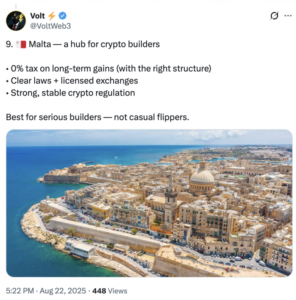
Malta has also gained attention from digital nomads, with many highlighting the country’s residence permit that allows remote workers to live there while continuing their jobs abroad.

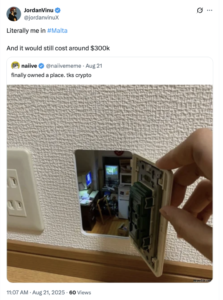
However, while Malta offers many opportunities for builders and digital nomads, many note that the cost of living and property prices are high. Some offset these challenges by relying on gains from crypto.
Crypto Cost Of Living: What 1 BTC Buys Here
A glimpse into the lifestyle economy — measured in sats, not cents.
Core Lifestyle Benchmark
Here’s how Malta’s everyday prices translate into cryptocurrency terms, based on retail sources and Bitcoin (BTC) prices as of August 2025:
BTC-to-Housing: The Long View
How far 1 BTC has gone over time in the Maltese housing market?
In 2010, 1 BTC bought a pizza 🍕.
Today, just 7–8 BTC could buy you a full home in Valletta, something that once cost thousands of BTC.
Regulatory + Economic Snapshot
- Joseph Muscat – Former Prime Minister: An early champion, Muscat declared in 2018, “Blockchain makes cryptocurrencies the inevitable future of money.” Under his watch, Malta embraced crypto regulations and earned the Blockchain Island nickname.
- Silvio Schembri – Lawmaker: A key architect of Malta’s blockchain laws, he actively promoted crypto startups and frequently reiterated Malta’s goal to be a global crypto hub.
- Abdalla Kablan – Tech Advisor: A prominent fintech expert advising the government, he helped shape Malta’s AI and blockchain strategy, ensuring the country stays at the forefront of tech innovation.
Risk Barometer
A quick gauge of Malta’s current crypto legal landscape for users:
Crypto Adoption Timeline
-
2017
PM announces national blockchain strategy. Malta’s very first Bitcoin ATM was installed (and infamously disappeared) in 2017.
-
2018
Parliament passes three landmark crypto laws; Malta dubbed “Blockchain Island.” Binance and OKX open offices. First Malta Blockchain Summit held.
-
2019
Banks remain reluctant; MFSA warns giants like Binance lack licenses. MDIA certifies first blockchain platforms for audit (world-first).
-
2020
PM Muscat resigns; new leadership enforces stricter due diligence. No full licenses early 2020; Crypto.com becomes first licensed exchange later in year.
-
2021
Public adoption rises in bull run. Local exchanges launch; Nomad Residence Permit introduced; Malta hosts first NFT art gallery
-
2022
Play-to-earn and metaverse trends arrive. Startup launches ARize metaverse. Malta aligns with EU MiCA.
-
2023
Malta tightens AML rules after EU sanctions. The EU passes MiCA; Malta adapts the framework. The Central Bank joins Digital Euro consultations.
-
2024
Some retail stores accept Bitcoin/USDC. Blockchain adopted in the public sector (e.g., diplomas). Gemini
-
2025
Full MiCA in force; Malta licenses multiple CASPs and enables passporting. First EU-regulated STO launches on Malta Stock Exchange. Crypto becomes part of the fintech ecosystem.
Meet Your Fellow Crypto Citizens
The Malta crypto community is collaborative and forward-looking, ideal for builders seeking EU-compliant innovation.
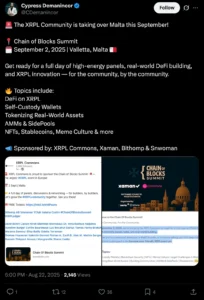
Main Events in Malta
 1, 3 September 2025
 Valletta / MMH Malta (Paola).
2 September 2025
Valletta / MMH Malta (Paola).
Valletta / MMH Malta (Paola).
2 September 2025
Valletta / MMH Malta (Paola).
Community Posts

Top 5 Trends To Watch
1. MiCA alignment and CASP licensing reinforce Malta’s hub status
- Malta’s full adoption of the EU’s Markets in Crypto-Assets (MiCA) regulation strengthens its position as a regulated blockchain and crypto services hub.
- Clear CASP licensing under MiCA provides regulatory certainty for exchanges, custodians, and infrastructure providers operating across the EU.
2. Tax incentives continue to attract long-term crypto holders and startups
- The absence of capital gains tax on crypto held as a store of value remains a key draw for high-net-worth individuals.
- Corporate tax refunds can reduce effective rates to as low as 0–5%, encouraging blockchain startups to establish operations in Malta.
- The local crypto market is projected to grow by 6.43% in 2026, reaching approximately $629.6k in revenue.
3. Rising adoption drives steady user penetration
- By 2026, the number of crypto users in Malta is projected to reach 48.92k, representing 8.91% population penetration.
- Mainstream platforms such as Binance and Tonkeeper support adoption, while Malta’s reputation sustains activity in DeFi and broader Web3 ecosystems.
4. Regulatory scrutiny leads to stronger oversight frameworks
- In July 2025, the European Securities and Markets Authority (ESMA) criticised Malta’s fast-track crypto licensing approach.
- The Malta Financial Services Authority has since strengthened risk assessment, AML, and KYC processes to balance innovation with regulatory robustness.
5. iGaming and blockchain converge through hybrid models
- Malta’s established iGaming industry increasingly integrates blockchain technologies, including tokenized assets, yield models, and play-to-earn mechanics.
- Industry events such as the SBC Summit and partnerships like SweetFlips illustrate how gaming and crypto converge within compliant, hybrid business models.
Neighbor Watch: What’s Happening Next Door?
🇮🇹 Italy — Legal, growing crypto adoption
- Regime: Crypto is legal and regulated, with oversight from Consob; capital gains are taxed at 26% on amounts equal to or above €2,000.
- Access: Retail trading is legal; Bitcoin ATMs and crypto-accepting retailers are increasing, especially in Rome and Milan.
- What’s next: Cultural adoption continues through sports and entertainment, with clubs like AC Milan and Juventus launching fan tokens and crypto becoming visible in stadiums and sports bars.
🇬🇷 Greece — Legal, early-stage growth
- Regime: Crypto is legal, with relatively light regulation and no strong institutional framework yet.
- Access: Retail participation is limited but growing, mainly through grassroots initiatives.
- What’s next: Expansion of crypto meetups and blockchain education programs in Athens is driving early awareness and community-led adoption.
🇹🇳 Tunisia — Officially banned since 2018
- Regime: Cryptocurrency use is legally prohibited, including payments, trading, and mining.
- Access: Despite the ban, an underground crypto scene operates via Telegram and P2P networks, with stablecoins used for informal remittances.
- What’s next: Around 1.69% of the population is estimated to hold crypto, and public debate persists following a
teenager’s arrest in 2021 for a Bitcoin transaction.
References
- CCN. Cryptocurrency Glossary
- CCN. Volatility Glossary
- CCN. Crypto Wallet Glossary
- CCN. Nigerians Ditched Naira for Stablecoins
- CCN. Why El Salvador Made Bitcoin Legal Tender (and Why It Won’t Work for Us)
- CCN. Binance Glossary
- CCN. Crypto Exchange Glossary
- CCN. Coinbase Glossary
- CCN. MetaMask Glossary
- Google Docs. Document
- DataReportal. Digital 2025: Malta
- uPay Blog. Crypto Adoption: Malta
- Global Citizen Solutions. Malta Digital Nomad Visa
- Attard Baldacchino. Malta Nomad Tax Guide 2025
- Quasa. Malta: The Perfect Choice for Freelancers and Remote Workers (Crypto Earnings)
- MFSA. Fintech Main Legislation (PDF)
- Global Referral Group. Low or Zero Tax Trading Structure (Malta Refund System)
- CSB Group. Cryptocurrency Malta
- Chiliz. Chiliz Blockchain Campus and CV Labs Partnership
- Dolfin Content Shop. Top NFT Art Agencies in Malta
- Book An Artist. NFT Artists Malta
- Facebook. AIBC World Post (Zack Ritchie, NFT Club)
- NFT Evening. FTNFT YoCerebrum Awards 2024
- Yogonet. SoftConstruct Announces FTNFT YoCerebrum Awards in Malta
- Peaka. Web3 DAO-Friendly Countries
- Shizune. Web3 Investors in Malta
- Chainalysis. 2024 Global Crypto Adoption Index (Methodology)
- CCN. Only Bitcoin Accepted: €3M Valletta Palazzo Mansion for Sale
- MFSA. Virtual Financial Assets
- CCN. NFTs Explained: An Introduction to Non-Fungible Tokens
- MDIA. Official Website
- Facebook. Valletta Local Council Post (NFTs in Malta)
- Malta Crypto Bank. Official Website
- Investing.com. Malta’s Michelin Chef Accepts Bitcoin and Lightning Payments
- X. Post by @VoltWeb3
- X. Post by @jordanvinuX
- Bankrate. Bitcoin Price History
- CCN. Bitcoin Pizza Day: Crypto Fumble Perspective
- Times of Malta. Property Prices Up 40% Since 2017 (Apartments +€80,000)
- IMIN Malta. Property Prices
- Immigrant Invest. Crypto Tax Havens
- CCN. Blockchain Island Malta Gets Its First Two-Way Bitcoin ATM
- Newsbook. Hacker Arrested in Malta Linked to $100M Crypto Robbery
- CCN. Protect Crypto: SIM Swaps, Phishing, Exchange Hacks
- AIBC. Official Website
- Luma. Event Page (rtyghimh)
- X. Post by @CDemanincor
- Telegram. Invite Link
- CCN. What Is the Markets in Crypto-Assets (MiCA) Regulation?
- Chambers. Corporate Tax 2025: Malta (Practice Guide)
- Statista. Cryptocurrencies Outlook: Malta
- ESMA. Official Website
- Reuters. EU Regulator Criticises Malta’s Crypto Licensing Process (Jul 10, 2025)
- Koinly. Crypto Tax Italy Guide
- MEXC Blog. Is Crypto Mining Legal in Tunisia?
- Reddit. Crypto Withdrawals in Tunisia or P2P (r/Tunisia)
- African Manager. Tunisia: More Than 202,000 Tunisians Own Cryptocurrencies
- Reddit. In Tunisia, a 17-Year-Old Teen Was Arrested (r/CryptoCurrency)