European bank stocks surge in 2024, defying rate cuts and delivering record returns. Italy's UniCredit and Intesa among the best performers. (Photo By: Ralph Orlowski/Getty Images)
Share
Key Takeaways
European bank stocks are closing their best year-end performance in over a decade.
This strong performance comes despite concerns about falling interest rates.
Banks are returning record levels of capital to shareholders, addressing investor concerns.
A combination of strong earnings, record shareholder returns, and resilience to falling interest rates has propelled European bank stocks to their highest levels in over a decade.
European bank stocks are on track for their best year-end performance in over a decade, driven by lender resilience amid falling interest rates and strong shareholder returns.
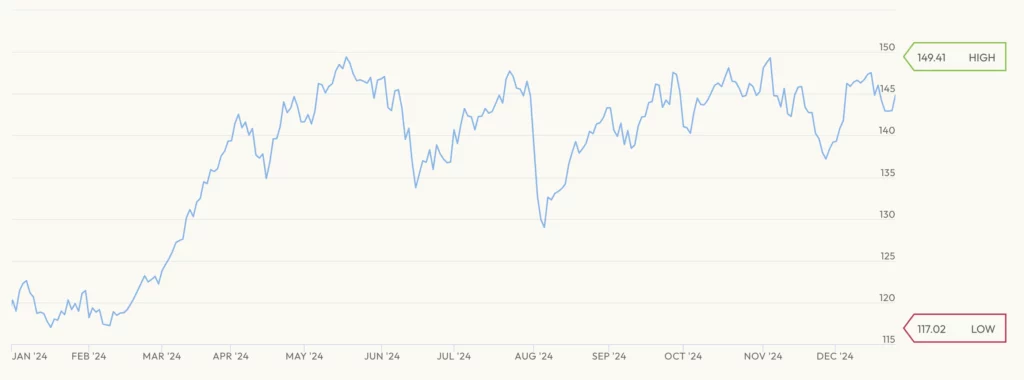
The Euro Stoxx Banks Index is going to exceed 142 by year’s end, its highest level since 2010, reflecting a 20% surge in 2024.
Despite concerns about rate cuts’ impact on profitability, stock prices remain robust.
Euro Stoxx Index is going to close the year up by 2024. Source: STOXX
Though mergers, acquisitions, and loan growth have slowed, 2024 has been highly profitable for European banks, benefiting from higher rates and effective risk management.
Citigroup estimates an average sector return on equity of 13%, enabling record capital returns to shareholders.
This return percentage addresses investor concerns over past dividend restrictions and windfall taxes.
Strongest Performers
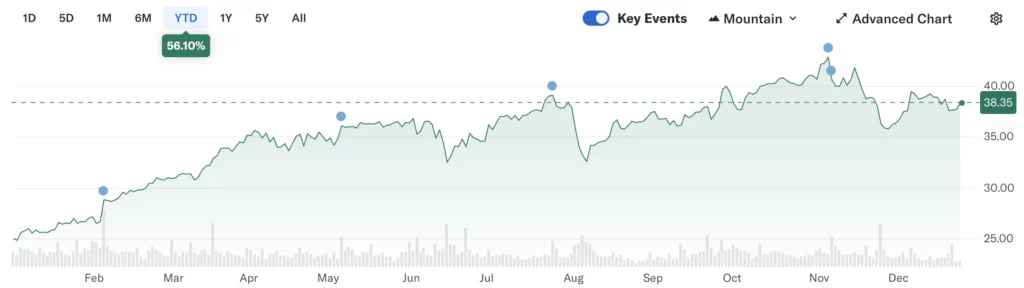
UniCredit emerged as the Eurozone’s top-performing large bank stock, soaring over 50% this year.
Last month, UniCredit’s bid for domestic competitor Banco BPM was rejected, though it acquired a significant stake in Germany’s Commerzbank.
UniCredit leads the gainers by increasing by over 50%. Source: Yahoo! Finance
Italy’s Intesa Sanpaolo recorded a gain of more than 40%, while Germany’s Deutsche Bank saw its shares rise by over 30%.
On the downside, the French bank BNP Paribas shares fell by nearly 8%, making it one of the sector’s weakest performers.
For the future, Citi analysts predict a slight decline in net interest income across the sector in 2025.
This is due to structural hedges that only partially counterbalance lower rates.
What’s Behind The Surge?
Citi analysts noted that in 2024, European and U.S. banks performed similarly until the U.S. elections.
Trump’s victory spurred U.S. bank outperformance, driven by expectations of deregulation, tax cuts, and fiscal stimulus.
On the other hand, ECB Supervisory Board member Anneli Tuominen emphasized the resilience of European banks.
She highlighted stronger capital buffers and reduced non-performing assets.
However, Tuominen warned against relaxing capital requirements despite calls for competitiveness, advocating instead for streamlined regulations.
Regarding mergers, Tuominen called for harmonizing EU banking regulations and advancing the European Deposit Insurance Scheme (EDIS) to foster cross-border consolidation.
Giuseppe Ciccomascolo began his career as an investigative journalist in Italy, where he contributed to both local and national newspapers, focusing on various financial sectors.
Upon relocating to London, he worked as an analyst for Fitch's CapitalStructure and later as a Senior Reporter for Alliance News. In 2017, Giuseppe transitioned to covering cryptocurrency-related news, producing documentaries and articles on Bitcoin and other emerging digital currencies. He also played a pivotal role in establishing the academy for a cryptocurrency exchange website. Crypto remained his primary area of interest throughout his tenure as a writer for ThirdFloor.