

Use cases that matter
Where crypto hits real life in Mexico:
- Daily purchases: Some users pay in USDT or BTC through apps like Bitso Pay, especially in convenience-store networks and online merchants, even though usage remains selective rather than universal.
- Remittances: Crypto-powered rails moved an estimated $3.3B in 2024, cutting transfer fees and settlement times for families receiving money from the United States.
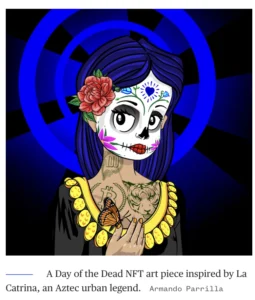
- NFT artists: Mexican artists sell NFT collections inspired by cultural heritage and local folklore on global marketplaces, using crypto to reach buyers without intermediaries.
- Freelancers: Developers, designers, and marketers receive payments in USDT, USDC, BTC, or ETH from international clients, then convert to pesos via exchanges such as Bitso.
- Gaming income: Play-to-earn games like Axie Infinity created small but meaningful income streams in rural and semi-urban communities, especially during peak adoption periods.
Citizen Voices
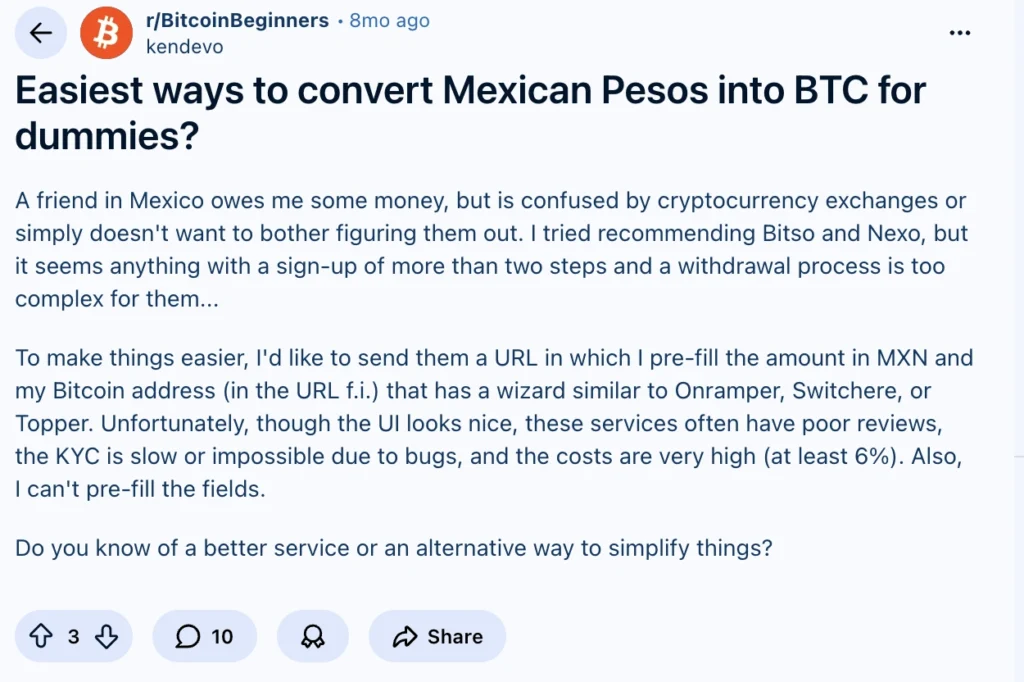
Kendevo
Mario Castañeda (pseudonym), active crypto user in Mexico
- On why adoption remains limited: “Mexico doesn’t really need crypto for everyday life, so there’s no strong push to use it more. That’s why adoption stays small. The government will have a hard time fully understanding it, even if there are capable people inside. Even with regulation, there are limits to what authorities can actually control.”
- On daily use cases: “Crypto use in Mexico is limited. The community is small but strong. Some people use it, but it’s not something most people rely on day to day. Mexico doesn’t have the same pressure to use crypto as places like El Salvador. Payments already work well enough, so crypto stays mostly in exchanges rather than in shops or daily spending.”
- On exchanges and access: “Bitso is the main gateway in Mexico. It’s licensed, connected to the banking system, and makes buying and selling crypto easy. You open an account, get a CLABE, deposit pesos, and that’s it. For more advanced users, crypto is mainly used to fund accounts on other exchanges where you can trade futures, gold, stocks, and other instruments. Crypto becomes a bridge to global markets, not a payment method.”
- On personal usage patterns: “I got into crypto during the pandemic. I saw that the world was changing and decided to go all in. I mostly hold crypto and trade selectively, usually in the mornings. I use crypto to fund trading accounts and operate in other markets. Finance always interested me, and crypto fits into that broader investment strategy.”
- On regulation and taxes: “Mexico isn’t very restrictive, but it’s also not very friendly. Crypto itself feels loosely regulated, but once you move larger amounts, the tax authorities step in. Above a certain level, everything is supervised by Hacienda. You can buy a house with Bitcoin, but not directly. It has to be structured through legal instruments like donations or asset transfers, and the person receiving the money has to declare it and justify the origin.”
- On the broader picture: “There are countries with much higher adoption than Mexico. Here, crypto exists, it works, and people can use it, but mostly behind the scenes. It’s useful, but it hasn’t become something people depend on for daily life.”
Crypto cost of living: What 1 BTC buys here
A glimpse into the lifestyle economy — measured in sats, not cents.
Core Lifestyle Benchmarks
BTC-to-Housing: The Long View
How far 1 BTC has gone over time in the housing market
Regulatory + Economic Snapshot
Authorities recognize the usefulness of virtual-asset rails, especially for remittances and B2B flows, yet keep a strict line between crypto and the banking system. The Fintech Law and Banxico circulars focus on preventing money laundering and financial instability while allowing regulated use cases like cross-border payments through licensed entities.
The tax authority treats crypto generally as a financial asset or investment. Gains and income need declaration under existing income-tax frameworks, while simple crypto-to-crypto swaps usually escape VAT.
Banxico initially announced plans to launch a central bank digital currency (CBDC) or digital peso. However, the project is delayed.
Traditional banks remain cautious, fintech and tokenization projects like project Agorá are launching.
Focus on AML enforcement; no high-profile hacks reported.
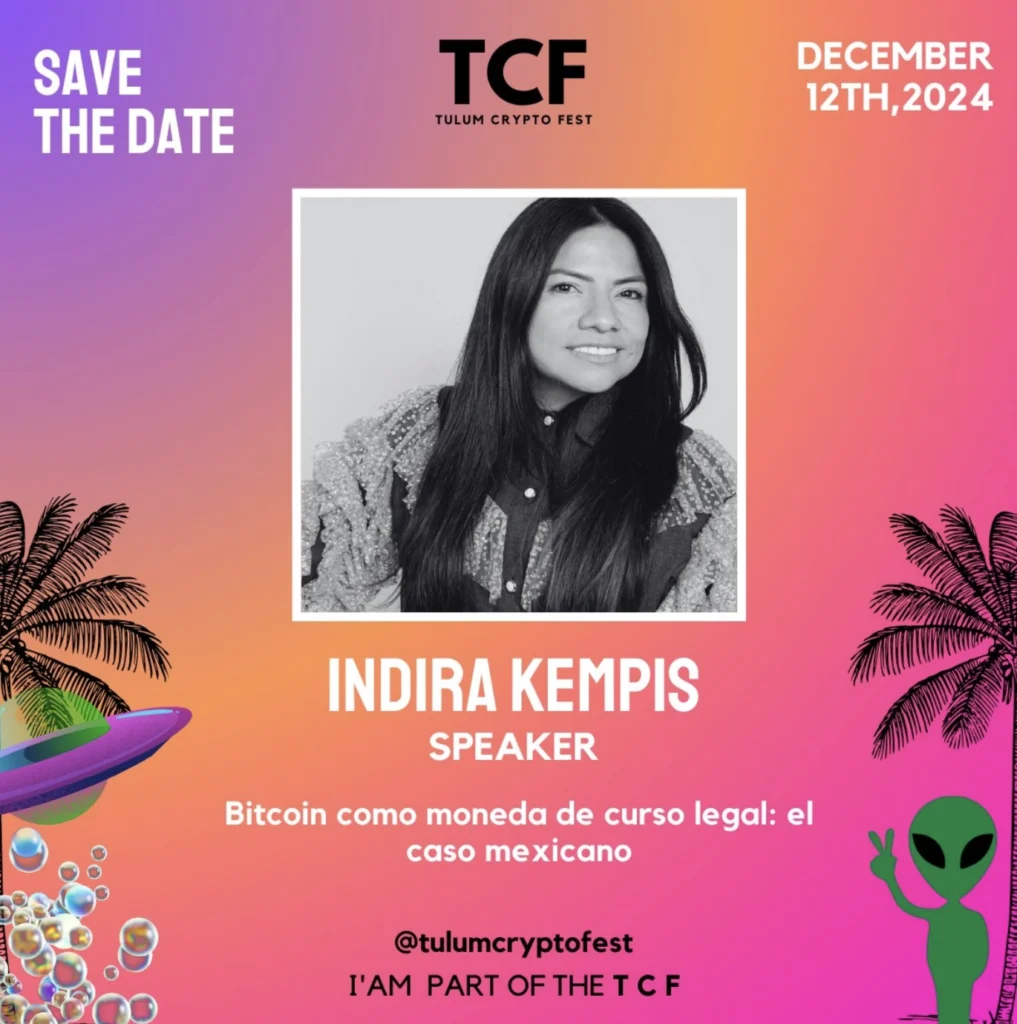
- Indira Kempis Martínez – Senator, Movimiento Ciudadano (Nuevo León): The most prominent pro-crypto political voice in Mexico. Proposed a Bitcoin legal tender bill inspired by El Salvador and advocates for crypto as a financial inclusion tool. While influential in public debate, her proposals have not advanced into law.
- Eduardo Murat Hinojosa – Former federal deputy: Expressed interest in crypto policy following El Salvador’s adoption in 2021, but without sustained legislative follow-through.
- Ricardo Salinas Pliego– Founder, Grupo Salinas: One of Latin America’s most vocal Bitcoin supporters. Publicly promotes Bitcoin adoption, encourages acceptance within his business ecosystem, and frames crypto as a hedge against inflation and financial exclusion. One of his quotes is “Sell the house and buy Bitcoin”.
- Xóchitl Gálvez – Former Senator and 2024 presidential candidate: Expressed openness toward blockchain and fintech innovation, framing digital tools as drivers of transparency and inclusion. While not a crypto champion, she showed a more innovation-friendly stance than the ruling administration.
- Elisa de Anda Madrazo – President of the Financial Action Task Force (2024–2026): Represents Mexico on the global stage by leading FATF, the body responsible for international AML and counter-terrorism financing standards. While not a pro-crypto advocate, her role directly influences how countries regulate virtual assets, making her one of the most important Mexican figures shaping crypto oversight worldwide.
Risk Barometer
Gives time-sensitive readers a feel for how volatile or stable the legal landscape is.
Crypto Adoption Timeline
-
2014-2017
Early Bitcoin meetups emerge and first Mexican crypto exchanges and platforms launch
-
2018
Congress passes the Fintech Law, defining “virtual assets” and creating a licensing framework for fintech institutions
-
2019
Banxico issues a circular restricting banks from directly offering crypto services without approval
-
2021
Banxico reiterates warnings and formally bars banks from providing crypto products to customers
-
2022
Crypto adoption rises during global economic stress
Meet Your Fellow Crypto Citizens
Mexico’s crypto community is vibrant, multilingual, and grassroots-driven. From developer collectives in Mexico City to blockchain meetups in Guadalajara and Monterrey, there is always a space to connect, build, and share ideas with other enthusiasts.
Local Web3 circles host regular gatherings ranging from informal café meetups to technical workshops on topics like stablecoins, smart contracts, and cross-border payment rails. ETHMexico events attract global developers, while Blockchain Land and Talent Land bring together thousands of students, founders, and creators exploring the next wave of digital innovation.
- NFT and gaming communities thrive on Discord and Telegram, where artists, designers, and gamers collaborate, mint collections, and join play-to-earn ecosystems. Cross-border remittance builders also form a strong part of Mexico’s scene, reflecting the country’s unique role in global stablecoin adoption.
- Regional hubs in Mexico City, Guadalajara, Monterrey, and Tijuana keep the movement active, blending fintech energy with Latin American creativity. Whether you’re into DeFi, design, Web3 payments, or digital art, Mexico offers a growing, open, and welcoming crypto culture.
- The Ethereum Mexico community still plays a central role in hosting gatherings in Mexico City — ranging from casual café meetups to deeper technical talks (Layer-2, stablecoins, smart contracts, cross-border rails, etc.).
- Web3 and broader developer groups remain active around Guadalajara’s tech scene and Monterrey’s startup hubs, organizing workshops, hack sessions, and developer programs linked to major events such as ETHMexico.
- Regional crypto clubs exist in Tijuana, Mérida, Puebla, Querétaro, and other cities, often multilingual (Spanish and English) to suit the international crowd of digital nomads and cross-border fintech workers.
Hubs, Players, Personalities & Coworking Spaces
- Talent Land in Guadalajara is a key nexus: coworking, hackathons, large-scale exhibitions, and developer networking. Thousands gather each year for blockchain, AI, and gaming tracks.
- The broader CDMX–Guadalajara–Monterrey corridor: It continues to be a magnet for fintech and blockchain startups thanks to strong engineering talent, proximity to the U.S. market, and an active digital-nomad population.
- Coworking hubs: examples such as Centraal, WeWork Reforma, and IOS Offices in Mexico City often host Web3 sessions, founder meetups, and protocol workshops.
- Crypto collectives: Mifiel, Mexo, and local Web3 collectives contribute to Mexico’s infrastructure across identity, payments, tokenization, and compliance.
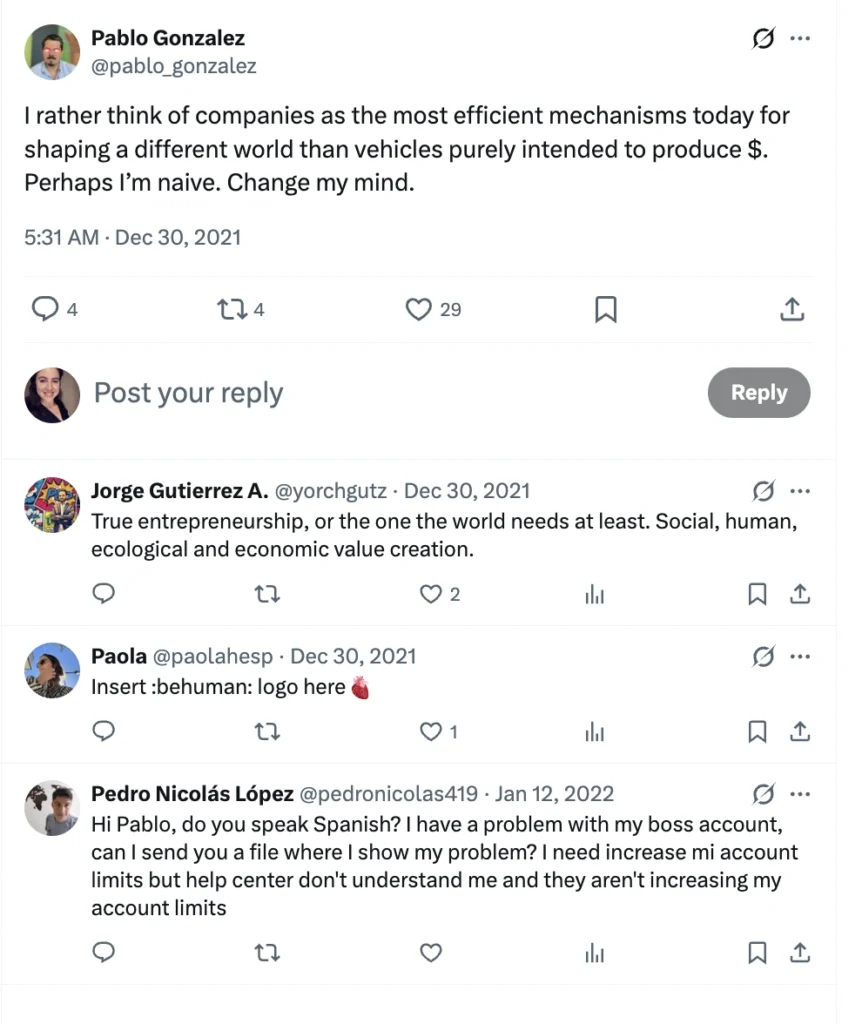
- Notable personalities: Builders such as Pablo González and Daniel Vogel (Bitso), NFT artists from the NFT MX scene, and developers behind ETHMexico projects are active in meetups and easily approachable, reflecting Mexico’s collaborative crypto culture.
Main Events in Mexico
 December 12–15, 2024
 Tulum, Quintana Roo
1–4 May 2025
Mexico City
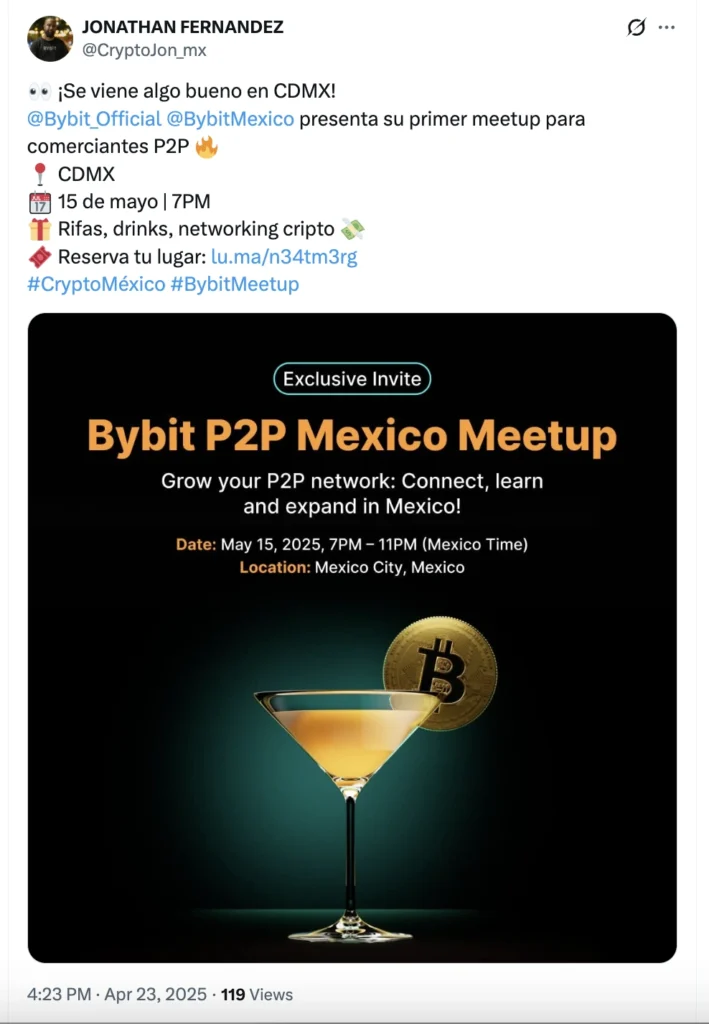
May 15, 2025
Mexico City
30 October–2 November 2025
Monterrey, Nuevo León
Ongoing through 2025
Mexico City & Guadalajara
9–11 April 2026
Centro Banamex, CDMX
Tulum, Quintana Roo
1–4 May 2025
Mexico City
May 15, 2025
Mexico City
30 October–2 November 2025
Monterrey, Nuevo León
Ongoing through 2025
Mexico City & Guadalajara
9–11 April 2026
Centro Banamex, CDMX
Top 5 Trends to Watch
1. Stablecoin remittance rails reach mainstream scale
- Billions in USDC and USDT now flow through the U.S.–Mexico remittance corridor, driven by instant settlement and significantly lower fees.
- Stablecoins increasingly function as financial infrastructure rather than speculative instruments, especially for cross-border payments.
2. Incoming VASP and AML regulation tightens oversight
- Planned reforms effective from July 2025 introduce stricter licensing, reporting, and monitoring requirements for Virtual Asset Service Providers.
- The framework aligns with FATF standards, emphasizing compliance and supervision rather than outright bans.
3. Tokenized real estate advances through pilots and sandboxes
- Early-stage growth is supported by regulatory consultations and sandbox-style experimentation.
- Proptech initiatives explore fractional ownership and digital property titles, particularly in Mexico City and Guadalajara.
4. Telegram and P2P crypto commerce expands informally
- Encrypted messaging platforms host thriving USDT trading and P2P markets serving freelancers and micro-merchants.
- P2P bots and informal exchanges continue to grow alongside, and sometimes outside, regulated platforms.
5. NFT adoption blends with streetwear and gaming culture
- Mexico’s urban art, esports, and streetwear scenes increasingly collaborate with Web3 creators.
- NFT-linked merchandise, collectibles, and gaming assets position NFTs as lifestyle and cultural identifiers rather than purely speculative assets.
Neighbour Watch: What’s Happening Next Door?
What crypto looks like across the border — and why it matters.
🇺🇸 United States — Innovation-driven, tightly regulated
- Regime: Legal and highly regulated under a mix of federal and state-level frameworks.
- Market & scale: One of the world’s largest crypto markets, with strong Web3 investment, active stablecoin development, and major exchanges operating under strict compliance rules.
- Regional impact: U.S. crypto policy directly shapes Mexico’s ecosystem, as most remittances originate in the U.S. and stablecoin rails often flow from U.S. fintechs into Mexican platforms.
🇬🇹 Guatemala — Legal, early adoption driven by remittances
- Regime: Crypto is legal to hold and transact, but remains largely unregulated.
- Use-cases: Stablecoins and Bitcoin see growing use among remittance recipients seeking faster and lower-cost transfers.
- Local signals: Guatemala City hosts expanding Bitcoin meetups, while rural regions use crypto informally for dollarized savings.
🇧🇿 Belize — Private ownership allowed, business activity restricted
- Regime: Crypto is legal to hold, but virtual asset business activity is tightly restricted.
- Regulatory action: Belize’s Financial Services Commission issued a 2023 notice freezing virtual asset licensing until 31 December 2025.
- Market impact: No new licenses are granted; existing providers were required to notify the FSC and cease exchange, transfer, custody, or issuance services within defined deadlines.
- Current reality: Unlicensed crypto business is prohibited, leaving private ownership and use via foreign platforms as the only viable option for now.
References
- Blackbox. Singapore’s Crypto Conundrum: High Adoption, Deep Skepticism
- Independent Reserve. Independent Reserve Cryptocurrency Index (IRCI) Singapore 2025
- Crowdfund Insider. Crypto Awareness Hits 94% in Singapore but Ownership Slips
- Reuters. Singapore population hits record 6.11 million, driven by foreign workers
- Freedom House. Freedom on the Net 2024: Singapore
- The Straits Times. More people own crypto in Singapore, with younger users leading the way: survey
- Sumsub. Singapore crypto regulations: all you need to know
- CoinGecko. Best crypto exchanges in Singapore
- Analytics Insight. Best DeFi projects operating from Singapore
- Reuters. Crypto ATMs offline as Singapore seeks curb on impulse trading
- Fintech News Singapore. MAS explains why Binance was pinned on Investor Alert List but not FTX
- The Financial Coconut. Complete list of MAS-licensed Digital Payment Token service providers
- Monetary Authority of Singapore. Financial Institutions Directory: Major Payment Institutions (Payments)
- MoneySmart. Crypto in Singapore
- Sony Singapore. Sony Electronics partners with Crypto.com to welcome direct crypto payment in Singapore
- Reuters. OKX Singapore launches stablecoin payments with local GrabPay merchants
- Fintech Weekly. Ripple Singapore MPI license expansion: digital payments
- CCN. MAS initiative: Singapore hub for tokenized assets
- Reuters. Singapore trial tokenised bills bring stablecoin laws, central bank chief says
- XaiGate. Stablecoin payment gateway in Singapore
- Freedom House. Freedom on the Net 2024: Singapore
- The Straits Times. More people own crypto in Singapore, with younger users leading the way: survey
- International Accounting Bulletin. Singapore leads crypto job opportunities
- Randstad Singapore. How can you get cryptocurrency jobs?
- Vertical Institute. Cryptocurrency analyst salary in Singapore
- Koinly. Crypto tax Singapore guide
- Charltons Quantum. Singapore crypto guide (PDF)
- CCN. TOKEN2049 Singapore breaks records, world’s largest Web3 event
- SMU Academy. Advanced Certificate in Web 3.0 (Module 2): Understanding NFTs and DAOs
- SUSS. FIN539 course
- Singapore Blockchain Association. Education
- Vertical Institute. Blockchain course
- NTU. Nanyang Blockchain Conference 2025
- Lexology. Article on Singapore blockchain regulation
- F6S. DAO companies in Singapore
- TRON DAO (Medium). TRON DAO unites with global community at TOKEN2049 Singapore
- Chainwire. HaloDAO partners with TrustToken to expand marketplace of international stablecoins
- Blockchain Reporter. Crypto and blockchain events of this week, majority in Singapore
- Vogue Singapore. Singaporean NFT artists
- The Peak Singapore. The NFT effect on Singapore art
- The Art Newspaper. Collector of Beeple Everydays work launches art and technology space in Singapore
- NFT Now. Co Museum: Chaw Wei Yang feature
- Warren Wee. Digital Art Week Asia 2024
- Art Outreach Singapore. Immemorial NFT: Rizman Putra
- Reuters. Singapore population hits record 6.11 million, driven by foreign workers
- Osborne Clarke. Blockchain makes steady advance in Singapore amid enhanced regulatory clarity
- Foodpanda Singapore. McDonald’s
- Wise. Cost of living in Singapore
- URA Singapore. Media release PR25-40
- FRED. Series: QSGN628BIS
- Yahoo Finance. BTC-USD historical data
- Global Property Guide. Singapore property price history
- MAS. Joint press release on restricting access to facilities for scam mules
- Sangfor. Singapore faces surge in cryptocurrency investment scams, authorities urge vigilance
- The Economic Times. Singapore HC axes WazirX restructure plan after $235 million cyber heist
- MAS. Creating the future of finance (speech)
- CCN. Bitget CMO Jamie Elkaleh at TOKEN2049: Mastercard need us?
- CCN. Yellow co-founder claims crypto far from mainstream at TOKEN2049
- Stablecoin Summit. Event site
- Merkle Science. Merkle Meets 2025 Singapore
- Meetup. Blockchain events in Singapore
- NUS Enterprise. BLOCK71 global incubation
- YouTube. Video (obiAIp9xA74)
- CCN. NDACHAIN: Vietnam national blockchain explained