Attackers drained $4.1 million from Shibarium Bridge using flash loans and validator key access.
The Shib team froze bridge operations and revoked attacker permissions, limiting losses.
SHIB dropped 11.5% and BONE plunged 43.5%, but both started to rebound after containment.
The exploit sparked a renewed focus on governance and validator key security for Shibarium.
In the world of crypto, security can be tested in an instant, and the latest breach on Shibarium Bridge proves it.
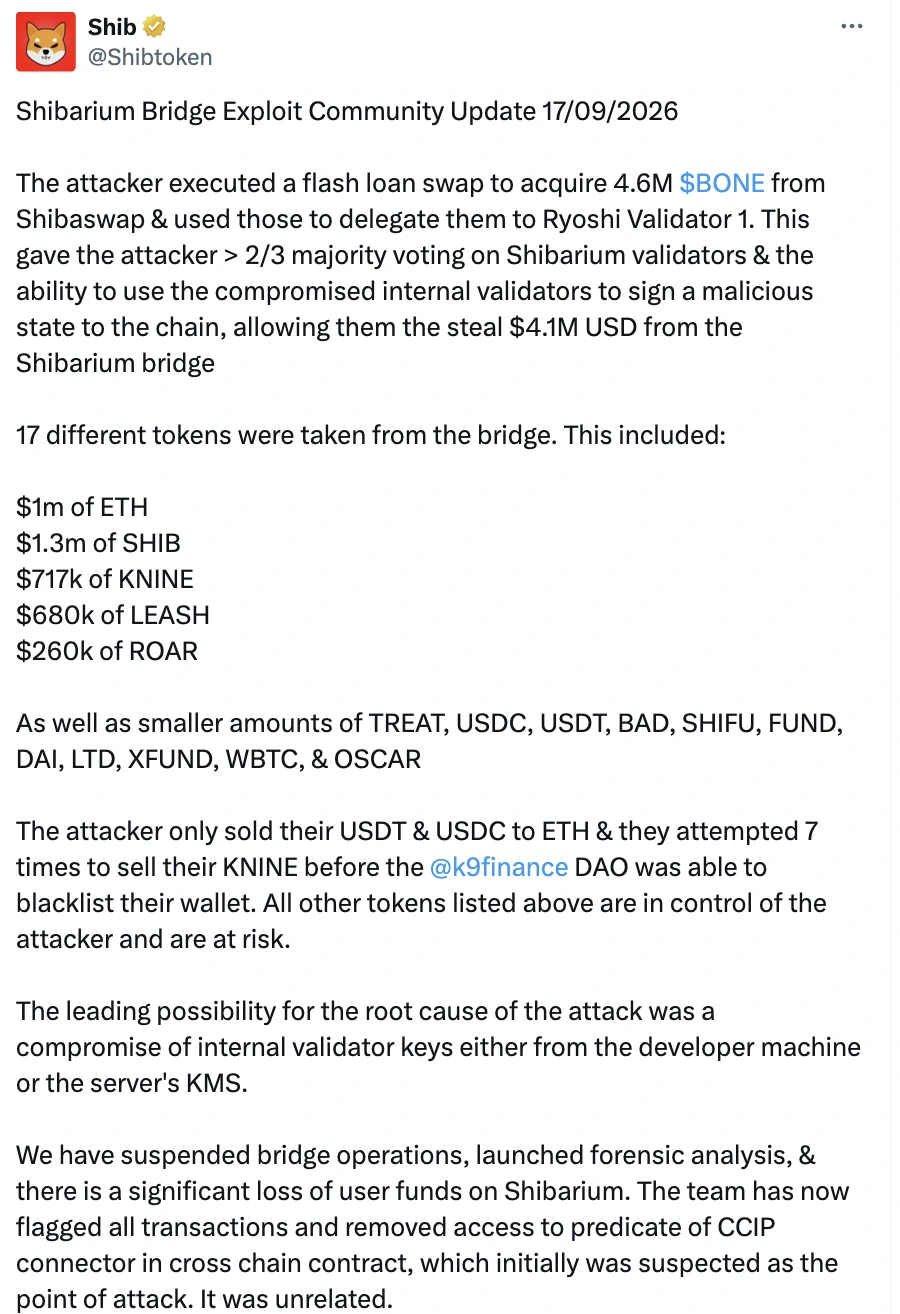
On September 12, 2025, attackers used a flash loan to grab huge sums without collateral and must be repaid within the same transaction, to buy 4.6 million BONE tokens (Shibarium’s gas and governance token).
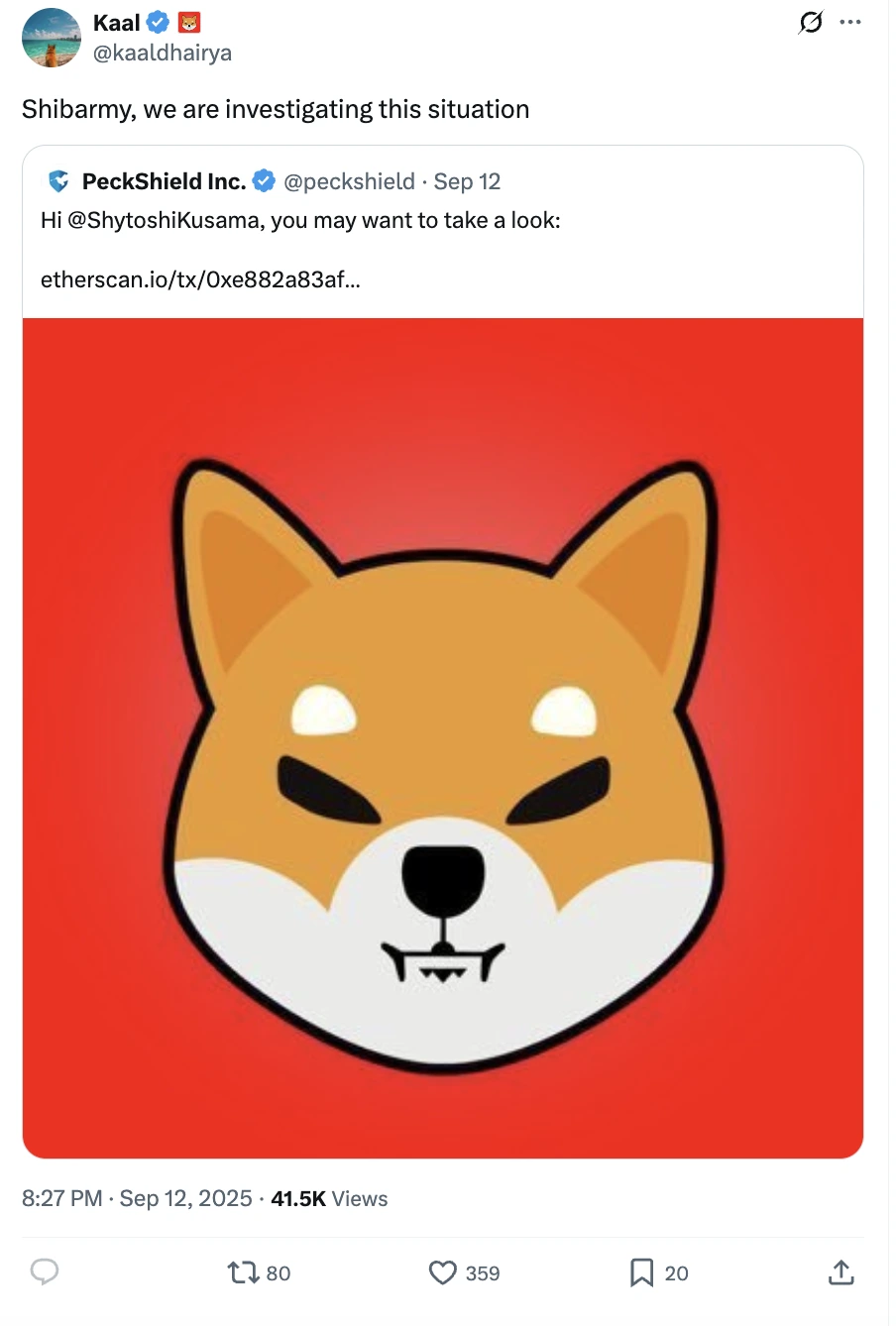
PeckShield alerted the Shiba Inu team on X about the suspicious transaction, prompting Kaal Dhairya to announce that the team was investigating the breach.
The attackers delegated these tokens to Ryoshi Validator 1, gaining over two-thirds of the voting power.
This incident fits a pattern of bridge hacks in 2025, with over $2.7 billion worth of cryptocurrency stolen across chains, according to Chainalysis’s report.
This article explains what happened in the Shibarium bridge attack, how the attackers used flash loans and validator keys to pull it off, the steps the team took to stop further losses, the market’s reaction to the exploit, and what upgrades and lessons can strengthen security going forward.
What Happened in the Shibarium Bridge Attack
Attackers struck the Shibarium bridge, which links the layer-2 chain and Ethereum. They pushed a fake network update that let them move tokens around.
Shiba Inu lead developer Kaal Dhairya called it a “sophisticated” plot that likely took months to plan.
The attackers signed a false version of the Shibarium bridge blockchain and drained 17 different tokens.
The haul included $1 million in ETH, $1.3 million in SHIB, $717,000 in KNINE, $680,000 in LEASH, and $260,000 in ROAR, along with smaller amounts of TREAT, USDC, USDT, BAD, SHIFU, FUND, DAI, LTD, XFUN, WBTC, and OSCAR.
Total losses hit $4.1 million before freezes kicked in.
The breach was traced to compromised validator keys, which let attackers sign a false blockchain version and drain tokens. Shib announced that these keys may have been exposed through a developer machine or the server’s key management system (KMS).
The Shib Team’s Moves to Stop Further Losses
The Shib team and its partners acted quickly with coordinated measures:
Shut down bridge operations: Blocked all bridge activity to stop more token drains.
Revoked access rights and root permissions: Cut off attacker control and flagged risky transactions.
Flagged suspicious transactions: Identified and blocked malicious withdrawals already in progress.
Removed predicate burn-only from plasma registry: Permanently disabled the contract function that could allow future unauthorized withdrawals.
Clarified CCIP connector suspicion: Ruled out the cross-chain CCIP connector as the cause of the exploit.
Paused staking and unstaking: Temporarily halted validator interactions.
Transferred stake manager funds: Secured assets in a 6/9 multisig-controlledhardware wallet.
Froze malicious validator’s BONE delegation: Neutralized the attacker’s voting power.
K9 Finance intervention: Blacklisted the attacker’s wallet after seven failed KNINE dumps, saving $700,000.
Bounty offers: K9 Finance posted a 5 ETH ($12,000) bounty for KNINE returns, while the core team offered 50 ETH ($120,000) for full fund recovery with no charges.
External security support: PeckShield, Hexens, and Seal 911 joined forensics, confirming no deeper protocol flaws.
Planned restoration: Announced a detailed post-mortem and committed to restoring funds once validator integrity is secured.
This coordinated action kept net losses under $2.5 million, a rare containment win compared to major bridge exploits like the $600 million Ronin bridge hack in 2022.
Market and Investor Reactions
News of the exploit shook the Shiba Inu ecosystem, triggering sharp market moves across its tokens:
SHIB sell-off: Price dropped about 11.5%, erasing more than $800 million in market capitalization before rebounding.
BONE crash: BONE fell 43.5% after its flash-loan spike as traders dumped holdings in panic.
KNINE pressure: KNINE slipped 10%, but K9 Finance Decentralized Autonomous Organization (DAO) blacklisted the attacker’s wallet, freezing funds and preventing deeper losses.
Community rally: The #SHIBArmy mobilized on X, with updates from @Shibtoken drawing over thousands of views.
Trading volume surge: Exchanges saw a spike in SHIB trading, showing both panic selling and buy-the-dip activity.
Bridge traffic decline: Usage dropped sharply as the team worked on security fixes.
These reactions stabilized the immediate fallout and also sparked a deeper conversation about Shibarium’s long-term security and governance.
With BONE at the center of staking and validator operations, its future role is now under scrutiny.
The Shibarium bridge exploit placed validator governance and bridge security under the spotlight. Future upgrades will likely focus on reducing single points of failure, introducing stricter multisig requirements, and improving real-time monitoring to catch suspicious transactions before funds are drained.
The response from the Shib team, partners, and community set a precedent for coordinated action.
If these lessons lead to regular security audits and faster recovery protocols, networks like Shibarium can strengthen trust and limit damage from future attacks.
This incident may also encourage other meme coin ecosystems to review their validator setups and cross-chain connections, turning a major breach into an opportunity to harden security.
Conclusion
The Shibarium bridge attack showed how quickly a network can face severe threats. Attackers used flash loans to gain control over validator power and drain $4.1 million in tokens. The exploit targeted 17 assets, including SHIB, BONE, and KNINE.
The Shiba Inu team acted fast to contain losses, revoke permissions, freeze delegations, and secure funds with multisig wallets. Outside security experts joined the investigation to confirm that no deeper flaws existed in the protocol.
Despite sharp sell-offs, SHIB and BONE prices began recovering as the community rallied. The event underlined the importance of validator key security and transparent communication in maintaining trust during crises.
Did this exploit reveal flaws in the Shibarium protocol?
Security experts confirmed the core protocol remained safe, pointing to key mismanagement.
What actions were taken to prevent a repeat attack?
Multisig wallets secured funds, staking was paused, and validator rights were revoked.
How did the market react after the attack?
SHIB and BONE saw heavy sell-offs but recovered as trust returned to the network.
What lessons does this hold for other Layer 2 networks?
It highlights the need for strict validator key security and real-time attack response.
Disclaimer:
The information provided in this article is for informational purposes only. It is not intended to be, nor should it be construed as, financial advice. We do not make any warranties regarding the completeness, reliability, or accuracy of this information. All investments involve risk, and past performance does not guarantee future results. We recommend consulting a financial advisor before making any investment decisions.
Dr. Lorena Nessi is an award-winning journalist and media technology expert with 15 years of experience in digital culture and communication. Based in Oxfordshire, UK, she combines academic insight with hands-on media practice.
She holds a PhD in Communication, Sociology, and Digital Cultures, and an MA in Globalization, Identity, and Technology.
Lorena has taught at Fairleigh Dickinson University, Nottingham Trent University, and the University of Oxford. She is a former producer for the BBC in London, with additional experience creating television content in Mexico and Japan.
Her research focuses on digital cultures, social media, technology, capitalism, and the societal impact of blockchain innovation.
She has written extensively on digital media and emerging technologies, with her work featured in both academic and media platforms. Her Web3 expertise explores how blockchain technologies shape culture, economics, and decentralized systems.
Outside of work, Lorena enjoys reading science fiction, playing strategic board games, traveling, and chasing adventures that get her heart racing. A perfect day ends with a relaxing spa and a good family meal.


 Easy
Easy