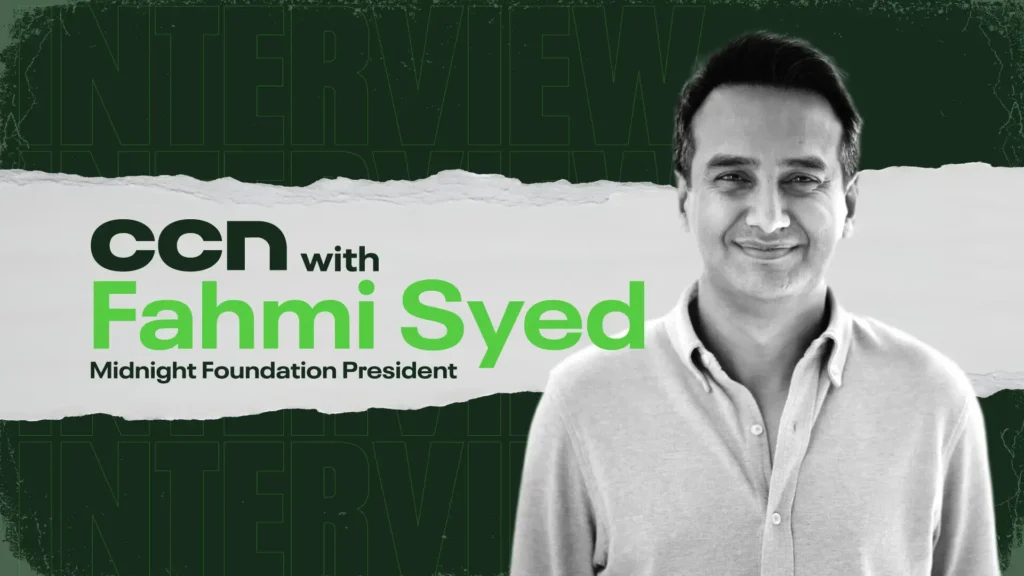
“Privacy is not about hiding. It’s about choice.” | Image credit: CCN
Share
Privacy has become one of the most contested design questions in blockchain. Public ledgers offer transparency and auditability, but they also expose user data, transaction histories, and behavioral patterns.
Fully private blockchains promise confidentiality, yet often clash with regulatory requirements and real-world compliance needs.
That tension has shaped a decade of experimentation, skepticism, and stalled adoption. In this CCN interview, Dr. Lorena Nessi speaks with Fahmi Syed, president of the Midnight Foundation, about how Midnight approaches privacy as a programmable choice rather than a binary feature.
The conversation examines how zero-knowledge proofs (ZKP) function in real-world systems, why privacy must operate at the application layer rather than the protocol level and where compliant privacy infrastructure fits into the next phase of blockchain adoption.
Watch the full interview here:
Why Blockchain Transparency Became a Structural Problem
Syed frames Midnight’s mission around a core contradiction in blockchain design. Distributed ledgers delivered decentralization, disintermediation, and automated transactions through smart contracts. At the same time, they made every action permanently visible.
“One of the troubling aspects of the industry as a whole is that everything you do on a blockchain is transparent,” Syed said.
“Everything you do on a blockchain is not only transparent, but also immutable.”
He contrasts that reality with everyday digital behavior. People routinely decide what information to share, when to share it, and with whom. That judgment applies to cookies, location data, identity, and financial activity. Blockchain systems, however, rarely allow that discretion.
With Midnight, Syed argues the goal is not secrecy, but rational disclosure.
“What we are bringing is the core principles of blockchain technology, but then putting on top of that the ability not only to fully shield data and metadata, so who you are, what you’re doing and where you’re doing it, but also with the use of our smart contract language, Compact, to also then enable selective disclosure of that information,” he said.
Privacy by Design, Privacy by Choice, and Midnight’s Middle Path
Blockchain privacy models typically fall into two categories. Fully private chains encrypt all transactions by default. Permissioned systems restrict access within closed environments. Both approaches introduce trade-offs.
“When you think about privacy by design, then what you’re looking at is blockchains where everything is private,” Syed said. “Think of Zcash, Monero, that’s privacy, full privacy by design.”
Those systems limit programmability and often struggle with regulatory compliance, particularly around know-your-customer and anti-money-laundering requirements.
Permissioned blockchains address compliance, but undermine decentralization by restricting who controls data access.
Midnight attempts to merge those models without inheriting their constraints.
“With Midnight, we’re sort of blending or merging those two worlds,” Syed said. “The blockchain has both a public state and a private state. So the choice is at the application level.”
Developers determine whether transactions run publicly or privately. If private, applications can still require disclosures through zero-knowledge proofs without revealing underlying sensitive data.
Syed uses age verification as an example.
“You do not need to give your date of birth to prove that you’re over a certain age,” he said. “I can prove mathematically through a zero-knowledge proof that I’m able to participate.”
The same logic applies to jurisdiction, accreditation, and regulatory eligibility without exposing identity or transaction history.
Who Controls Privacy: Developers or Users?
Control over privacy does not sit solely with application developers. Syed explains that Midnight allows execution rights to be delegated, shifting authority to users when needed.
“The ability to execute a private transaction can be delegated from one party to another,” he said.
Applications can either run private transactions themselves or delegate execution resources to users.
When delegated, users retain control over encryption keys and disclosure choices. The application facilitates access but cannot view private data.
That flexibility introduces multiple service models. Applications may offer free services with less privacy or paid services where users retain full control.
According to Syed, the design intentionally allows that trade-off to remain explicit rather than hidden.
Regulated DeFi Without Public Exposure
Midnight’s design also opens a path for regulated decentralized finance (DeFi), an area many institutional actors avoid today.
“Within Midnight, you could end up building a DeFi where people can prove their identities,” Syed said. “They can prove they are of a certain jurisdiction, of a certain creditworthiness or net worth.”
Only participants who meet predefined criteria would access specific liquidity pools. Compliance requirements become enforceable without publishing identity data on-chain.
“That’s not the Midnight Network’s choice,” Syed added. “That’s a choice we give to the application and the developers.”
Featured in CCN’s Top 101 in Crypto and Blockchain
The Role of the Midnight Foundation
The Midnight Foundation does not operate as a protocol gatekeeper. Instead, its role centers on ecosystem stewardship.
“The foundation’s role is to grow the ecosystem,” Syed said. “To be the custodians of that network and the ecosystem.”
That includes supporting developers, attracting partners, and positioning Midnight as a privacy layer that can integrate with other blockchains rather than compete with them.
“We’re not tribalists,” Syed said.
“We want other chains and other applications to come and work with us.”
Beyond Finance: Healthcare and Forensic Data Management
While financial use cases dominate blockchain discussions, Syed points to healthcare as one of Midnight’s most immediate real-world applications.
“We have a partner who is bringing proof of patient data to the Midnight Network,” he said.
In Turkey, clinics serving millions of patients use the system to share clinical data securely without exposing personal information. In California, a children’s hospital is exploring Midnight for inter-clinical trials across competing institutions.
Supply chain applications offer another example, particularly in forensic evidence management.
“If you think about forensic evidence around criminal cases, they tend to be very sensitive,” Syed said. “Very important to track that without exposing sensitive data publicly.”
A trial in Uttar Pradesh, India focuses on maintaining chain-of-custody records while protecting victim and investigator identities.
Why Institutions Are Reconsidering Privacy Infrastructure
Syed argues that readiness begins with individuals before institutions. Public awareness of data exploitation has grown alongside concern over manipulation, surveillance, and platform dominance.
“People recognize there are browsers out there like Brave who do put privacy first,” he said.
Institutions face similar pressures, particularly around compliance costs, data breaches, and legal exposure.
“If you’re a large financial institution, the cost of compliance is very expensive,” Syed said.
Private blockchains replicate existing Web2 control structures. Midnight, by contrast, allows enterprises to share proofs without surrendering data ownership.
“That’s where a privacy-enabling solution like Midnight allows those enterprises to think differently about how they build their technology stacks,” he said.
Two Tokens, Two Roles: NIGHT and DUST
Midnight separates ownership from utility through a dual-token model.
“NIGHT will be publicly visible,” Syed said.
“It gives you access and ownership of the Midnight Network.”
Ownership of NIGHT generates DUST, a secondary resource used to execute private transactions.
“NIGHT is your power station,” he said. “DUST is your electricity.”
That separation allows users and enterprises to lock in transaction costs without consuming speculative assets.
It also enables transaction delegation, allowing institutions to use Midnight without holding crypto assets on their balance sheets.
Why Midnight Launched on Cardano First
Midnight launched its ownership token as a Cardano-native asset to leverage existing infrastructure.
“So therefore we instantly benefit from Cardano’s access to liquidity,” Syed said.
The Midnight Network itself rolls out in stages through 2026, allowing the team to prioritize stability, governance, and privacy protections independently of market pressures.
Blockchain Privacy and the Shift Toward User-Controlled Disclosure
Syed rejects the notion that privacy implies wrongdoing.
“Privacy is not about hiding,” he said. “It’s about choice.”
Midnight’s goal is to let users decide what to reveal, when to reveal it, and for what purpose. That choice, he argues, aligns more closely with how people already interact with digital systems.
“In the future with Midnight, you may have a choice of having a transparent DeFi solution or a private accredited solution,” he said.
He expects Midnight to become infrastructure rather than a headline.
“Good technology normally is hidden away,” Syed said.
“The best outcome for me in the next two, three years is that Midnight is so widely used that we become invisible.”
Disclaimer:
The information provided in this article is for informational purposes only. It is not intended to be, nor should it be construed as, financial advice. We do not make any warranties regarding the completeness, reliability, or accuracy of this information. All investments involve risk, and past performance does not guarantee future results. We recommend consulting a financial advisor before making any investment decisions.
Dr. Lorena Nessi is an award-winning journalist and media technology expert with 15 years of experience in digital culture and communication. Based in Oxfordshire, UK, she combines academic insight with hands-on media practice.
She holds a PhD in Communication, Sociology, and Digital Cultures, and an MA in Globalization, Identity, and Technology.
Lorena has taught at Fairleigh Dickinson University, Nottingham Trent University, and the University of Oxford. She is a former producer for the BBC in London, with additional experience creating television content in Mexico and Japan.
Her research focuses on digital cultures, social media, technology, capitalism, and the societal impact of blockchain innovation.
She has written extensively on digital media and emerging technologies, with her work featured in both academic and media platforms. Her Web3 expertise explores how blockchain technologies shape culture, economics, and decentralized systems.
Outside of work, Lorena enjoys reading science fiction, playing strategic board games, traveling, and chasing adventures that get her heart racing. A perfect day ends with a relaxing spa and a good family meal.


 Easy
Easy