The landscape of digital identity is shifting from fragmented social profiles to unified, decentralized ecosystems. At the heart of this transformation is the Ethereum Name Service (ENS), a protocol that has long served as the bridge between complex blockchain infrastructure and human-readable naming.
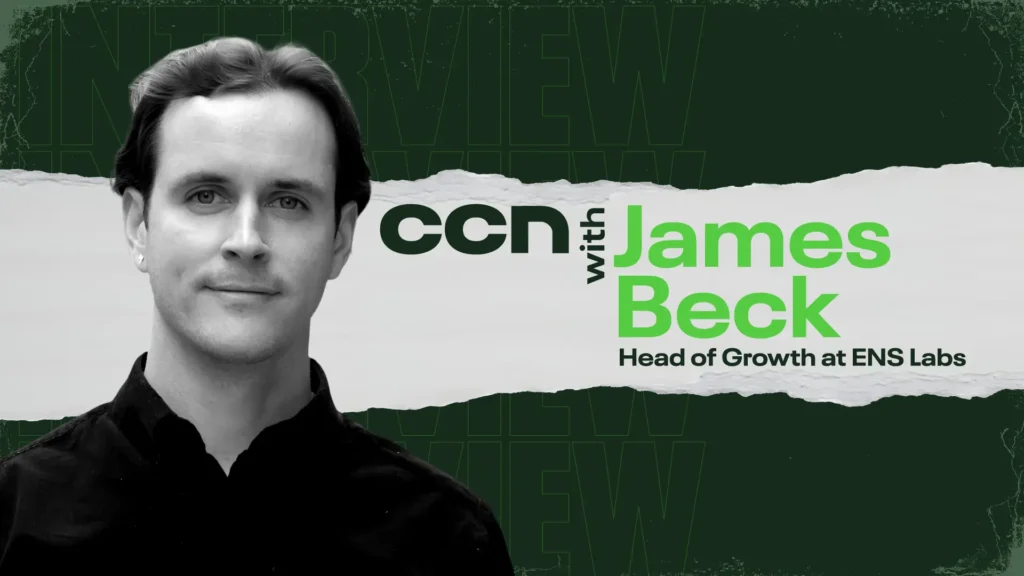
James Beck, the Head of Growth at ENS Labs, recently sat down with CCN to discuss the future of the protocol. With a background in the Ethereum ecosystem dating back to 2017, including key roles at Consensys for MetaMask and Linea, Beck is now focused on driving the integration of ENS as a universal decentralized identity layer.
From Simple Naming to Universal Profiles
While ENS is widely known for its naming capabilities, its role is expanding into a richer layer of reputation and social context. Beck explains that although it started as a tool to resolve addresses to names, it has become a “universal profile that can link wallets with social identities.”
“ENS started as a simple tool to resolve addresses to names and vice versa, but have been steadily evolving to be used as a universal profile that can link wallets, with social identities. Because ENS is a flexible protocol, different apps and ecosystems have built out profiles and reputation in different ways. For example, Basenames (which are ENS subnames of base.eth) wanted a way to track builders’ on-chain contributions such as hackathon participation, skill attestations, and verified credentials. Celonames, on the other hand, partnered with Self to provide KYC, in order to determine who are ‘real’ people compared to anonymous addresses or agents. We are also speaking with government service providers on how they can issue verifiable credentials for citizens that also map to an ENS name,” Beck explained.
The Technical Leap: ENSv2 and “Namechain”
A major focus for the coming year is ENSv2, which aims to ensure .eth names function “seamlessly and reliably across chains and ecosystems”. This involves a significant technical overhaul, specifically the creation of Namechain, a ZK rollup deployed using a framework called Surge.
Beck highlights that this new infrastructure is designed to inherit the “liveness and decentralization of the Ethereum L1” while solving critical latency issues. Currently, fetching cross-chain data can involve delays of an hour or more. However, by combining based rollups with trusted execution environments (TEEs), ENSv2 will deliver “state updates in seconds rather than hours.”
The Tech Behind ENSv2: Namechain and ZK Rollups
To support this vision, ENS Labs is undergoing a massive technical overhaul, utilizing zero-knowledge (ZK) technology and “based” rollups to solve latency and cost issues.
“We are very excited by the host of new tech we are using for ENSv2. At the network level, we are building Namechain, a ZK rollup that will be deployed using Surge, a based rollup framework developed by Nethermind and built on the Taiko stack. We have always believed that based sequencing and native rollups are the best design for a rollup to inherit both the liveness and decentralization of the Ethereum L1.
Another aspect that will improve with ENSv2 is CCIP-Read performance. CCIP-Read revolutionized cross-chain data fetching. However, it suffers from a critical limitation: waiting for ‘safe’ state on other L2s introduces significant latency.
“Working with Nethermind, we’ve designed a solution that leverages the unique properties of based rollups combined with preconfirmations and trusted execution environments (TEEs). This approach delivers state updates in seconds rather than hours,” Beck noted.
Building the Cross-Chain Bridge
Interoperability remains a significant hurdle for Web3. Beck highlighted that the next phase of ENS focuses on making digital identities legible across the entire Ethereum ecosystem and beyond.
“A major focus of ENSv2 next year is making sure .eth names function seamlessly and reliably across chains and ecosystems. ENS currently supports users updating addresses for their Bitcoin, Solana and nearly every EVM chain. We are also working with the Ethereum Foundation on making layer-2 networks interoperable, by mapping chain IDs with human-readable names (like optimism.on.eth) so that knowing which chain you’re transacting on is more legible, Beck explained.
Removing the “Web3 Barrier”
One of the primary goals for ENS Labs is making on-chain identity accessible to “non-crypto-native” users by removing technical friction. The new ENS App will utilize Rhinestone intents to simplify the registration flow. Beck envisions a future where users don’t have to bridge funds or manually swap tokens, creating a “UX that will feel more similar to a Shopify checkout than a typical crypto application”.
This accessibility extends to the traditional web as well. ENS remains the only blockchain naming protocol that follows ICANN’s rules, allowing users to import existing .com or .org domains to inherit ENS features. A new partnership with D3 also introduces the Doma protocol, which lets domain owners “tokenize their domains so that control is represented by a transferable token”.
Looking Ahead to 2026
Success for ENS isn’t just about internal milestones; it’s about becoming the “standard identity infrastructure for the web,” Beck emphasized.
By 2026, Beck expects a successful migration to Namechain and the launch of new management tools that function when “gas is near zero”. This efficiency will allow ENS to support a wider range of use cases, from “fintech apps” to “naming AI agents or real-world assets.”
“A north start metric will always be the number of integrations across applications, wallets, and the DNS. The more useful ENS is, the more it becomes standard identity infrastructure for the web,” Beck concluded.
The information provided in this article is for informational purposes only. It is not intended to be, nor should it be construed as, financial advice. We do not make any warranties regarding the completeness, reliability, or accuracy of this information. All investments involve risk, and past performance does not guarantee future results. We recommend consulting a financial advisor before making any investment decisions.

Dr. Guneet Kaur is a senior editor at CCN.com and a Science Fellow at Exponential Science. She is a fintech and blockchain expert with extensive experience in digital finance education, blockchain ecosystems, and cryptocurrency markets. She has worked with global media such as Cointelegraph, as well as education and blockchain platforms, to design and lead strategic content and learning initiatives. As an educator and assessor for top-tier executive programs, she bridges real-world fintech trends with academic insight.
Dr. Kaur is also a published researcher and peer reviewer across fintech and data science journals, including Financial Innovation Journal and International Journal of Big Data Intelligence and Applications. Her work spans data-driven analysis, Web3 innovation, and technical content development. With a strong foundation in both industry and academia, she translates complex financial technologies into practical applications, empowering learners, professionals, and institutions across the rapidly evolving digital finance landscape.


 Easy
Easy