“Nobody can take over control. Nobody can change an identity or a transaction that has been recorded on the blockchain-like network on the distributed ledger and that makes the solutions ready for use today.” | Image credit CCN
Share
Blockchain conversations often revolve around price action, trading bots, or artificial intelligence managing crypto assets.
This narrative shapes much of the public understanding of the industry. A quieter shift is taking place in the background, driven by enterprises, regulators, and infrastructure providers.
Digital identity is emerging as a core layer of the next phase of distributed systems. Companies now ask how to verify who is acting, what authority they hold, and whether systems can trust each other across borders.
This transformation becomes more urgent as AI agents begin to operate independently. These systems can execute transactions, negotiate terms, and access sensitive data without direct human input.
Without a reliable identity framework, automation creates more risk instead of efficiency.
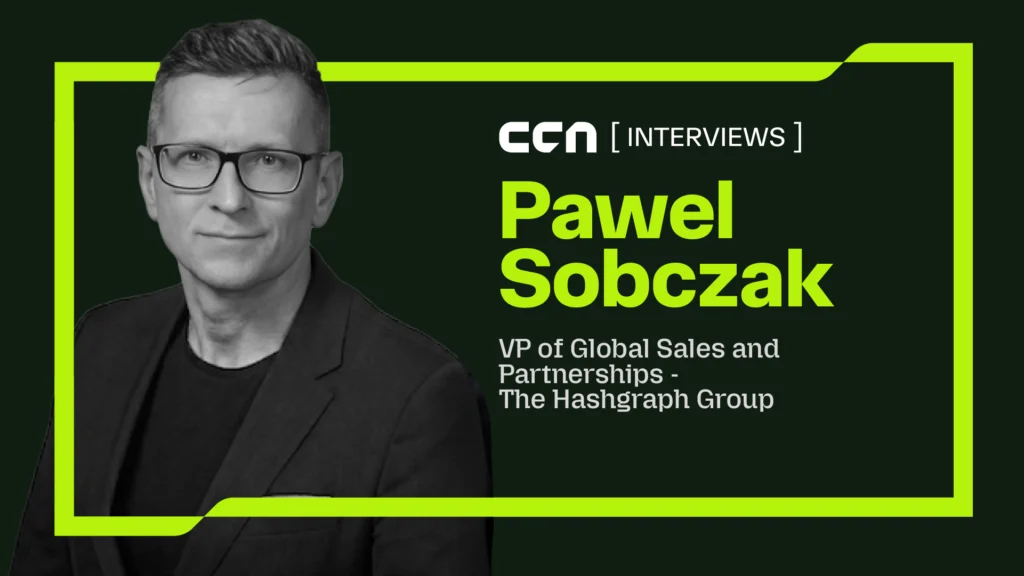
In an interview with CCN, Pawel Sobczak, Vice President of Global Sales and Partnerships at The Hashgraph Group, explained why identity infrastructure may carry more long-term value than AI-driven trading systems.
His perspective focuses on trust, compliance, scalability, and the growing need to verify both humans and machines in a digital economy.
Watch the video here:
Blockchain Moves Beyond Crypto Use Cases
Blockchain and distributed ledger technologies (DLTs) have moved far beyond their original role in cryptocurrencies.
Enterprises now test and deploy these systems across multiple industries, including logistics, finance, healthcare, and digital infrastructure.
Sobczak explained that The Hashgraph Group works to bring these technologies into real-world business environments.
Instead of targeting crypto-native users, the company focuses on enterprise decision-makers such as CFOs, supply chain leaders, and security teams.
The company builds on Hedera, a distributed ledger that uses a graph-based structure rather than a traditional chain.
This design improves performance, reduces costs, and lowers energy consumption. These features matter when systems operate at scale and require predictable outcomes.
Distributed ledger technologies now support a broader portfolio of use cases. Identity stands out as one of the most relevant, especially as systems begin to interact across organizations and jurisdictions.
Why Identity Matters More Than AI Automation
AI continues to expand across industries. Companies now deploy agent-based systems that act on behalf of users, organizations, and machines. These agents can search, negotiate, transact, and execute decisions without constant human supervision.
Sobczak explained the challenge through a simple example.
“Imagine my purchasing agent is connecting, looking for the best provider of the products, in an automated way, high frequency, without human intervention at every stage of the activity and talking to multiple providers.”
This scenario introduces a key question. How can systems trust each other when no prior relationship exists?
“How can we ensure that those two agents really are what they claim to be, that those two agents are authorized to do what they claim they are authorized in terms of placing an order up to special value, commit to certain terms and conditions of the delivery or price?”
Traditional identity systems struggle to answer this question. They rely on centralized registries that do not scale well across companies, borders, or autonomous systems.
AI automation increases efficiency, but it also increases risk. Identity becomes the foundation that determines whether automation can operate safely.
Decentralized Identity and Self-Sovereign Models
Decentralized identity systems aim to shift control away from centralized authorities. Instead of relying on a single provider, individuals and organizations can manage their own credentials.
Sobczak said distributed ledger technologies support this model by design.
“The blockchain and the distributor leisure technologies, including Hedera, play a critical role because they are designed for decentralized systems with equal participation from all the players, not relying on any particular centralized registry or identity source.”
These systems create tamper-resistant records that cannot be altered once confirmed. This property strengthens trust between unknown parties.
“Nobody can take over control. Nobody can change an identity or a transaction that has been recorded on the blockchain-like network on the distributed ledger and that makes the solutions ready for use today.”
Self-sovereign identity also introduces selective disclosure. Users can prove specific attributes without revealing full datasets. This approach supports privacy while maintaining verification.
Challenges in Moving From Pilots To Scale
Despite strong technical capabilities, adoption remains uneven. Sobczak pointed to a gap between what technology can do and what businesses can implement.
“There is a gap between technical capabilities and the business readiness to use those technical capabilities and at the same time manage the risk and manage the costs.”
Enterprises require systems that reduce risk, control costs, and integrate with existing infrastructure. Many blockchain-based identity solutions still operate at the pilot stage.
Another challenge comes from scale. Traditional identity systems were designed for humans, not machines.
“The traditional ID systems were prepared for people because there’s a limited number of people on the planet.”
The situation changes when devices, robots, and AI agents enter the system.
“But if you look at the smart devices, the drones, robots, soon every household will have a few robots beyond the Roomba cleaning the floor, but really humanoid robots.”
These systems operate at machine speed and generate high volumes of transactions. Identity frameworks must evolve to support this environment.
Compliance Without Increasing Surveillance
Regulation plays a central role in identity systems. Governments and institutions must ensure compliance with frameworks such as Know Your Customer (KYC) and Anti-Money Laundering (AML) rules.
Sobczak said regulatory frameworks in Europe already support identity innovation.
“All of that is already covered by the EIDAS 2.0, the European regulation.”
Decentralized identity can improve efficiency in compliance processes. Instead of repeating checks, institutions can reuse verified credentials.
“They can share the credential, they can share the information about that individual or company that has been once checked and reused.”
This model reduces duplication and cost. It also supports privacy through selective disclosure.
“Not disclosing everything if not needed, controlling how much is disclosed, but disclosing certain proofs and confirmation that the KYC process happened and it’s safe to deal with that entity.”
This approach creates a balance between compliance and user control.
AI Agents Increase Identity Risks
The rise of AI agents introduces new risks that traditional systems cannot handle. These agents operate at high speed and often interact without human oversight.
Sobczak stressed the importance of distinguishing between humans and machines.
“I think first it has to be clear if you are speaking with a person, speaking with a machine.”
The rapid development of deepfake technology adds another layer of complexity.
“Technology today allows us to create really deep fakes that are very difficult to distinguish, even if you see the video, is it real or is it AI-generated?”
Identity systems must verify not only who an entity is, but also what it is allowed to do. This includes access to sensitive data such as financial records or medical information.
These requirements push identity systems toward more advanced, decentralized models.
Adoption Trends Across Regions
Adoption of decentralized identity varies across regions and user groups. Some users prefer centralized systems, especially those linked to governments.
“There are some people that are fully trusting their governments and the ID systems that are controlled by the government central registries.”
At the same time, other regions show faster adoption of decentralized approaches. Sobczak pointed to Africa as an example.
“We ran a huge hackathon last year in Africa that brought around 50,000 participants.”
This initiative demonstrated how decentralized identity systems can scale quickly and support large user bases.
Developers, students, and emerging markets often adopt new identity models faster due to fewer legacy constraints.
Centralized and Decentralized Systems Will Coexist
Sobczak does not expect decentralized identity to replace traditional systems. Government-issued identities will remain necessary for public services, taxation, and travel.
“I think you cannot disconnect from your central government identity.”
At the same time, decentralized identity will expand across new use cases.
“But there’s beside of those selected use cases, a lot of other applications where this decentralized identity and self-sovereign identity have real use cases.”
The future will likely involve hybrid systems that allow users to move between centralized and decentralized environments.
Privacy, Control, and User Responsibility
Privacy concerns remain central to the discussion. Sobczak emphasized that self-sovereign identity gives users control over their data.
“The whole idea of self-sovereign identities is that you decide how much you share. You own your own data.”
No system can eliminate risk entirely.
“There is in any technology, there is room for misuse, for fraud, for scamming, spamming, etc.”
The focus shifts toward creating tools and frameworks that reduce risks while preserving user autonomy.
Identity as the Foundation of the Next Digital Economy
Digital identity systems address a fundamental challenge in the digital economy: trust. As AI agents, machines, and global systems interact at scale, identity becomes the layer that determines whether transactions can happen safely.
Sobczak described this shift as part of a broader transformation.
“We are now experiencing the move of agency, the ability to act, transact, commit in the name of the organization, individual.”
This transformation requires identity systems that operate across borders, organizations, and technologies.
“Those agenting AI systems working across countries, across jurisdictions, across organizations will need identity.”
Distributed ledger technologies provide a foundation for this shift, but adoption depends on usability, regulation, cost, and real-world implementation. Identity may not dominate headlines, but it is becoming one of the most important building blocks of the digital future.
Disclaimer:
The information provided in this article is for informational purposes only. It is not intended to be, nor should it be construed as, financial advice. We do not make any warranties regarding the completeness, reliability, or accuracy of this information. All investments involve risk, and past performance does not guarantee future results. We recommend consulting a financial advisor before making any investment decisions.
Dr. Lorena Nessi is an award-winning journalist and media technology expert with 15 years of experience in digital culture and communication. Based in Oxfordshire, UK, she combines academic insight with hands-on media practice.
She holds a PhD in Communication, Sociology, and Digital Cultures, and an MA in Globalization, Identity, and Technology.
Lorena has taught at Fairleigh Dickinson University, Nottingham Trent University, and the University of Oxford. She is a former producer for the BBC in London, with additional experience creating television content in Mexico and Japan.
Her research focuses on digital cultures, social media, technology, capitalism, and the societal impact of blockchain innovation.
She has written extensively on digital media and emerging technologies, with her work featured in both academic and media platforms. Her Web3 expertise explores how blockchain technologies shape culture, economics, and decentralized systems.
Outside of work, Lorena enjoys reading science fiction, playing strategic board games, traveling, and chasing adventures that get her heart racing. A perfect day ends with a relaxing spa and a good family meal.


 Easy
Easy