Home / Analysis / Crypto / Technical Analysis / Arthur Hayes Drops a $150 Hyperliquid (HYPE) Price Target for August 2026 — Here’s What the Data Actually Says
BitMEX co-founder Arthur Hayes published his “HYPE Man” essay, setting a $150 price target for the coin.
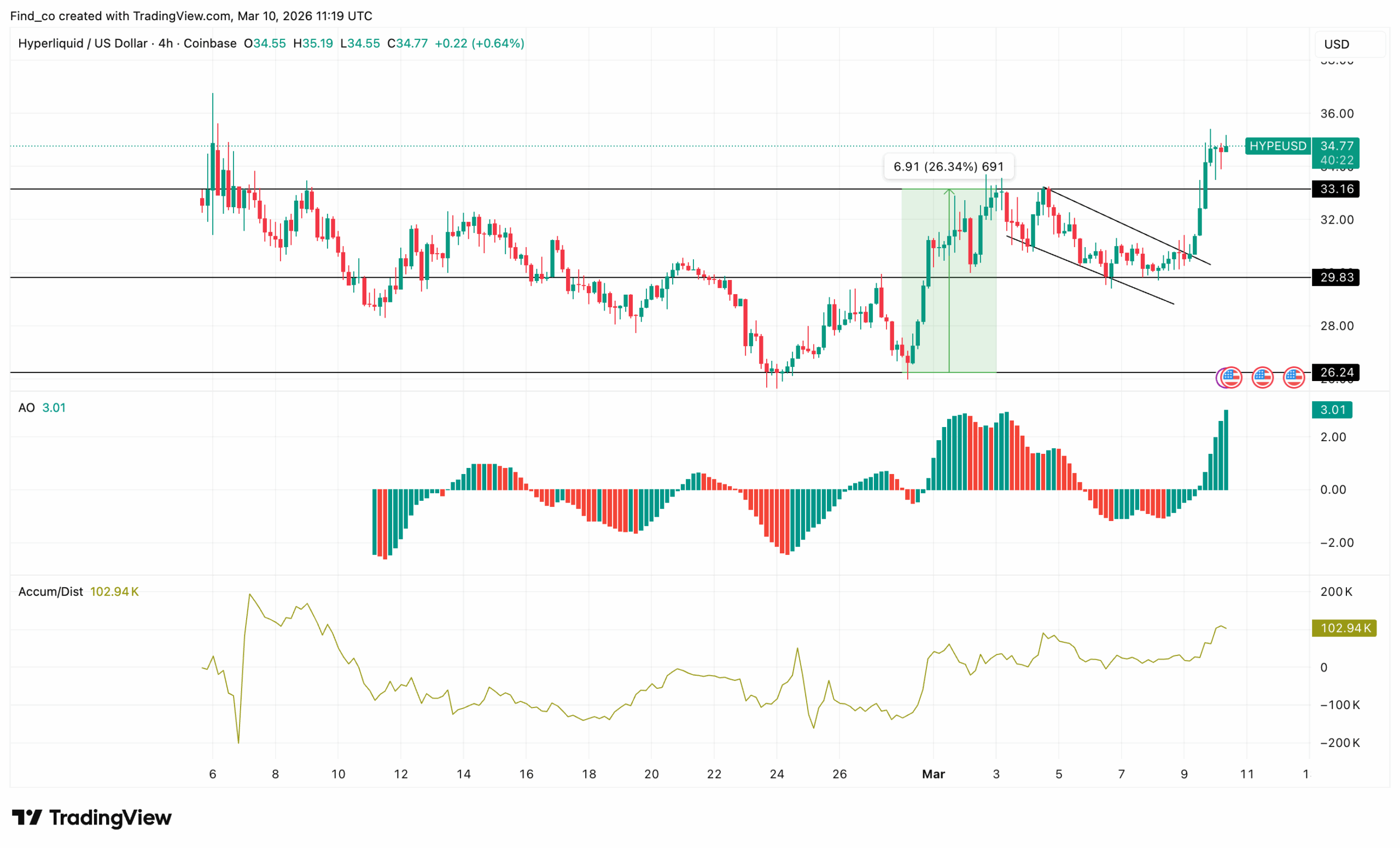
HYPE has cleared a 4-hour descending channel and is currently testing the $34.77 resistance.
Technical analysis suggests the Hyperliquid coin price could rally to a new all-time high in 6 months.
On March 9, 2026, Arthur Hayes, BitMEX co-founder and one of crypto’s most closely watched voices, published a detailed investment thesis on Hyperliquid (HYPE) through his Crypto Trader Digest Substack.
His conclusion was unambiguous, and he set a $150 price target for the HYPE coin by August 2026.
From the current price, this is approximately five times its price of around $30 at the time of writing.
Here is exactly what Hayes said — and whether the data behind it holds up.
Why Hayes Think HYPE Will Win
The foundational logic of Hayes’ thesis begins with a historically grounded observation.
During periods when Bitcoin trades sideways or declines, the best-performing altcoins have consistently been exchange tokens, and HYPE falls into this category.
He draws a direct parallel to GMX, which reached an all-time high of $90 in April 2023 precisely because it dominated decentralised perpetual exchange volumes at a time when the broader market was depressed.
Besides that, the centrepiece of Hayes’ financial case is Hyperliquid’s revenue architecture.
No other crypto project returns capital to token holders at this rate. That buyback mechanism means HYPE is not a speculative governance token waiting for utility to arrive.
“Hyperliquid must give traders something new and shiny to trade on-chain. Precious metals, AI stonks, and oil are what the plebes desire to trade. And now, using perps, anyone from around the world can trade 24/7 with higher leverage than TradFi exchanges offer. For these reasons, my model assumes HIP-3 revenue will rise 160% in six months,” Hayes explained
For Hayes’ $150 target to materialise, his model requires Hyperliquid to grow its 30-day annualised revenue run rate from approximately $843 million in March to $1.4 billion by August.
HYPE Price Analysis
Amid this prediction, Hyperliquid is breaking out again. At the time of writing, the HYPE coin trades at $34.77, having just cleared a descending channel that formed after the 26.34% rally from the $26.24 floor on Feb. 24.
As seen below, HYPE’s price is pressing the $33.16 resistance and trading at its highest level since early March 6.
Both indicators confirm the move. The Awesome Oscillator (AO ) at 3.01 is its strongest positive reading in over a week, with green bars building momentum.
The Accumulation/Distribution (A/D) line at 102,940 is near its highest level on the chart.
This indicates that institutional accumulation has been building steadily throughout the entire consolidation period, rather than being distributed into it.
That A/D distinction matters. Smart money accumulated during the $33 range while the price consolidated.
As it stands, the next resistance might be near $36. Once HYPE’s price reaches this point, the market value could breach $40 in the short term.
HIP-3 and HIP-4: The New Revenue Accelerants?
Meanwhile, two protocol-level developments form Hayes’ most forward-looking revenue arguments.
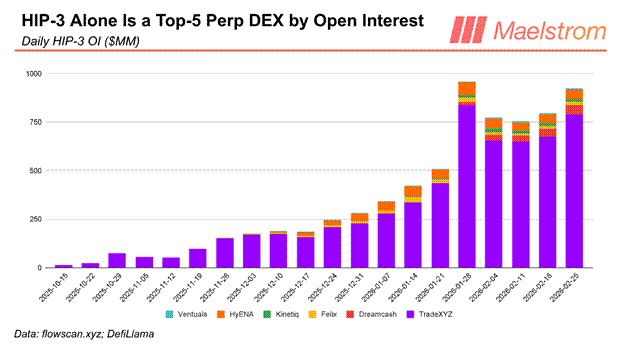
First is the HIP-3, Hyperliquid’s permissionless listing protocol, which allows anyone staking 500,000 HYPE coins to create derivative markets on any underlying asset using Hyperliquid’s matching and margin engine.
HIP-3 Open Interest | Credit: DeFiLlama
HIP-4, which Hayes expects to launch within three months, will enable permissionless prediction markets.
He treats this as a bonus scenario not included in his base model. Additionally, he notes that if the Hyperliquid team executes it as well as they have executed previous upgrades, the revenue impact could be material almost immediately.
Before now, Hayes’ previous bearish stance on HYPE late last year was partly driven by uncertainty over how aggressively the eleven-person Hyperliquid team, which took no VC funding and therefore holds substantial token allocations outright.
However, the data since then has been reassuring.
After distributing close to 20% of the awarded tokens in November and December 2025 — likely for tax obligations and lifestyle adjustments — the team distributed approximately 1% in January and February 2026.
Hayes interprets reduction as a deliberate decision to support price recovery. In addition, his model uses a four-month average of 815,750 tokens per month as its distribution assumption.
Even in his most bearish stress test maximum team distributions of nearly 10 million tokens monthly and no P/E expansion beyond 12 times, the model still produces a price target of $58, representing approximately 75% upside from HYPE’s $30 entry point at the time of writing.
HYPE Price Prediction: $87 Feasible
In the meantime, the daily chart frames an ambitious target.
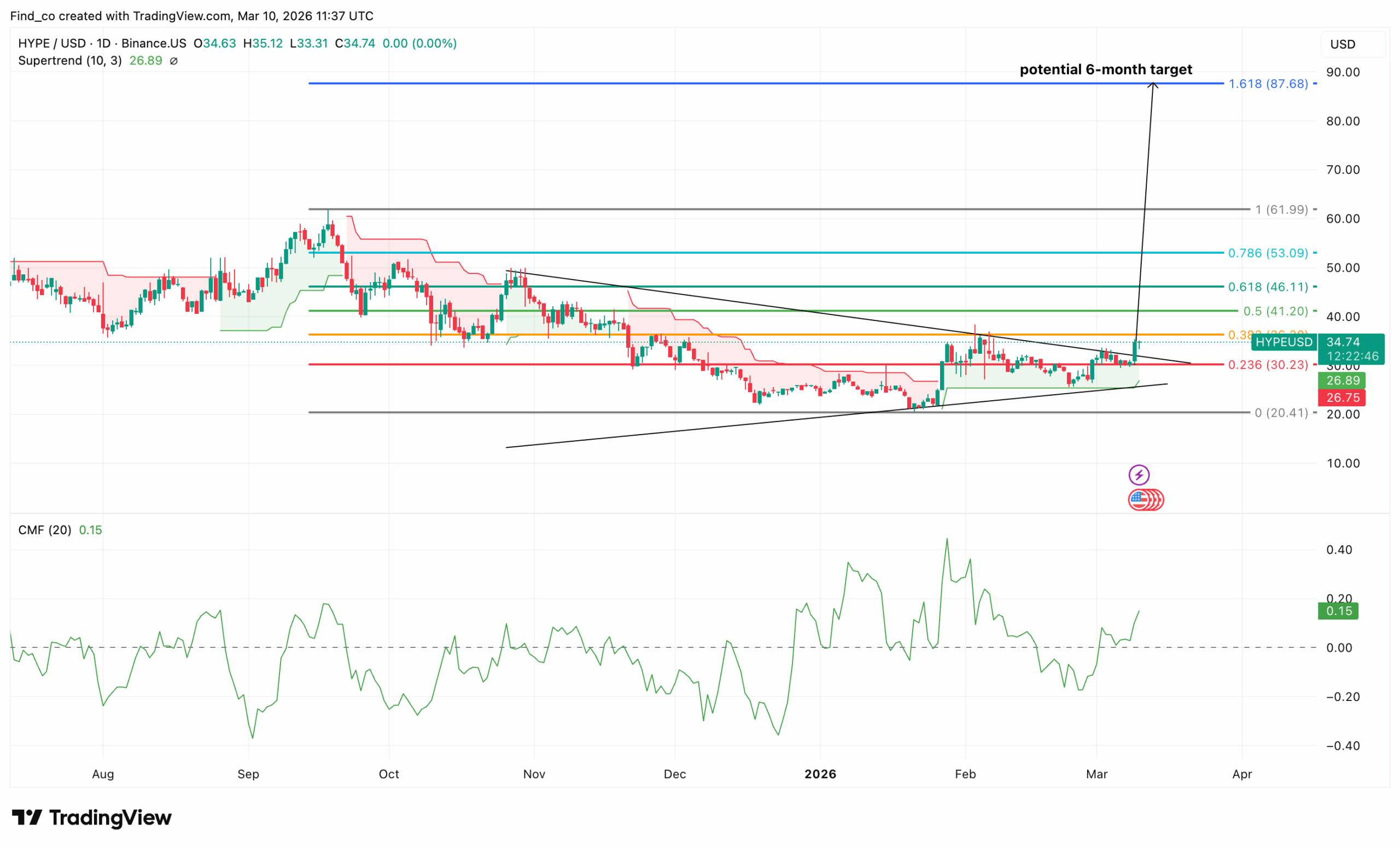
From the image below, HYPE’s price has broken above a descending channel that has compressed the price since the September peak near $62.
Furthermore, the Supertrend at $26.89 flipped bullish, and the price has held above it. The ascending channel from the $20.41 floor is intact, with higher lows throughout February and March.
Besides that, the Chaikin Money Flow (CMF) is positive and rising. This appears to be consistent with genuine accumulation rather than distribution.
Thus, the step ladder of Fibonacci targets is clear: $36.96 (0.382), $41.20 (0.5), $46.11 (0.618), $53.09 (0.786), and $61.99 (1.0) before the 1.618 extension becomes realistic.
If demand for HYPE remains elevated, the chart annotates a potential 6-month target at $87.68.
However, the altcoin needs to hold support around $30.23 (0.236 Fib) for this to materialize. If the altcoin loses the Supertrend at $26.89, the bull case resets entirely.
In that scenario, the HYPE coin price might decline to $20.41.
Disclaimer:
The information provided in this article is for informational purposes only. It is not intended to be, nor should it be construed as, financial advice. We do not make any warranties regarding the completeness, reliability, or accuracy of this information. All investments involve risk, and past performance does not guarantee future results. We recommend consulting a financial advisor before making any investment decisions.
Victor Olanrewaju is a crypto analyst and reporter at CCN with deep roots in on-chain research and technical analysis. His crypto journey began in 2017, but it was the 2020 Uniswap airdrop that sparked a full-time pivot into the space.
With a foundation in copywriting, Victor honed his craft creating high-converting content for leading crypto brokers — most notably an XRP price prediction that ranked #1 on Google during the 2021 bull run.
He later joined AMBCrypto in 2022, where he combined storytelling with technical and on-chain analysis to cover key market narratives.
In 2024, he expanded his expertise at BeInCrypto, collaborating with analysts and using tools like Glassnode, Santiment, and IntoTheBlock to break down Bitcoin and altcoin trends.
At CCN, Victor covers the top cryptocurrencies, memecoins, macro shifts, blending real-time insights with deep-dive metrics.
He holds a Bachelor’s degree in Physics from the University of Ibadan, equipping him to simplify complex data for a wide audience. Follow his work or connect on LinkedIn or X.