On Nov. 21, it added to this figure, completing the issuance of $3 billion in senior convertible notes due 2029 at a 0% interest rate. This brings MicroStrategy’s total debt to $7,569,932,000.
While the company has managed its borrowing thus far, the question remains: how much debt can MicroStrategy continue to amass?
What kind of events or shifts in market conditions could trigger a catastrophic collapse of MSTR stock? And how much pressure can MicroStrategy withstand before the cracks in its Bitcoin empire begin to show?
According to MicroStrategy’s recently announced “21/21 Plan,” the company has set its sights on raising a staggering $42 billion over the next three years. The strategy outlines raising $21 billion from equity through an at-the-market offering and an additional $21 billion through fixed-income securities.
The approach shows an aggressive push to expand Bitcoin holdings, which has already reached unprecedented levels.
By Nov. 24, 2024, MicroStrategy had increased its Bitcoin holdings from 252,220 BTC to 386,700 BTC through share issuances and new debt (Figure 3).
The company has already tapped into $3 billion—14.29% of the $21 billion debt outlined in the plan.
Figure 3: MicroStrategy’s Quarterly Growth in Bitcoin Reserves. Credit: mstr-tracker.com
At this pace, it could fully deploy the funds by May or June of 2025, thus significantly raising its total liabilities.
However, such rapid accumulation of Bitcoin brings major risks. Under the widely known four-year cycle theory, Bitcoin historically experiences sharp declines of 70–80% following its market peaks (2014, 2018, 2022) (Figure 4).
If such a downturn occurred in 2026, MicroStrategy could face severe financial consequences.
A margin call, a situation where collateral value falls below a required threshold, could force the liquidation of assets (Bitcoin) to meet debt obligations.
As a result, this would create a cascade effect, potentially devastating the company’s stock and even Bitcoin itself.
Why Margin Calls Do Not Apply
However, much of MicroStrategy’s debt comprises unsecured convertible notes, which carry no recourse to the company’s assets. Unlike traditional secured loans, which require collateral and trigger margin calls when asset values fall, these notes do not tie directly to the company’s Bitcoin reserves.
The lack of recourse significantly reduces the risk of forced liquidation, which shields MicroStrategy from the immediate threat of a margin call, even in a worst-case Bitcoin scenario.
As of Nov. 27, 2024, MicroStrategy’s average Bitcoin purchase price stood at $56,761.
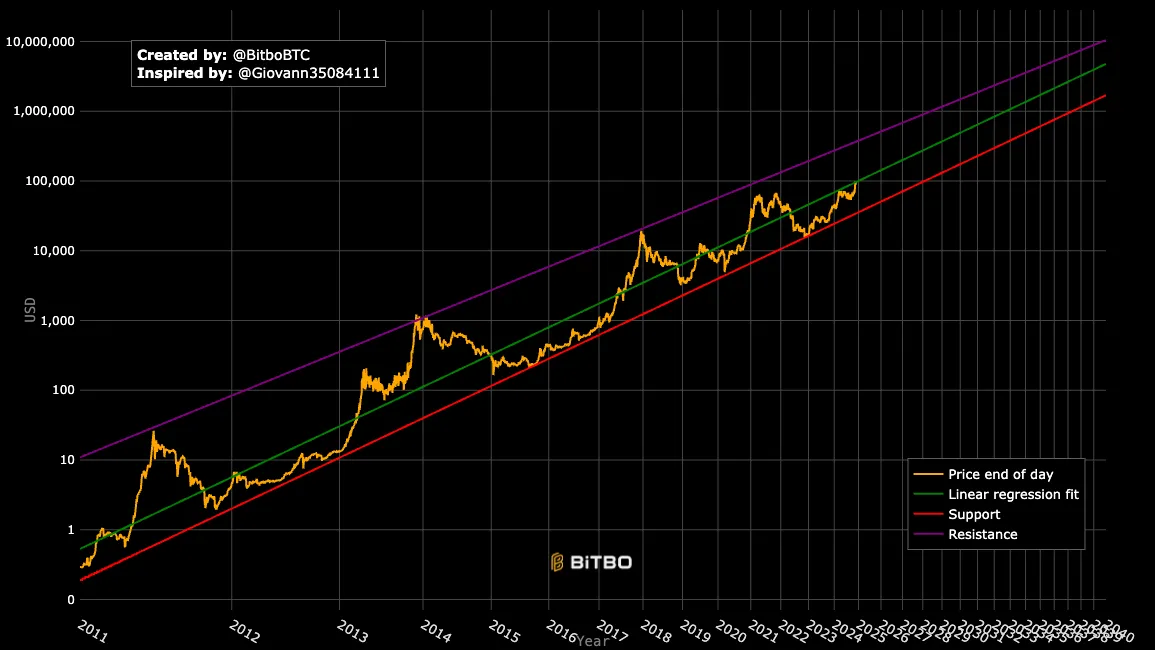
According to Giovanni Santostasi’s power law theory, one of the most accurate models for forecasting Bitcoin’s price movements at the time of writing the article, the cryptocurrency is projected to remain within a range of $50,708.76 to $70,742.60 during a potential bear market in 2026 (Figure 5).
Figure 5: Bitcoin Price Projections with Power Law. Credit: Giovanni Santostasi, Bitbo
However, as the company accumulates Bitcoin, the average acquisition price will inevitably rise, thus amplifying the impact of any future price downturns.
For instance, a $10,000 drop below the average purchase price on a portfolio of 500,000 BTC could create a $5 billion unrealized loss. To provide context, in November 2022, MicroStrategy faced a ~$2 billion portfolio decline, representing a ~50% drawdown on its ~$4 billion investment.
Today, debt issuers adopt a different strategy and offer interest-free loans in exchange for convertible notes. These instruments function as long-dated call options and grant lenders the right to convert the debt into equity at a future date.
Lenders gain exposure to MicroStrategy’s stock performance, betting on its potential appreciation without requiring immediate collateral.
Bitcoin as the Single Point of Failure
The real vulnerability lies elsewhere.
The Pearson correlation coefficient between MicroStrategy’s stock price and Bitcoin shows its dependence on the cryptocurrency.
Before its Bitcoin pivot, from Aug. 10, 2016, to Aug. 10, 2020, the correlation stood at -0.658, meaning the stock price moved opposite Bitcoin’s value. Post-purchase, from Aug. 11, 2020, to Nov. 13, 2024, the correlation flipped to 0.858.
The near-perfect positive correlation ties MicroStrategy’s fate almost entirely to Bitcoin’s market performance. If Bitcoin suffers, so too does MicroStrategy’s stock.
Moving Train With No Brakes
Despite the risks, MicroStrategy’s strategy is gaining traction beyond its walls. Companies like Semler Scientific and Metaplanet have incorporated Bitcoin into their balance sheets, and the U.S. government is likely to create a Bitcoin reserve.
Additionally, with Bitcoin ETFs gaining approval, the cryptocurrency is becoming a more entrenched part of the traditional financial ecosystem.
Michael Saylor is completely undeterred by critics and remains steadfast in his mission. He has repeatedly declared that MicroStrategy will never sell its Bitcoin, framing the strategy as a bet on the future of money itself.
This may seem like a bold claim, but there’s no stopping this train. As corporate giants follow their lead and Bitcoin solidifies its place in the global financial system, the momentum grows unstoppable.
With the stakes rising and the future teetering on Bitcoin’s volatile edge, MicroStrategy’s journey ahead promises either unparalleled triumph or an unforgettable dot-com bubble-like reckoning.
Disclaimer:
The information provided in this article is for informational purposes only. It is not intended to be, nor should it be construed as, financial advice. We do not make any warranties regarding the completeness, reliability, or accuracy of this information. All investments involve risk, and past performance does not guarantee future results. We recommend consulting a financial advisor before making any investment decisions.
Toghrul Aliyev is the Head of Research who began his journey in crypto in 2021. It all started with a Reddit post that went viral, leading to a writing position while he was still in medical school. As he learned more about crypto, he became deeply interested in it and decided to focus entirely on this field after completing his medical degree and becoming a doctor.
Toghrul specializes in thorough research, always aiming to find details others might miss. He also has a strong understanding of stocks, real-world asset tokenization, and related areas. He is skilled in Python and SQL, which he uses to improve his crypto analysis through data analytics and data science.
When he’s not working, Toghrul enjoys sports, hiking, reading philosophy, such as Seneca's works, and playing story-driven video games.