Your Stolen Crypto Didn’t Just Disappear. Here’s Where It Went
Published 18 June 2026
Authors
By Albert Quehenberger
Share
How investigators read transaction timing, wallet behavior and service exposure in modern investment scams
Editor’s note: Case references, wallet addresses, order identifiers, and transaction details in this article are anonymized or modified for publication. The examples are used to explain investigative methods, not to identify a specific victim, account holder, platform account, or live proceeding.
The first trace is rarely the transaction. It is the message that came before it.
A stranger appears in a chat application. The conversation does not begin with a demand for money. It begins with attention, routine and trust. A supposed investment opportunity is introduced slowly. A dashboard shows gains. Small withdrawals appear to work. Then the requests become larger: liquidity checks, tax payments, security deposits, account verification fees, and wallet migrations.
By the time the victim realizes the platform was not legitimate, the funds may already have moved through a sequence of wallets, swap services, bridges, stablecoin routes, and virtual asset service providers. What looked like a personal relationship has become a financial trail. For investigators, the visible case begins where the deception meets the ledger.
The blockchain records movement. It does not automatically explain meaning. A professional investigation has to reconstruct chronology, value movement, wallet behavior, service exposure, possible beneficial control, and evidentiary gaps. The work is not simply to draw a line from one address to another. It is to turn a scattered sequence of transfers into a record that can be understood, challenged, and acted upon.
A Fraud Case Is Also a Financial Investigation
Many investment scams and so-called pig-butchering schemes are built through social engineering rather than technical intrusion. The victim is not necessarily hacked. The private key may never be stolen. Instead, the victim is persuaded to transfer assets voluntarily to wallets apparently used or controlled by the fraud network.
That distinction changes the investigative frame. A conventional cyber incident may start with a compromised device, server or credential. A crypto investment scam often starts with deception and then becomes a financial investigation. The relevant questions resemble those in fraud, money laundering and asset-tracing cases: Who appears to have controlled the receiving wallet? What happened to the value after receipt? Which intermediaries were used? Where did the funds become exposed to a regulated platform? Which off-chain records may exist?
Investigators describe this as a flow-of-funds analysis. The objective is to reconstruct the movement of value from the victim’s wallet through subsequent hops, identify exchange exposure, assess service attribution, and determine whether any point in the chain may support preservation requests, freezing requests where legally and operationally available, account identification, or legal process.
How Analysts Read the Transaction Pattern
In crypto fraud investigations, the decisive question is often not whether a transaction exists. It is what the transaction pattern reveals. Analysts examine the chronological sequence of transfers: when the victim sent funds, how quickly the assets moved onward, whether several deposits were consolidated, and whether outgoing transactions occurred shortly after incoming victim payments. The timeline becomes the first witness that the fraud network cannot coach.
Timing can indicate wallet function. A wallet that receives funds and forwards them within minutes may be an operational collection address or laundering waypoint. A wallet that receives repeated victim deposits before a larger outgoing transfer may be a consolidation wallet. A wallet that interacts repeatedly with a known exchange deposit address may represent an exchange-facing route. The point is not to label too quickly, but to test each interpretation against the transaction graph.
Transaction size matters as well. Analysts look for round amounts, test payments, split transfers, escalating deposits, structured withdrawals, rapid conversion into stablecoins, and fragmentation across multiple wallets. They compare incoming and outgoing values, check whether amounts are preserved or shaved, and examine whether asset conversion changes the appearance of the trail without changing the economic logic.
Velocity analysis is another signal. If funds leave a receiving wallet seconds or minutes after arrival, that can suggest automation, operational discipline, or pre-arranged laundering infrastructure. If funds remain static, the investigative focus may shift to account monitoring, preservation requests, and future movement alerts. In either case, timing is not background detail. It is evidence context.
The Investigative Checklist
A serious on-chain case file usually tests several questions in parallel. The goal is to move from raw blockchain data to an investigative theory that can be challenged, documented, and used by compliance teams, lawyers, or authorities.
Core investigative questions
Analytical focus
What investigators test
Timeline reconstruction
Build the chronological sequence of deposits, onward transfers, swaps, bridge movements, consolidation events, and exchange-facing transactions.
Transaction-size analysis
Identify round amounts, split payments, test transactions, escalating victim deposits, structured withdrawals, and repeated value patterns.
Velocity analysis
Measure how quickly assets move after receipt and whether forwarding behavior suggests automation, operational wallets, or laundering waypoints.
Flow-of-funds mapping
Trace asset movement through collection wallets, intermediary wallets, swap services, DeFi protocols, bridges, stablecoin routes, and exchanges.
Wallet clustering
Assess whether multiple addresses may be under common control using transaction behavior, timing, reuse, counterparty patterns, and chain-specific heuristics.
Exchange exposure
Identify when assets appear to reach a virtual asset service provider and document chain, asset, amount, timestamp, deposit address, and attribution confidence.
Counterparty mapping
Map recurring counterparties, known services, deposit addresses, payment processors, OTC-like routes, and nested service patterns.
Asset conversion analysis
Review swaps between ETH, stablecoins, and other assets, including whether conversion coincides with obfuscation or preparation for cash-out.
Evidence preservation
Preserve transaction hashes, screenshots, chat logs, wallet exports, platform messages, collection dates, and chain-of-custody records.
Pig-Butchering Patterns
In so-called pig-butchering schemes, the transaction pattern often mirrors the psychological pattern. Initial transfers may be smaller. The victim tests the platform. A limited withdrawal may be allowed or simulated. Later payments grow larger as the fraudster introduces taxes, liquidity requirements, compliance reviews, or security deposits.
On-chain, analysts may see escalating deposits from the same victim wallet, rapid onward movement after each payment, conversion through swap services, or consolidation with deposits from other victims. The timing of communications can matter. If a demand for a ‘tax’ or ‘unlock fee’ is followed by a transaction and immediate forwarding, the communication record and the on-chain timeline reinforce each other.
This is why investigators do not analyze the blockchain in isolation. Chat logs, screenshots, wallet transfers, and platform messages are compared against one another. The question is whether the on-chain behavior supports the story emerging from the human interaction.
Ponzi-Like Investment Structures
Ponzi-like crypto investment schemes require a different lens. They may involve multiple participants, repeated deposits, apparent payouts, referral structures, and dashboards that create the impression of profitable trading. Early payouts can make the structure look legitimate and encourage recruitment.
The on-chain question is whether the movement of funds indicates genuine investment activity or redistribution. Analysts compare incoming deposits from newer participants with outgoing payments to earlier participants. They look at timing, transaction sizes, wallet reuse, operational collection points, payout wallets, and the absence or presence of traceable trading activity. A single payout does not prove a Ponzi structure. A repeated pattern of deposits and funding payouts may become significant when combined with other evidence.
In such cases, transaction-size analysis is central. Similar payout amounts, recurring payout intervals, near-simultaneous deposits and withdrawals, and consolidation of participant funds into operational wallets can all become indicators. The goal is not to force a label onto the data. It is to test whether the flow of funds matches the economic story presented to participants.
From Address to Transaction Graph
On-chain investigation begins with data that appears simple: wallet addresses, transaction hashes, timestamps, asset amounts, and network information. The work becomes complex once analysts try to determine what those data points mean.
Analysts use transaction graph analysis, hop analysis, wallet clustering, address attribution, temporal correlation, counterparty mapping, and exchange-exposure assessment. In account-based networks, they examine flows between addresses, smart contracts, and token transfers. In UTXO-based systems, they may consider change-address behavior, transaction inputs and outputs, consolidation patterns, and clustering heuristics.
A single address rarely tells the story. Fraud networks may use collection wallets, operational wallets, deposit addresses, intermediary wallets, bridge routes, DeFi liquidity pools, swap services, nested services, and centralized exchanges. The investigative question is not only where the assets went, but what role each address or service appears to play in the broader structure.
Taint analysis can be useful, but it is not a substitute for judgment. Serious reports distinguish between observed transactions, analytical inferences, and confidence levels. They explain why an address is believed to belong to a cluster, why a platform attribution is reliable, and what information still requires confirmation through KYC, CDD, EDD, account records, or law enforcement process.
The Financial Investigation Layer
Traditional financial investigation concepts remain central. Asset tracing, source-of-funds analysis, source-of-wealth review, beneficial ownership, transaction monitoring, sanctions screening, suspicious activity indicators, and AML typologies all apply in digital asset cases.
When funds appear to reach infrastructure associated with a virtual asset service provider, the focus shifts partly off-chain. A blockchain address may be visible, but the account behind a deposit address may only be identifiable through exchange records. Those records can include KYC files, IP logs, login history, device information, withdrawal addresses, account notes, linked bank details, travel rule data and internal transaction monitoring alerts. Real-world investigations often reach a turning point at precisely this stage. In a 2026 case handled by Romanian law enforcement, approximately $210,000 in stolen cryptocurrency was identified and intercepted after investigators traced the movement of funds to a regulated service provider before additional laundering attempts could occur. The case illustrates why exchange-exposure analysis is often one of the most valuable stages of a crypto fraud investigation. Blockchain tracing may reveal where assets moved, but compliance records and coordinated intervention can determine whether meaningful recovery remains possible.
This is why evidence packages need precision. A platform compliance team cannot act effectively on a broad statement that a victim was scammed. It needs the chain, asset, transaction hash, timestamp, amount, deposit address, exposure analysis, risk rationale, and supporting legal or law enforcement documentation. In some jurisdictions, this may feed into a subpoena, production order, preservation request, suspicious activity report, suspicious transaction report, or mutual legal assistance process.
Why Jurisdiction Shapes the Investigation
Crypto fraud routinely crosses borders faster than conventional legal systems can respond. The victim may be in one country, the communications infrastructure in another, the scam platform registered nowhere meaningful, the swap service operating internationally, and the exchange account subject to a separate regulatory regime.
Jurisdictional analysis, therefore, becomes part of the case file. Investigators need to know which entity may hold records, which authority can request them, which compliance channel may preserve data, and whether the available evidence meets the threshold for urgent escalation. In practice, technical accuracy can determine whether a request reaches the right team or disappears into a general support queue.
What the Visual Evidence Shows
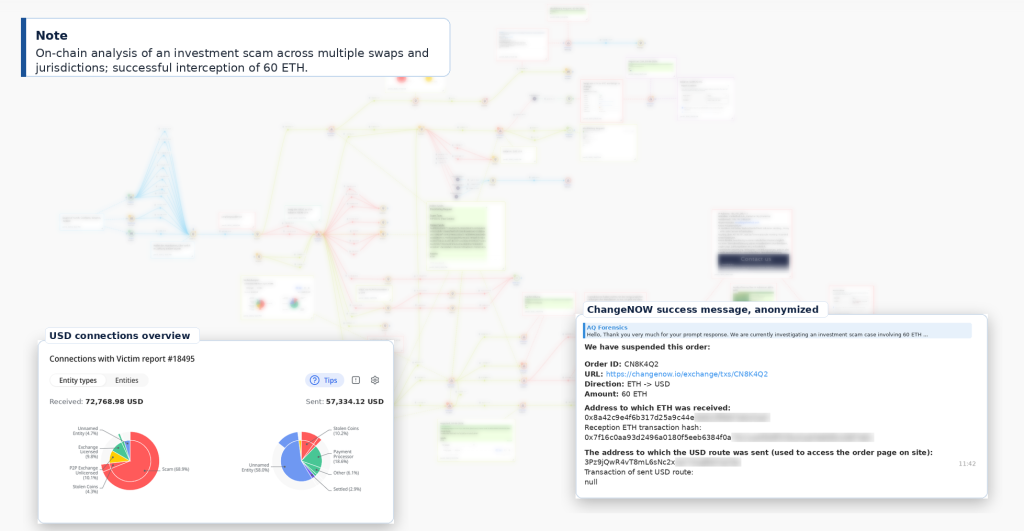
The anonymized visualization below shows how a case file may combine several evidence types: an on-chain transaction map, a USD-denominated exposure overview, and a modified service-status message. Wallet and hash values are partially blurred because even altered technical identifiers can provide investigative clues when published without context.
An anonymized investigation graphic combining transaction mapping, USD exposure, and a modified ChangeNOW-related status message. Wallet and hash values are partially blurred for publication.
When a Status Message Matters
A service-status message can become relevant when it confirms that a transaction, order, or account interaction was flagged, suspended, or routed through a particular provider. For investigators, the value is not the screenshot alone. It is the connection between the screenshot, the blockchain transaction, the wallet path, the service attribution, and any later records held by the provider. The image becomes useful only when it is anchored to the flow of funds.
This is where chain of custody matters. Screenshots, chat logs, wallet exports, transaction records, and platform messages should be preserved in a way that separates original evidence from edited publication material. Dates, sources, and collection methods should be recorded. If a document is later reviewed by lawyers, prosecutors or a court, the difference between evidence and illustration must be clear.
Identity, Deception, and Open-Source Evidence
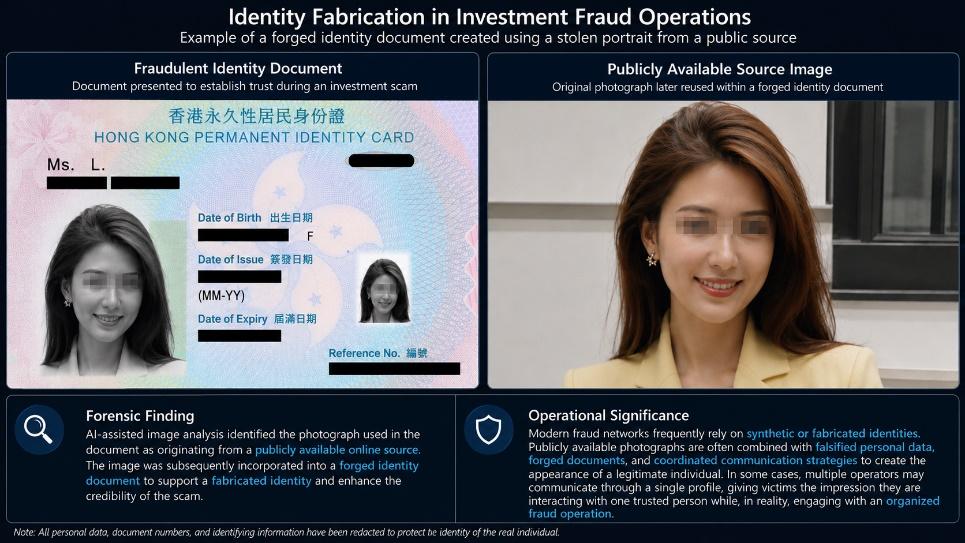
The on-chain trail is only one side of the case. Fraud networks often combine financial routing with fabricated identities, stolen profile photographs, forged documents, fake dashboards, and scripted support communication. Open-source intelligence can help connect those materials to prior uses, reused templates, domain infrastructure, social accounts, or known fraud typologies.
Investigators may compare profile images, document layouts, platform language, domain registration patterns, Telegram handles, website clones, and wallet reuse. None of those elements alone necessarily proves who is behind the operation. Together, they can support attribution hypotheses and guide requests for records.
Fraud investigations often combine on-chain tracing with identity, document, and open-source evidence review.
The Limits of the Ledger
A blockchain does not show intent. It does not show the name of the person behind a wallet. It does not reveal the conversation that persuaded a victim to transfer funds. It does not automatically distinguish a fraud wallet from an exchange deposit address, an OTC desk, a payment processor, or an intermediary service.
Those limits are important. Overstating on-chain certainty can weaken a case. A stronger approach states what is known, what is inferred, what confidence level supports the inference, and what external records are needed. In serious financial investigations, uncertainty is not hidden. It is managed.
The Real Measure of Success
In crypto fraud cases, success should not be measured by dramatic promises of recovery. Guarantees are a warning sign. The more realistic measure is whether investigators can turn fragmented digital traces into a coherent, usable record.
That record may support a freeze request, an exchange escalation, a civil claim, a criminal complaint, a source-of-funds review, an AML investigation or a request for account records. It may also show that recovery is unlikely, but evidence preservation remains important for broader enforcement action.
The first message may have looked ordinary. The transaction graph does not. Between those two points sits the real work of the investigation: turning fragmented payments, wallet behavior, service exposure, and human deception into a record that can be understood, challenged, and acted upon. The ledger provides visibility. Financial investigation provides meaning. On-chain analysis connects the two.
This methodology is effective until you encounter the first case where it is not. Not in the way expected, and not for the reasons usually assumed. In the next part, we will examine exactly such a case: an investigation in which all standard indicators pointed to one scenario, yet the final conclusion led somewhere entirely different.
About the Author
Albert Quehenberger
Albert Quehenberger, is the CEO of AQ Forensics GmbH and a specialist in blockchain forensics, cryptocurrency investigations, and on-chain analysis. With over a decade of experience in digital investigations, he supports authorities, law firms, companies, and private clients in complex crypto-related cases. He regularly trains law enforcement agencies and lawyers, has spoken at the United Nations, and is featured in the latest ChangeNOW documentary, where he raises awareness about common cryptocurrency fraud schemes.