A crypto exchange might lose its spot on a user’s phone home screen while simultaneously receiving more trading orders, as an increasing number of traders delegate the trading process to artificial intelligence (AI).
As early as 2027, more than half of retail crypto orders, by transaction count, could be initiated and managed by AI agents without requiring user confirmation for every transaction, provided they operate within predefined user permissions and risk limits. Consequently, the exchange app will no longer be a mandatory stop on the path to executing a trade. Instead, the agent will connect directly via a dedicated interface, and the user will no longer need to log into the app every time they need to check or adjust an order. Think of Samantha organizing Theodore’s emails in Her, where he asks for help, and the assistant handles the task. The exchange would remain the place where orders are processed, while the agent becomes the interface the user interacts with.
The reason I think this is plausible is the emergence of infrastructure that bridges the capabilities of AI models with real-world actions. In May, AWS unveiled a preview of Amazon Bedrock AgentCore Payments, before making it generally available in August. The infrastructure enables AI agents to pay for access to digital services and data. At MEXC, we are also testing API-based infrastructure to connect agents capable of submitting trading instructions within permissions and risk limits set by users.
This process doesn’t require an active client session for every trading operation. However, the ability to submit an order is only part of the challenge. The system must also verify whether the agent is authorized to perform the operation and report back on the status of the instruction.
Consider a common technical scenario: a program submits an order but fails to receive a response due to a connection error. Retrying the request might seem like the natural solution. However, the initial order could have already been executed, and a duplicate transaction could create unintended market exposure that cannot simply be rolled back — a discrepancy an AI agent’s algorithm is less likely to overlook.
Crypto Users Are Increasingly Open to Delegating Control to AI
APIs and trading bots have long existed. However, agentic systems expand the range of tasks a program can potentially execute without step-by-step human guidance, creating new requirements regarding data, error handling, and access control. While traditional trading bots generally operate based on predefined rules, agentic systems can interpret a higher-level objective, select tools and determine a sequence of actions needed to pursue it.
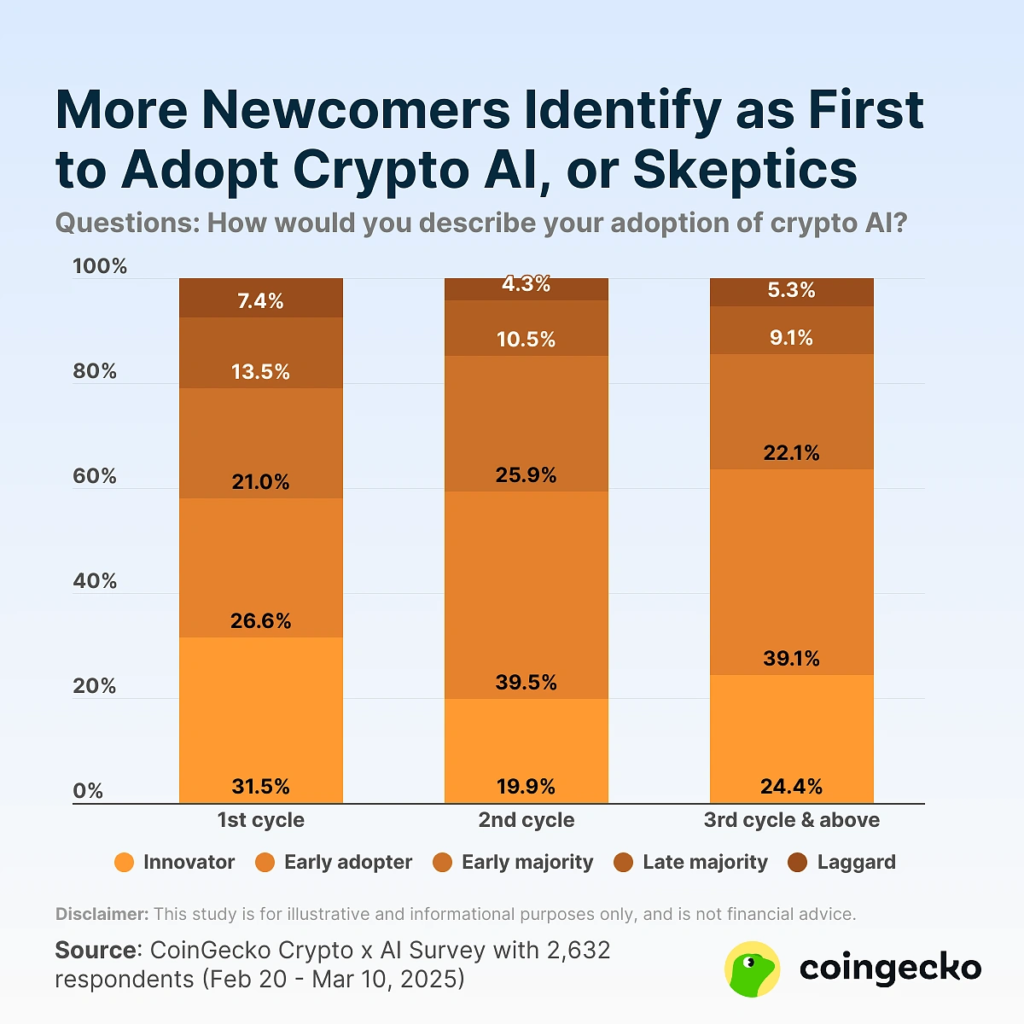
Are users willing to delegate so much authority? A part of the audience is. In a CoinGecko survey conducted in February–March 2025 among 2,632 crypto market participants, 35.9% of respondents said they were willing to let AI agents manage at least 60% of their crypto portfolio, including 14.5% who were willing to delegate their entire portfolio. MEXC’s AI-powered features saw strong adoption in Q1 2026, averaging 138,274 daily active users and accumulating over 1.04 million active users throughout the quarter. MEXC-Al bot answered more than 5.1 million user queries during this period.
Coingecko’s Crypto x AI Survey covered 2,632 crypto users
So what supports the prediction that AI agents could execute the majority of retail crypto trades already in 2027? It might seem that AI is still a long way from becoming firmly embedded in our daily activities. While many users may prefer to navigate the complexities of crypto trading themselves, mass automation doesn’t require the majority of investors to entrust all their funds to AI immediately. The volume of trading operations involving AI agents could grow through partial delegation, where the user retains control over the strategy while the program executes a limited set of repetitive operations. A few such active agents can submit more orders than a large number of manual traders. That is why AI’s share of order count could rise much faster than its share of assets under management or overall trading volume.
Agent Readiness Strengthens an Exchange’s Competitiveness
For trading platforms, the benefits of being compatible with AI agents may extend well beyond mere automation. Being available 24/7 to onboard a user or help them solve a problem is one of them. While the platform retains responsibility for execution, liquidity, asset custody, and transaction processing, the task of explaining trading nuances and rules to the user will increasingly fall to a program operating outside the platform’s own application.
For exchanges, this means a new form of competition for client access — much like how ChatGPT, Grok, and Claude continuously refine their interfaces and performance to become primary applications for everyday use. A platform with an attractive app but a clunky API risks being left out of the selection process entirely, as the user might never even reach its interface.
The “Know Your Agent” Approach
Still, granting agents greater capabilities without proper authorization management is a poor way to accelerate adoption. We are exploring the “Know Your Agent” (KYA) approach to link program actions to specific users and granted permissions while minimizing security risks. While trading platforms previously focused on knowing their human users, they must now also understand the AI agents operating on them.
For instance, an exchange needs to know which agent is making a request, what operations are available to it, and when its authorization expires. The user, meanwhile, must be able to revoke access and view the action history. Crucially, these limitations must operate independently of the model’s decisions. If a program is authorized to analyze a balance, that doesn’t grant it the right to trade. If trading is permitted, it does not imply the right to withdraw funds. Likewise, a misinterpretation of an instruction should not automatically expand access to capital.
Delegating an instruction to software also doesn’t automatically remove an exchange’s existing regulatory responsibilities. Trading with AI agents involved will still need to operate within applicable requirements around customer identification, sanctions controls, market-abuse surveillance, and dispute handling.
Such an architecture is also vital for building user trust. It is easier for a person to delegate a specific task with clear boundaries than to agree to abstract AI-driven portfolio management. The ability to monitor and halt the program ensures its autonomy remains manageable.
Furthermore, a simple interface is unlikely to automatically equalize the results achieved by a novice and a professional. An agent can reduce the time spent gathering information and executing orders, but it cannot eliminate market uncertainty or investment risks, nor can it turn a flawed strategy into a successful one. While reducing operational complexity is a significant achievement in itself, promising superior investment returns alongside it would be overreaching.
In the coming years, exchanges will demonstrate increasing effort in streamlining behind-the-scenes interactions, such as data exchange, permission verification, execution confirmation, and error analysis. The quality of this work will determine the complexity of the tasks users are willing to entrust to their assistants. Consequently, by 2027, the industry may adopt a new metric of success: the number of tasks a client completes via the exchange without ever opening its app.
About the Author
Vugar Usi Zade
Vugar Usi Zade is the CEO of MEXC. He previously served as Chief Operating Officer at Bitget, Chief Marketing Officer at Beincrypto, and Marketing Director at SONY. Prior to that, he held senior positions at renowned companies including Facebook, Danone, and Carlsberg.
Vugar also possesses a robust background as an experienced management consultant, having served as a Senior Manager at Bain & Company with a focus on private equity investments. He holds master's and postgraduate degrees from Harvard University and the University of Oxford, and is a published author and researcher.