Key Takeaways
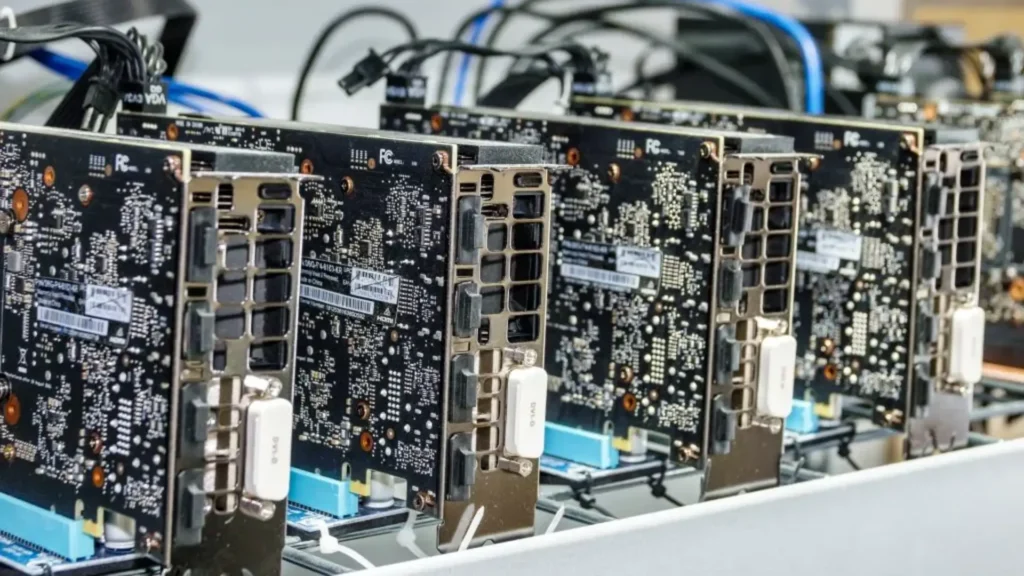
- Recent Chinese tariff hikes could increase costs for U.S.-based Bitcoin mining companies purchasing ASICs from China.
- The tariff increases encourage a more evenly distributed global Bitcoin mining power.
- Despite challenges for U.S. miners, China remains dominant in the Bitcoin mining sector.
As geopolitical tensions reshape global trade, unexpected ripple effects emerge in Bitcoin (BTC) mining.
What appears at first to be a setback—higher Chinese tariffs making mining hardware more expensive for U.S. firms—could rebalance power within the Bitcoin network.
And that shift might be a blessing in disguise for a technology built on the ideals of decentralization and censorship resistance.
Strengthening Bitcoin’s Censorship Resistance
The recent increase in Chinese tariffs on the U.S. will raise the cost for U.S.-based public Bitcoin mining companies to purchase ASICs primarily produced in China. However, this shift could ultimately benefit the health of the Bitcoin mining ecosystem.
When one country controls too much of the Bitcoin hashrate, it risks compromising the network’s censorship resistance, a core principle of Bitcoin.
If most of the Bitcoin network’s hashrate is centralized in the U.S., the government could exert more control over mining companies, as seen with MARA’s compliance with the U.S. Treasury’s Office of Foreign Assets Control (OFAC).
A geographically diverse Bitcoin mining operation is key to maintaining the security and independence of the network.
While the U.S. already holds more than half of the Bitcoin network’s hashrate, the tariff increases may force a more balanced distribution of mining power, which could ultimately help strengthen Bitcoin’s decentralization.
A Trade War With Unintended Consequences
Robby Greenfield, founder of Umoja, believes China holds a significant advantage in this trade dispute.
“They are not reliant on any U.S. intellectual property or hardware to thrive, and this remains true within the Bitcoin mining industry in which they are already market leaders with Bitmain and others,” Greenfield said.
But the real story, he suggests, is not in the immediate costs of mining equipment but in the broader implications of how Bitcoin is decoupling from traditional financial markets.
Greenfield argues that the volatility and unpredictability of trade policy are pushing Bitcoin further away from global economic structures and toward a more independent position.
Arthur Breitman, co-founder of Tezos, shares a similar view. “Tokens cross borders much more easily than ASICs,” he said. “This is an important benefit of proof of stake; it can be fluid and more resistant to geopolitical pressures.”
The Corporatization of Bitcoin Mining
Greenfield foresees a future where the high costs of mining and the increasing centralization of resources push Bitcoin mining toward greater corporatization.
He warns that this trend will affect the security and stability of the Bitcoin network. “Mining will become increasingly corporatized due to the inherently centralizing nature of the cost of block creation,” he told CCN.
As the Bitcoin network matures and mainstream demand grows, governments will likely step in to support mining operations, particularly if Bitcoin continues to decouple from traditional financial markets.
Greenfield views this support as a way to hedge against economic instability, with the U.S. dollar’s weakening purchasing power pushing more institutional players into the Bitcoin space.
But this new reality also presents a paradox. While corporatization might boost the long-term health of the network, it could also undermine Bitcoin’s founding principles of decentralization.
“Decentralization can only persist if the cost of mining decreases, or new structures (like decentralized compute) introduce themselves onto the Bitcoin blockchain to diversify the responsibility of mining,” Greenfield cautioned.
Broader Implications for Crypto
While Bitcoin is recognized as a commodity in many jurisdictions, including the U.S., the impact of new tariffs could extend far beyond just the mining sector.
James Butterfill, from CoinShares, suggests that the immediate effect could be negative, especially for risk assets like Bitcoin. Higher tariffs may reduce economic growth, spur inflation, and lead to a drop in Bitcoin’s price, especially as it often correlates with equities.
However, in the long run, the situation could shift. If the U.S. faces stagflation and can’t raise interest rates further, Bitcoin may rebound while stocks struggle.
Bitcoin’s correlation with the NASDAQ is about 40%, but it has decoupled during times of crisis, like the March 2023 banking collapse, acting as a safe haven.
“Bitcoin behaves differently from altcoins,” Butterfill said. “While Ethereum and others are growth-oriented, Bitcoin is increasingly seen as digital gold,” Butterfill said.
Despite short-term volatility driven by tariff policies and inflation, Bitcoin’s role as a hedge may strengthen as the economic landscape becomes more unstable. “U.S. policy decisions will continue shaping global markets and Bitcoin’s future,” Butterfill concluded.
The future of Bitcoin mining and the network’s health is now in a state of flux.
The current tariff hikes present a challenge for U.S. miners, but they may also push the Bitcoin network in a direction that better aligns with the principles of decentralization, ultimately ensuring its resilience against external pressures.

Giuseppe Ciccomascolo began his career as an investigative journalist in Italy, where he contributed to both local and national newspapers, focusing on various financial sectors.
Upon relocating to London, he worked as an analyst for Fitch's CapitalStructure and later as a Senior Reporter for Alliance News. In 2017, Giuseppe transitioned to covering cryptocurrency-related news, producing documentaries and articles on Bitcoin and other emerging digital currencies. He also played a pivotal role in establishing the academy for a cryptocurrency exchange website. Crypto remained his primary area of interest throughout his tenure as a writer for ThirdFloor.