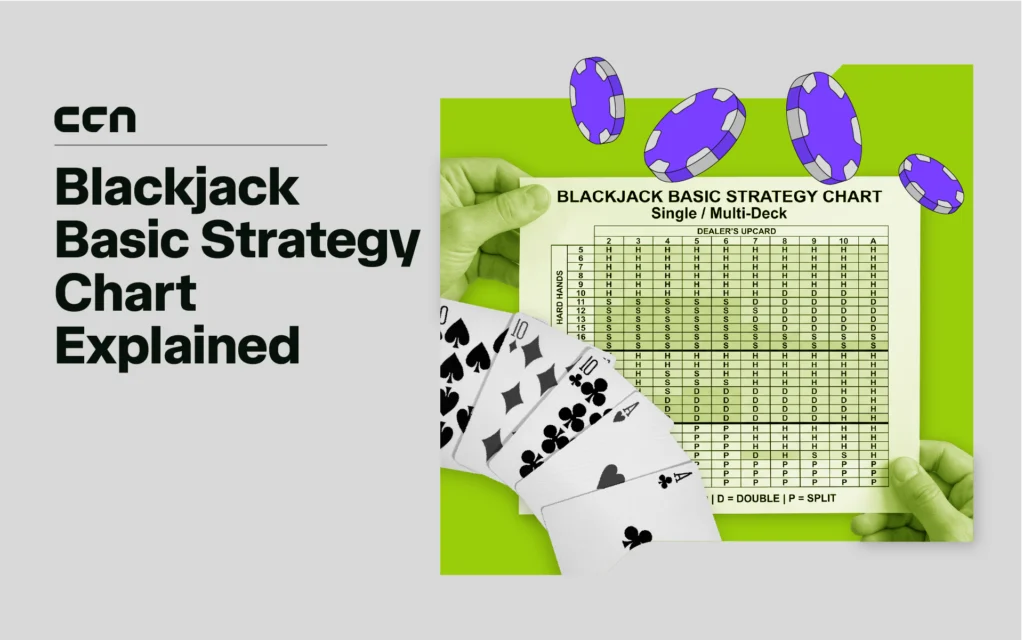
Following a blackjack basic strategy chart ensures you’ll benefit from the game’s low house edge. Our chart tells you the mathematically optimal way to play every hand. You’ll learn when to hit, stand, double down, or split, so you’re not simply relying on gut instinct.
We’ll explain how the blackjack basic strategy chart works, and we’ll show you how to use it. If you follow this chart consistently, you’ll unlock blackjack’s high return to player (RTP) rate.
What Is Blackjack Basic Strategy?
Basic strategy is the mathematically optimal way to play every hand you can be dealt at the blackjack table. These rules are derived from simulating millions of blackjack hands, and they tell you precisely how to act in each situation.
Optimal blackjack play is determined by:
- Your starting hand. The two cards you’re dealt.
- The dealer’s upcard. The card that the dealer is showing, as the other card is dealt face-down.
For each possible combination, the math identifies the play with the best expected return. Blackjack basic strategy doesn’t guarantee success, but it does maximize your chances of winning.
Blackjack has a house edge of around 0.5%, which is much lower than the edge on most other online casino games. However, that famously low house edge is conditional. You’ll only benefit from it if you play perfectly. If you deviate from optimal blackjack play, the house edge can increase to 2% or more.
Basic strategy doesn’t involve card counting, memorizing dealt cards, or varying your bets. It’s simply the right answer to every situation the game can present, worked out in advance. Casinos are fine with you using it, and you can keep the chart open in another tab when playing online.
Three Types of Blackjack Hand
Every blackjack hand falls into one of three categories, and the chart is organized around them. Identifying your hand type is always step one.
- Hard totals. A hard hand contains no ace, or an ace that’s forced to count as 1. A 10 and a 7 is a hard 17, and so is a queen, a 6, and an ace. Hard hands have no flexibility – if you draw too high a card, you’ll go bust – so the chart plays them more cautiously.
- Soft totals. A soft hand contains an ace counted as 11. An ace and a 6 is a soft 17. You can’t bust a soft hand with one hit, because the ace simply drops to 1 if needed. That safety net is why the chart hits and doubles soft hands far more aggressively than hard ones.
- Pairs. When your first two cards match, you have the option to split them into two hands. The chart tells you when splitting is worth it.
Blackjack Basic Strategy Chart
This chart explains the best way to play every blackjack hand. You’ll see that it generally depends on what the dealer is showing.
We’ve broken our blackjack basic strategy chart down into the three types of hands mentioned above: pairs, hands involving an ace, and hands that don’t feature an ace. You can reference this chart whenever you play blackjack online.
| Hard Totals |
How to Play the Hand |
| 8 or less |
Always hit. |
| 9 |
Double down if the dealer is showing 3-6, hit if the dealer has 7 or higher. |
| 10 |
Double down if the dealer’s showing 2-9, otherwise, hit. |
| 11 |
Always double down. |
| 12 |
Stand if the dealer’s upcard is 4-6, otherwise hit. |
| 13-16 |
Stand if the dealer is showing 2-6, otherwise hit. |
| 17 or more |
Always stand. |
| Soft Totals |
How to Play the Hand |
| A, 2 or A, 3 |
Double down if the dealer has 5-6, otherwise hit. |
| A, 4 or A, 5 |
Double down if the dealer’s upcard is 4-6, otherwise, hit. |
| A, 6 |
Double down if the dealer is showing 3-6, otherwise, hit. |
| A, 7 |
Double down if the dealer’s upcard is 3-6, stand if the dealer has 2, 7, or 8, otherwise, hit. |
| A, 8 or A, 9 |
Always stand. |
| Pairs |
How to Play the Hand |
| Aces |
Always split. |
| 2s or 3s |
Split if the dealer shows 2-7. |
| 4s |
Split if the dealer has 5-6. |
| 5s |
Never split. |
| 6s |
Split if the dealer has 2-6. |
| 7s |
Split if the dealer has 2-7. |
| 8s |
Always split. |
| 9s |
Split if the dealer has 2, 3, 4, 5, 6, 8, or 9. |
| 10s or face cards |
Never split. |
The dealer’s weak upcards (4, 5, and 6) trigger the most aggressive plays, including doubling down, splitting, and standing on low totals. That’s because the dealer is most likely to bust from those positions. If the dealer has a strong upcard (7 or higher), the chart plays it straighter: you’ll mostly hit until you have a competitive total.
Basic Strategy: Key Rules
If the full chart feels like a lot to take in, these core rules cover the decisions that matter most:
- Always stand on hard 17 or more.
- Always double down on 11, and double down on 10 unless the dealer shows a 10, jack, queen, king, or ace.
- Always split aces and 8s, and never split 5s or 10s.
- Stand on 13-16 against a dealer 2-6, and stand on 12 against a dealer 4-6. Hit on 12-16 against 7 or higher.
- Hit soft hands aggressively – a soft 17 or lower is never a stand.
- Never take insurance.
If you memorize those key rules, you’ll end up playing better blackjack than most people at the table. Following the chart helps you navigate the finer edges.
Surrender and Insurance
Some tables offer late surrender, which lets you fold your hand after the deal and reclaim half your bet. Used correctly, it’s a genuine edge-saver, but the correct spots are rare:
- Surrender hard 16 (but not a pair of 8s) against a dealer 9, 10, or ace.
- Surrender hard 15 against a dealer 10.
- Avoid surrendering in any other situations.
Insurance is a different story. It’s offered whenever the dealer shows an ace, and it’s essentially a side bet on whether they have blackjack. The payout never justifies the true odds, so basic strategy players always decline insurance.
Does the Chart Change with the Rules?
The chart above assumes you’re playing a standard online blackjack game. That means the game will feature multiple decks, the dealer has to stand on soft 17, and doubling after splitting is allowed. A handful of plays shift when those rules change, so it’s worth checking the table rules before you sit down.
The biggest variable is the dealer’s soft 17. At tables where the dealer hits soft 17, a few plays get more aggressive: you’d double down on 11 against a dealer’s ace, and you’d also double a soft 19 (ace and 8) against a dealer’s 6.
Doubling after splitting matters too. If the table doesn’t allow it, you split small pairs less freely: 2s and 3s are only split against a dealer 4-7, while you split 6s against 3-6, and you never split 4s.
It’s also beneficial to be more aggressive on certain hands if you’re playing single deck blackjack at the best crypto casinos. In that case, you’d double down on 11 against a dealer ace, double 9 against a 2, and even double hard 8 against a 5 or 6.
None of these adjustments are worth agonizing over as a beginner. Consistently following the standard blackjack basic strategy chart will always vastly outperform intuition, regardless of the specific table rules.
Basic Strategy Myths
Following a few costly myths can lead you to deviate from the chart. Avoid falling into these traps:
- “I’m due a win.” Every hand is independent, so past results have no bearing on future hands. Losing three in a row doesn’t alter your chances of winning the fourth hand, so don’t play more aggressively if you think you’re due a win.
- “Bad players hurt the table.” Another player’s decisions don’t affect your odds. The card order is random, so don’t worry about what the other players are doing.
- “Mimic the dealer to win.” The dealer must follow fixed rules (hitting on 16 or less, standing on 17 or more), but following them won’t help you win. You act first, so simply mimicking the dealer isn’t the optimal way to play.
- “The chart guarantees profit.” Basic strategy minimizes the house edge, but it can’t eliminate it. You’re simply playing the best possible game.
Conclusion
Following blackjack basic strategy is crucial if you want to unlock the game’s high RTP. Keep the chart handy and consult it on every hand while you’re learning the ropes. You’ll eventually memorize the optimal way to play each hand, so you won’t need to check the chart during each session.
FAQs
Yes, basic blackjack strategy ensures you benefit from the game’s high return to player (RTP) rate. It doesn’t remove the house edge or guarantee a profit, but it maximizes your chances of winning. Basic blackjack strategy tells you when to hit, stand, split, and double down, which lowers the casino’s mathematical advantage.
Blackjack has a house edge of around 0.5% if you use basic strategy. The precise house edge varies depending on the number of decks used and the game rules. One game, Single Deck Desperado Blackjack, has a 0.04% house edge, while other games have an edge of more than 1%.
You should always follow the blackjack strategy chart if you want to benefit from the game’s low house edge. If you deviate from the chart, the house edge will be higher. You’re free to ignore the chart on certain hands, but that’s not the optimal way to play blackjack.
Yes, blackjack basic strategy is legal at casinos. They have no problem with you making the best mathematical decision on each hand, as the house still retains a slim edge. What they don’t like is card counting, as that can swing the edge in your favor, so they take steps to stop experienced players from counting cards.

Ilija is a CCN writer with 7 years of experience covering all things crypto. Ever since a fateful run-in with Litecoin in 2013, he's been an avid investor and writer in the space. When he's not maniacally hacking away at his keyboard, Ilija spends his time either hiking in nature or holed up in his apartment gaming.


 Easy
Easy