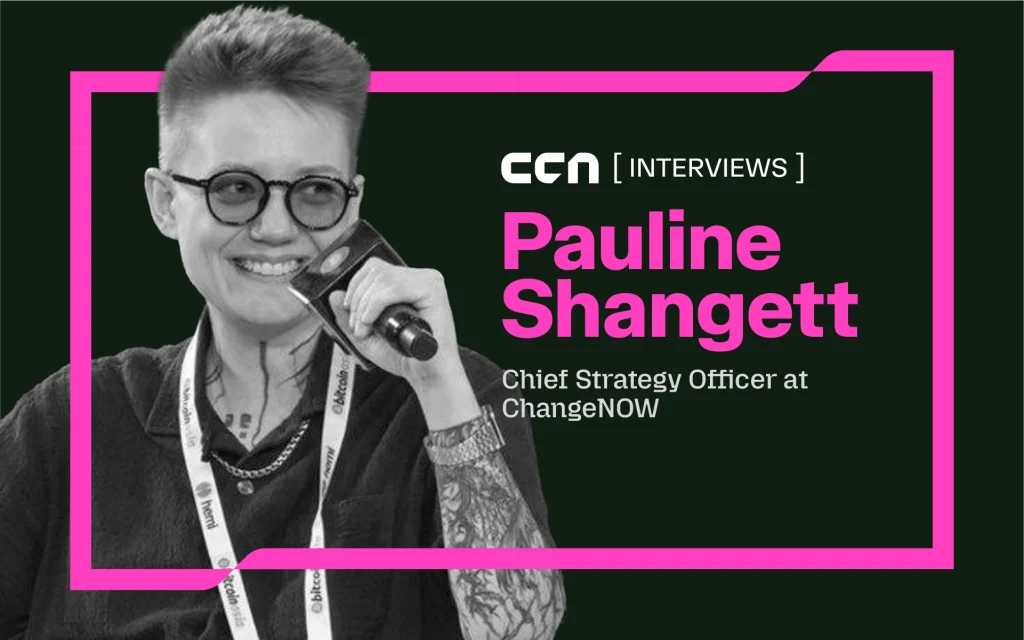
The platform’s Chief Strategy Officer sat down with CCN at Consensus Miami to talk limit orders, privacy, and the $100 million ChangeNOW has returned to hack and drain victims this year alone.
By Samuel Burke, Chief Content Officer, CCN
Most executives at crypto platforms processing over $1 billion in monthly volume arrive at the job through trading desks, venture firms, or engineering teams. Pauline Shangett arrived through a linguistics graduate program.
The path matters because it shaped everything about how ChangeNOW’s Chief Strategy Officer thinks about product design and its value to users. Instead of forcing users to navigate fragmented DeFi protocols or complex order books, Shangett’s focus is on the long-term retail investor—someone who demands institutional-grade security, speed, and a frictionless experience without the overhead of managing infrastructure risks.
“Centralized exchanges are way too complicated for the average user,” Shangett said on the floor at Consensus Miami — the annual gathering that drew more than 15,000 attendees to a city that has made crypto central to its economic identity. “Decentralized exchanges are way too unreliable for the average user. So we take all of the risks connected to user error, protocol corruption, hacks — and we put them upon ourselves, so that our clients can have a streamlined interface.”
That philosophy, held consistently since Shangett joined the company in 2018, now underpins a platform processing more than $1 billion in monthly volume without ever taking custody of user funds. She’s grown with the company, multiple C-Suite roles, and now, as CSO, she sets the product and brand direction for a platform that has quietly grown from a swap tool into one of the non-custodial sector’s most expansive ecosystems.
The Space Between Coinbase and Chaos
ChangeNOW operates in a gap most crypto users feel but few can articulate. It is neither a centralized exchange like Coinbase nor a decentralized protocol like Uniswap. It routes between them — acting, in Shangett’s words, as “a middleman between Uniswap or Coinbase or Binance or Raydium,” so that users never have to navigate those platforms directly.
The appeal is architectural. Centralized exchanges, she argues, are too complicated for everyday users. Decentralized exchanges are too unreliable. ChangeNOW absorbs the friction — user error, protocol risk, interface complexity — and presents a deliberately streamlined, high-efficiency interface in its place.
“Sometimes somebody needs to hop in, hop out, they need to do it very quickly,” Shangett said. “For example, they need gas for a transaction to top up their crypto card. Or they are already stressed by the amount of money they’re planning to exchange, so they don’t need any additional stress.”
The platform has also threaded itself through the wallets where many users already live — Tangem, Trezor, Exodus, Edge, Bitcoin.com — so that swaps happen without ever leaving the wallet interface. “I think that’s pretty cool,” Shangett said, with the matter-of-fact confidence of someone who helped build it.
Building the Ecosystem, Feature by Feature
What started as a swap tool has grown into something considerably more ambitious. ChangeNOW now offers a wallet, a business API, perpetual contracts, prediction markets, and — just launched — limit orders, which let users set a target price and have the swap execute automatically when the market hits it.
None of this was entirely planned. Shangett is candid about that.
“I would say it’s rather the latter,” she said when asked whether the full ecosystem was always the vision or whether the market pushed the company there. “We listen to the feedback of our users. We listen to what the market is interested in at the moment. Most of our product strategy actually comes from there.”
The limit orders feature, long requested by users, she frames as “a long-awaited homecoming rather than us hiding our heads in the sand.” The company, she says, simply had higher priorities first.
Coming soon: an AI assistant embedded within the app, engineered specifically to provide users with high-fidelity, real-time insights during critical market moments. The system will draw on 14 separate databases, with hard-coded rules designed to minimize the model’s capacity to hallucinate. “It’s going to accompany the user at every step of the way,” Shangett said, “not giving investment advice, but providing all the necessary information so that the client can make decisions without ever leaving the interface.”
The Privacy Problem
The launch of PrivateSend — a feature that shields a sender’s wallet address from recipients — arrives at a fraught moment for crypto privacy tools. Tornado Cash’s sanctions were lifted in March 2025, but the criminal case against its founders continues. Seventy-three exchanges delisted privacy coins last year, a 43% increase from 2023.
Shangett is deliberate in her framing. PrivateSend, she insists, is not a mixer and was never designed to be one.
“All of our transactions that come through private transfers are still subject to the same AML rules and regulations that all other transactions on ChangeNOW are subject to,” she said. “It’s just a way for people to hide their original wallet address and not expose it to the people they want to send money to.”
The use cases she invokes are mundane: not wanting to reveal a wallet balance, not wanting a transaction history visible to a counterparty. “If you try to privately send stolen money through us, your transaction data — not personal data, and I think this is important — is still going to be recorded by us,” she said. “If law enforcement comes by, we’re still going to follow all of the due process.”
That cooperation with law enforcement, she notes, is measurable. From January through May of this year alone, ChangeNOW has helped intercept and recover nearly $100 million in stolen funds from hacks and drains.
“We very happily collaborate with law enforcement and other regulatory authorities,” Shangett said. “But harvesting user data is not our goal. We definitely do not need to keep your money without a reason. That doesn’t make any sense for us. It’s not our business.”
The RWA Bet She Fought For
The real-world asset market — tokenized stocks, bonds, commodities — grew 420% in the opening months of 2025, ballooning from $5.8 billion to over $30 billion, with BlackRock and Fidelity among those driving the charge. Most tokenized assets, however, still live in permissioned, walled-garden environments far from open DeFi.
Shangett’s conviction on RWAs preceded the rest of ChangeNOW’s team, by her account. “I fought like a lion to actually get that implemented,” she said. “For the longest time, I was completely obsessed with it. And I can say that I finally won.”
Her argument is not philosophical — it’s structural. Traditional markets are inaccessible to large swaths of the global retail population due to geographic constraints, minimum balance requirements, and compliance hurdles. Tokenization removes those barriers. “RWAs are a very sharp way to democratize traditional asset classes to retail,” she said. “I think it’s a very big thing.”
The platform’s near-term focus within RWAs is on stocks and commodities — the most familiar asset classes for users new to tokenization. Private credit, bonds, and equity are planned for later phases. “We need to ease our user base into TradFi assets and ease the Web2 crowd into the Web3 side of things,” Shangett said. “I do feel it’s important we go slow.”
Moving Away From DeFi, Toward Investors
The most pointed thing Shangett said at Consensus Miami may also be the most strategically revealing: ChangeNOW is intentionally moving away from DeFi.
Not out of ideology. Out of business logic.
“We are leaving trading — on centralized exchanges, on aggregators, bridges, and decentralized exchanges — to professional traders, because they are adapted to them,” she said. “Our position is that we service not retail traders, but retail investors.”
The distinction matters. Traders need speed, depth, and leverage tools. Investors need simplicity, safety, and a way to build positions over time without a PhD in wallet security. As DeFi proliferates, Shangett believes that second group will need more and more support navigating it. ChangeNOW wants to be the platform that provides it.
“It’s a purely business, purely utility perspective,” she clarified, when pressed on whether this was a principled stance against decentralization. “I’m not talking about philosophy.”

With over half a decade of experience commentating on the cryptocurrency market and even more as a trader and investor, Jay has developed a robust knowledge base that enables him to dive deep into the inner workings of crypto platforms and the broader market to deliver unique, user-focused insight.
Jay's work has spanned public relations firms, crypto projects, affiliate sites, and news outlets.


 Easy
Easy