"The amount of humanitarian suffering in the world right now is astronomical". Can blockchain help? | Image credit: CCN
Share
Humanitarian aid systems often struggle with trust, slow delivery, and weak accountability. Donors want proof. Beneficiaries need speed, safety, and dignity.
Governments add layers of sanctions compliance, reporting requirements, and political pressure.
Field teams still operate in places where internet access is limited, literacy rates remain low, and banking infrastructure is scarce.
Blockchain promised solutions for more than a decade. Many pilots did not scale. Many projects focused on technology first and real-world systems second.
That gap has fueled skepticism, especially from aid professionals who have seen “innovations” arrive with big claims and small results.
In this CCN interview, Dr. Lorena Nessi speaks with Nigel Pont, Senior Advisor for Humanitarian Affairs at HesabPay and the Algorand Foundation, and Matt Keller, Director of Impact and Inclusion at the Algorand Foundation.
The conversation examines where blockchain already functions in humanitarian payment systems, where its limits remain, and which ethical questions are still unresolved.
It focuses on live deployments in Afghanistan and Syria, where HesabPay uses blockchain infrastructure to support aid distribution, improve fund traceability, and coordinate payments without placing sensitive personal data on-chain.
Watch the full interview here:
Why Humanitarian Aid Keeps Running Into the Same Bottlenecks
At the start of the interview, Nessi frames the central tension in humanitarian tech. Aid systems need trust, speed, and accountability, but reforms often land unevenly. Keller and Pont argue that cash delivery, even when it helps people quickly, creates predictable risks and recurring inefficiencies.
Pont explains why cash assistance sits at the center of modern humanitarian thinking.
“In the humanitarian sector, there’s a recognition now that where markets work, cash is the best form of humanitarian assistance,” Pont said.
Pont adds that cash preserves dignity because it gives people choice. It also reduces waste because recipients can prioritize what matters most for their own household. Yet the delivery method matters, especially in conflict zones and sanctioned jurisdictions.
Aid distribution has historically relied on physical cash, informal networks, and mobile money systems that vary by country. Those tools can help, but they also create choke points, long lines, and safety risks.
When recipients must travel to predictable locations to pick up cash, bad actors can target them. When agencies rely on slow banking rails, families wait longer. When donors cannot verify where funds ended up, public trust erodes.
Keller argues that skepticism about the aid sector has become a political force.
“Almost exactly a year ago, USAID, which accounted for something like 30 to 40% of the world’s aid, was decimated,” Keller said.
He adds that corruption narratives played a major role in the justification, whether or not the public claims matched the reality on the ground.
His point is blunt: aid systems now face both operational strain and reputational strain. Any tool that improves traceability and confidence has growing strategic value.
The Afghanistan Case: 150,000 Wallets and $30 Million in Aid
Keller links the Algorand Foundation’s role to a real use case: HesabPay in Afghanistan.
“A few years ago, we really kind of backed a company in Afghanistan called HesabPay,” Keller said.
He explains the original problem: getting value from donors to end beneficiaries in distressed environments where the system “was broken.”
Pont then describes what HesabPay built, and what changed.
“In the last 12 months, we’ve opened over 150,000 wallets for 150,000 families, and they’ve received more than $30 million of aid,” Pont said.
Pont explains that the aid arrived as “an Afghani stablecoin, a local token, it’s minted on Algorand.”
He also notes that many recipients had never used any financial account before.
For a humanitarian payment system, that detail changes everything. A product cannot assume prior banking experience. It cannot assume smartphone ownership, stable connectivity, or high literacy. It cannot assume trust in institutions.
Pont says HesabPay responded by simplifying the product for “low literacy, low financial literacy and low bandwidth environments.”
That design philosophy drives the on-the-ground usability, even when the underlying system involves blockchain settlement.
Recipients can receive aid on-chain and then choose how to use it. Pont describes two common options: cashing out into local fiat currency, or buying goods and services through merchant acceptance networks.
In practice, that approach aims to reduce queue-based distribution, cut predictable risk patterns, and shorten the time between donor funding and household use.
Syria: USDC, Agent Networks, and a Different Operating Reality
Pont explains that Syria differs from Afghanistan. The system still focuses on payments, but the assets and rails change due to local constraints and practical liquidity.
“In Syria we’ve been ramping up for the last eight or nine months and we’re starting to get some traction there,” Pont said.
He adds that “it’s possible for us to use USDC,” and that “USDC is the main sort of token flowing through the system.”
Pont describes the operating model: aid organizations purchase USDC and then use the HesabPay platform to distribute payments to beneficiaries, vendors, and staff.
An agent network supports cash-out and local access, which matters in places where digital payments cannot cover every need.
The key difference: Syria’s regulatory environment remains unsettled, and the practical market infrastructure differs.
Keller describes Syria as “a case of first impression,” where regulations “don’t really exist yet” and remain “in the process of becoming.”
That uncertainty shapes compliance planning, banking relationships, and how organizations structure their flows.
What Algorand Actually Does in This System
Keller emphasizes that the Algorand Foundation’s role is not a marketing add-on. It provides investment support, ecosystem support, and technical infrastructure that helps a real payment system run.
“I’ll say the specific role of Algorand is to really invest and support the company HesabPay because we believe in the humanitarian nature of what they’re doing,” Keller said.
Pont frames the value proposition in terms of cross-border compliance and transparency.
“These two locations, Afghanistan and Syria, you they’re very complex jurisdictions with a lot of sanctions, money laundering, terrorist financing restrictions,” Pont said.
He argues that the aid sector needs a compliance system that can operate internationally while allowing donors, regulators, and the international community to verify outcomes. He also connects that need to one of the harshest critiques aimed at humanitarian institutions: weak transparency that undermines trust.
Pont explained that HesabPay aims to address trust gaps in humanitarian aid by ensuring that funds flow can be verified through public blockchain records.
Security and Safety: Does Digital Aid Reduce Harm?
A major concern in humanitarian payments is whether digitizing aid puts recipients at risk. Keller points to research that suggests the opposite.
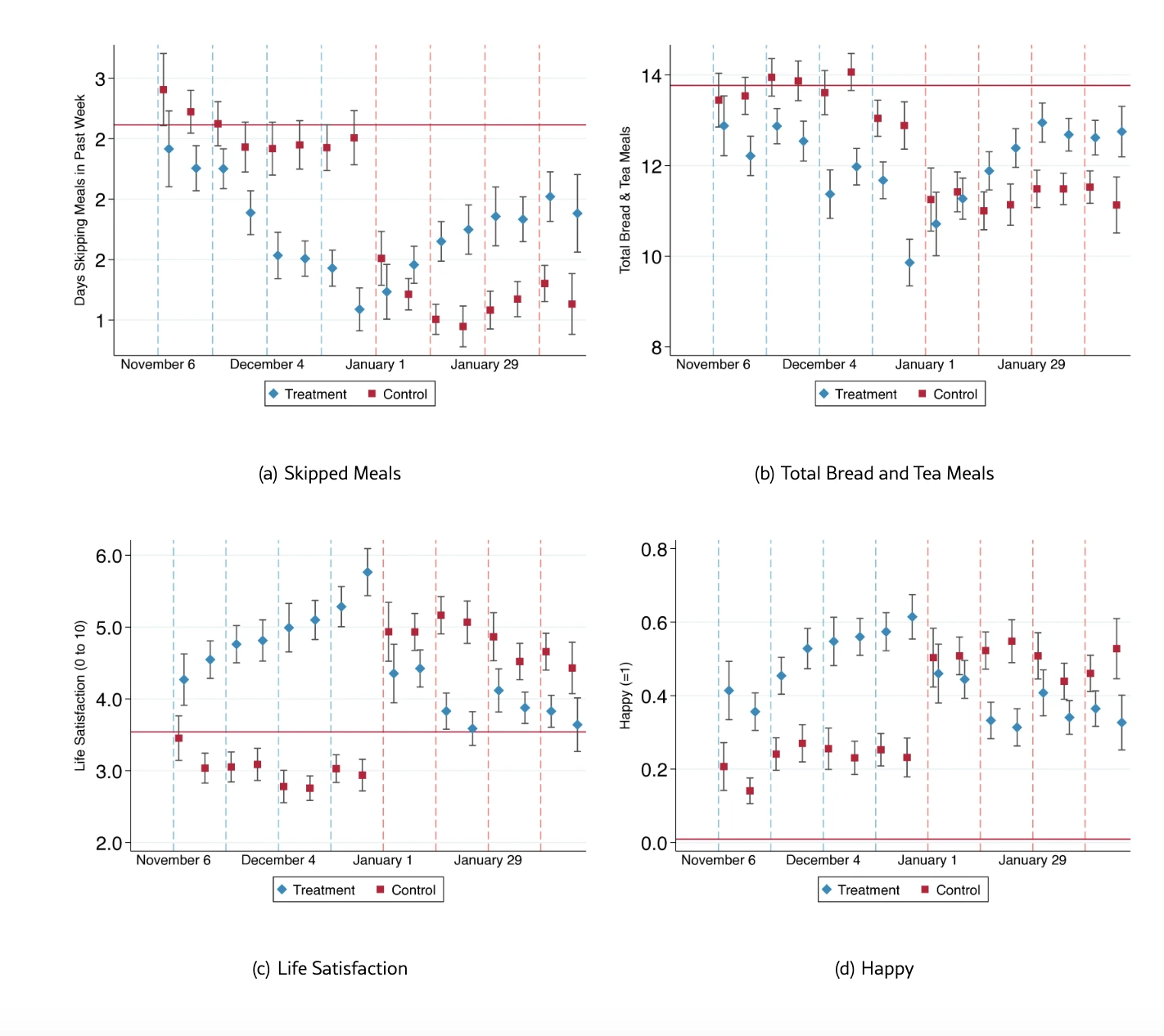
“I’ll point you to a London School of Economics study where they did a randomized trial with 2,500 women,” Keller said.
He adds, “It turns out there’s actually less risk.”
Keller explains the logic: digital value stored on a phone or wallet reduces the need to carry large amounts of cash, which can turn recipients into targets.
He also ties digital delivery to agency, especially for women, by allowing recipients to decide how to spend funds.
Research study data | Source: Arxiv
Pont reinforces the operational safety gains. He explains that digital delivery reduces the need for people to queue for hours in a predictable location. Instead, recipients receive a message that funds arrived and then visit any one of many locations at a time of their choosing.
Pont said the approach significantly lowers risk, even though it does not remove it entirely, making aid delivery safer overall.
Privacy: What Should Never Go On-Chain
Transparency does not require exposure of personal identities. Pont addresses the data question directly when Nessi asks what should never be recorded on-chain.
“We don’t write any PII (personally identifiable information) or DII (demographically identifiable information) to the chain,” Pont said.
He adds that “there’s no way of associating a public wallet with a person’s PII or DII from what’s on-chain.”
Pont also acknowledges a broader public debate: many people do not want a world where anyone can view their full transaction history.
Yet he argues that aid funds occupy a special category because they involve public or charitable money, where donors demand verifiable accountability.
HesabPay’s approach attempts to balance both: keep identity data off-chain, while using public settlement rails to prove that funds moved where they should.
Aid Trust Portal: Transparency Without a Block Explorer Learning Curve
Pont introduces a tool designed to make on-chain transparency useful for real organizations.
“We’ve built a platform called the Aid Trust Portal,” Pont said.
He explains how it works: aid organizations can upload the public keys for wallets involved in a project, including recipients, vendors, agents, merchants, and the organization’s own wallets.
The portal then visualizes flows of funds in real time using blockchain data.
Pont argues that typical block explorers do not offer intuitive interfaces for understanding relationships across large numbers of wallets. The portal aims to turn raw transaction data into operational visibility.
Keller connects this to the broader public trust issue. If donors question where money went, real-time verifiable tools give aid organizations a stronger answer, with fewer intermediaries and fewer opaque steps.
Designing for Low Literacy, Low Bandwidth, and Feature Phones
Pont explains that HesabPay tries to “abstract away the blockchain complexities” to make the system usable for disadvantaged communities. He stresses that many recipients never had a bank account. Some have smartphones, some have feature phones, and some have no reliable connectivity.
HesabPay uses custodial solutions in many contexts to help manage keys. Pont describes physical QR code cards that allow users to access accounts without needing a smartphone.
He also describes a feature designed for illiteracy: audio confirmation in local language during cash-out approvals.
“The phone now speaks to the user,” Pont said, and it states in local language what transaction is being requested, so users can understand even if they cannot read the screen.
Keller adds context: Afghanistan has one of the highest illiteracy rates in the world, “particularly amongst women,” Pont notes.
That reality turns product design into a humanitarian constraint. A solution that works only for digitally fluent users will not reach the populations most in need.
Regulation: Working With Local Authorities After Crypto Bans
Pont gives a specific example of regulatory risk.
“In Afghanistan, crypto per se is banned,” Pont said.
He describes how HesabPay engaged the regulator and clarified that the system operates as a regulated electronic money institution.
“We’re creating e-money,” Pont said. “It happens to be tokens on a blockchain.”
He stresses that the system does not rely on exchange-traded speculative tokens and does not offer yield-bearing instruments, which also matters for local legal constraints and Sharia compliance.
Pont also explains that regulation is complex at both ends of the pipeline. On the sending side, moving funds from Western jurisdictions into Syria or Afghanistan raises compliance questions. On the receiving side, local rules shift, enforcement varies, and humanitarian operations require case-by-case negotiation.
Stablecoin Aid, Digital Identity, Offline Tools, and Smart Contracts: How the Future Looks
Keller frames the future direction through the Humanitarian Payments Council, which brings together an “eclectic mix” of organizations, including Visa, Mastercard, and major U.N. agencies. He argues the trajectory points to stablecoins becoming a standard tool for cash-based assistance.
“We can see that the puck is headed toward a place where digital payments to beneficiaries in the form of stablecoins is going to be what the future is all about,” Keller said.
Pont outlines two problems he expects the sector must solve next: identity and offline functionality.
Pont raised the question of how know-your-customer (KYC) requirements can apply to people who lack formal identity documents.
He also points to weak internet access in the most distressed jurisdictions, arguing that future systems must function offline, potentially with biometric identity layers.
He mentions collaboration with Paycode, focusing on decentralized identity biometrics and offline capability.
Then, Pont then adds a third frontier: smart contracts for conditional aid and parametric insurance tied to disaster triggers like rainfall data, drought indicators, earthquakes, or other measurable events.
He expects scaling in the next five to 10 years, especially for remote farmers and herders.
Keller expands the disaster relief angle beyond conflict zones. He describes U.S. disaster response as slow, bureaucratic, and paper-based.
He links that to an initiative called the care survivor wallet, designed to streamline access to assistance after hurricanes, floods, tornadoes, and other disasters that grow in frequency and intensity.
AI in Humanitarian Payments: Needs Assessment and Agents
In the final part of the interview, Nessi asks about AI’s role. Pont describes two areas where AI and machine learning can shape aid delivery.
First, agents may automate parts of payment operations, though he says nobody knows the full shape yet.
Second, rapid needs assessments already use satellite imagery and mobile data.
Pont points to organizations like GiveDirectly using these methods to evaluate damage, such as roof conditions after hurricanes, then connect household needs to payout mechanisms.
He argues that AI-driven assessments combined with blockchain payment rails could speed up the time from crisis to cash delivery.
Limits, Scale, and What Blockchain Can and Cannot Fix
In his closing remarks, Keller framed the work as an example of technology addressing an existing operational gap rather than a forced experiment.
“I think this is a real case of technology meeting a real need,” Keller said.
Pont closed by pointing to the scale of the humanitarian crisis and the reality of shrinking aid budgets.
“The amount of humanitarian suffering in the world right now is astronomical,” Pont said.
He added that blockchain cannot increase global aid funding on its own, but it can strengthen trust and operational efficiency, allowing available resources to reach intended recipients more effectively while donor confidence increases.
Disclaimer:
The information provided in this article is for informational purposes only. It is not intended to be, nor should it be construed as, financial advice. We do not make any warranties regarding the completeness, reliability, or accuracy of this information. All investments involve risk, and past performance does not guarantee future results. We recommend consulting a financial advisor before making any investment decisions.
Dr. Lorena Nessi is an award-winning journalist and media technology expert with 15 years of experience in digital culture and communication. Based in Oxfordshire, UK, she combines academic insight with hands-on media practice.
She holds a PhD in Communication, Sociology, and Digital Cultures, and an MA in Globalization, Identity, and Technology.
Lorena has taught at Fairleigh Dickinson University, Nottingham Trent University, and the University of Oxford. She is a former producer for the BBC in London, with additional experience creating television content in Mexico and Japan.
Her research focuses on digital cultures, social media, technology, capitalism, and the societal impact of blockchain innovation.
She has written extensively on digital media and emerging technologies, with her work featured in both academic and media platforms. Her Web3 expertise explores how blockchain technologies shape culture, economics, and decentralized systems.
Outside of work, Lorena enjoys reading science fiction, playing strategic board games, traveling, and chasing adventures that get her heart racing. A perfect day ends with a relaxing spa and a good family meal.


 Easy
Easy