We’ve assembled a team of trading veterans to test the top exchanges using objective metrics, including spot trading pair availability, fees, order book depth, and more.
In this guide, we’ll be looking at the results of our testing, as well as what factors you should think about when choosing the right spot crypto trading platform for you.
Key Takeaways:
Spot trading crypto means buying or selling a token at its current price with instant settlement. Unlike derivatives like futures, it gives you ownership of the underlying token.
Spot trading is significantly safer and less complex than trading derivatives, making it more popular among beginners and risk-conscious traders.
A large number of spot trading pairs makes it easier to get into new tokens and pivot your portfolio based on market trends.
Execution speed can make a big difference in volatile markets or when using crypto trading bots.
Deep, liquid order books are crucial to maximizing speed and capital efficiency when spot trading crypto.
Best Crypto Spot Trading Platforms in 2026 are:
Disclosure
We sometimes use affiliate links in our content, when clicking on those we might receive a commission at no extra cost to you. By using this website you agree to our terms and conditions and privacy policy.
ChangeNow is one of the best hybrid crypto exchanges out there. While offering crypto custodial services, users also enjoy some other decentralized exchange features, like dApps integration. Here, you can swap, buy, sell, and enjoy others services like Now payments, Now Nodes, a white label wallet that allows you launch your own non-custodial wallet, a telegram bot, a widget, a tracker, and a native token. It's centralized nature comes in the fact that you can buy and sell crypto with lots of fiat payment methods and currencies, so it is a full package.
Promotions
Experience A 1-minute Swap On A Non-custodial Platform.
Fees (Maker/Taker)
$0 Per Month, $15 Per Month, $100 Per Month
Products
Trade, Spot Trading, OTC Trading+7
Trade
spot trading
OTC trading
peer to peer
day trading
Earn/stake
pay
loans
NFTs
wallet
Cryptocurrencies
Bitcoin, Ethereum, Tether+219
Bitcoin
Ethereum
Tether
Build'N'Build
USD Coin
Solana
Ripple
Dogecoin
Cardano
Toncoin
Shiba Inu
Avalanche
TRON
Chainlink
Polkadot
Polygon Matic
Wrapped Bitcoin
Litecoin
Dai
NEAR Protocol
Bitcoin Cash
Monero
Stellar
Cosmos
Filecoin
Ethereum Classic
Aptos
Hedera Hashgraph
Immutable
Optimism
Arbitrum
VeChain
The Sandbox
Decentraland
Axie Infinity
Injective Protocol
Render Token
The Graph
Maker
Aave
Chiliz
Helium
PAX Gold
Compound
Lido DAO Token
THORChain
Stacks
Arweave
Sui
Conflux Network
Lido Staked ETH
Bitget Token
Wrapped Ethereum
OKB
Uniswap
Pepe
Ondo
Mantle
First Digital USD
Bittensor
Kaspa
Celestia
XDC Network
Artificial Superintelligence Alliance
Jupiter
Quant
Worldcoin
PayPal USD
Bonk
Flare
Tether Gold
Sei
JITO
JasmyCoin
PancakeSwap
Core
Floki Inu
Ethereum Name Service
SushiSwap
Kava.io
1inch Network
Tezos
Algorand
Flow
Trust Wallet Token
Curve DAO Token
KuCoin Token
MultiversX
Gitcoin
Zcash
IOTA
Basic Attention Token
Frax
Ethena
Ethena USDe
Fasttoken
Pi Network
SATS
Adventure Gold
Audius
Alchemy Pay
Arkham
API3
Bounce Token
Altlayer
Aergo
Amp
Aevo
ARPA Chain
Astar
Ark
Ankr
AirSwap
Alpaca Finance
Blur
Badger DAO
Bancor
BakeryToken
Biconomy
Chromia
Celer Network
Celo
Shentu
Civic
Convex Finance
Cartesi
Cyber
COTI
DigiByte
DIA
ether.fi
FUNToken
FLUX
Firo
Ampleforth
Golem
GMX
Gnosis
Moonbeam
Holo
IoTex
ICON
Illuvium
JUST
Kadena
Liquity
Livepeer
Lisk
Memecoin
Manta Network
Treasure
Mask Network
MetisDAO
Origin Protocol
ORDI
Ontology
Osmosis
Powerledger
Phala Network
Pendle
Portal
Pyth Network
ConstitutionDAO
Polkastarter
Quickswap Old
Qtum
iExec RLC
Rocket Pool
Reserve Rights
Ronin
Ravencoin
Starknet
Storj
Status
Spell Token
Sun (New)
SuperVerse
Toko Token
Theta Fuel
Tellor
Tensor
LayerZero
Usual
Eigenlayer
Hamster Kombat
Neiro - First Neiro on Ethereum
Catizen
Berachain
KAITO
Pudgy Penguins
Solayer
Bio Protocol
ChainGPT
Cookie DAO
Solv Protocol
Alchemix
Bitcoin SV
Movement
DeXe
Binance Staked SOL
Nexo
Wrapped eETH
Hyperliquid
Casper
Zilliqa
Secret
Nervos Network
TrueUSD
BitTorrent
Mina
Dash
STEPN
Gemini Dollar
UNUS SED LEO
Synthetix
APEcoin
Gala
Theta Network
Fantom
Cronos
Internet Computer
Binance USD
Payment Methods
Bank Transfer, Bank Wire Transfer, SEPA (Single Euro Payments Area)+230
Bank transfer
Bank Wire Transfer
SEPA (Single Euro Payments Area)
ACH (Automated Clearing House)
Visa
MasterCard
Apple Pay
Google Pay
PIX
FPS (Faster Payments Service)
Revolut
Bitcoin
Ethereum
Tether
Build'N'Build
USD Coin
Solana
XRP
Dogecoin
Cardano
Toncoin
Shiba Inu
Avalanche
TRON
Chainlink
Polygon
Polkadot
Wrapped Bitcoin
Litecoin
Dai
NEAR Protocol
Bitcoin Cash
Monero
Stellar
Cosmos
Filecoin
Ethereum Classic
Aptos
Hedera Hashgraph
Immutable
Optimism
Arbitrum
VeChain
The Sandbox
Decentraland
Axie Infinity
Injective Protocol
Render Token
The Graph
Maker
Aave
Chiliz
Helium
PAX Gold
Compound
Lido DAO Token
THORChain
Stacks
Arweave
Sui
Conflux Network
Lido Staked ETH
Bitget Token
Wrapped Ethereum
OKB
Uniswap
Pepe
Ondo
Mantle
First Digital USD
Bittensor
Kaspa
Celestia
XDC Network
Artificial Superintelligence Alliance
Jupiter
Quant
Worldcoin
PayPal USD
Bonk
Flare
Tether Gold
Sei
JITO
JasmyCoin
PancakeSwap
Core
FLOKI
Ethereum Name Service
SushiSwap
Kava.io
1inch Network
Tezos
Algorand
Flow
Trust Wallet Token
Curve DAO Token
KuCoin Token
MultiversX
GateToken
Zcash
IOTA
Basic Attention Token
Frax
Ethena
Ethena USDe
Fasttoken
Pi Network
SATS
Adventure Gold
Audius
Alchemy Pay
Arkham
API3
Bounce Token
Altlayer
Aergo
Amp
Aevo
ARPA Chain
Astar
Ark
Ankr
AirSwap
Alpaca Finance
Blur
Badger DAO
Bancor
BakeryToken
Biconomy
Chromia
Celer Network
Celo
Shentu
Civic
Convex Finance
Cartesi
Cyber
COTI
DigiByte
DIA
ether.fi
FUNToken
FLUX
Firo
Ampleforth
Golem
GMX
Gnosis
Gitcoin
Moonbeam
Holo
IoTex
ICON
Illuvium
JUST
Kadena
Liquity
Livepeer
Lisk
Memecoin
Manta Network
Treasure
Mask Network
Metis
Origin Protocol
ORDI
Ontology
Osmosis
Powerledger
Phala Network
Pendle
Portal
Pyth Network
ConstitutionDAO
Polkastarter
Qtum
iExec RLC
Rocket Pool
Reserve Rights
Ronin
Ravencoin
Starknet
Storj
Status
Spell Token
SUN
SuperVerse
Toko Token
Theta Fuel
Tellor
Tensor
LayerZero
Usual
Eigenlayer
Hamster Kombat
Neiro - First Neiro On Ethereum
Catizen
Berachain
KAITO
Pudgy Penguins
Solayer
Bio Protocol
ChainGPT
Cookie DAO
Solv Protocol
Alchemix
Bitcoin SV
Movement
DeXe
Binance Staked SOL
Nexo
Wrapped eETH
Hyperliquid
Casper
Zilliqa
Secret
TrueUSD
BitTorrent
Mina
Dash
STEPN
Gemini Dollar
UNUS SED LEO
Synthetix
APEcoin
Gala
Theta Network
Fantom
Cronos
Internet Computer
Binance USD
QuickSwap (Old)
Languages
Azerbaijani, Catalan, Czech+55
Azerbaijani
Catalan
Czech
Danish
German
Estonian
English
Spanish
French
Hausa
Croatian
Indonesian
Italian
Swahili
Latvian
Lithuanian
Hungarian
Malay
Dutch
Norwegian
Uzbek
Filipino
Polish
Portuguese
Portuguese (Brazil)
Romanian
Slovenian
Slovak
Serbian
Finnish
Swedish
Vietnamese
Turkish
Zulu
Greek
Bulgarian
Kazakh
Russian
Tajik
Ukrainian
Georgian
Armenian
Hebrew
Urdu
Arabic
Farsi
Amharic
Hindi
Bengali
Sinhala
Thai
Lao
Burmese
Khmer
Korean
Japanese
Chinese (Simplified)
Chinese (Traditional)
Licenses
N/A
Security
256-Bit SSL Encryption, 2FA Google Authenticator, 2FA Authy
YouHodler Crypto Exchange, launched in Cyprus in 2018, stands as a versatile platform offering a plethora of crypto-fiat financial services including lending, trading, and savings accounts.
Promotions
Get Up To 10,000 USDT In Rewards When You Deposit And Trade!
Fees (Maker/Taker)
Deposit And Withdrawal Fees, Deposit And Withdrawal Fees, Loan Fees+1
Deposit and Withdrawal Fees
Deposit and Withdrawal Fees
Loan Fees
Conversion Fees
Products
Spot Trading, Day Trading, Earn/stake+3
spot trading
day trading
Earn/stake
loans
mining
wallet
Cryptocurrencies
Bitcoin, Ethereum, Tether+57
Bitcoin
Ethereum
Tether
Build'N'Build
Solana
Ripple
Dogecoin
Cardano
Toncoin
Shiba Inu
Avalanche
TRON
Chainlink
Polygon Ecosystem Token
Polkadot
Litecoin
NEAR Protocol
Bitcoin Cash
Stellar
Cosmos
Filecoin
Immutable
VeChain
The Sandbox
Decentraland
Axie Infinity
Injective Protocol
Render Token
The Graph
Aave
PAX Gold
Compound
Lido DAO Token
Stacks
Sui
Uniswap
Pepe
Ondo
Mantle
Artificial Superintelligence Alliance
Quant
Worldcoin
Bonk
Tether Gold
PancakeSwap
Floki Inu
SushiSwap
1inch Network
Tezos
Trust Wallet Token
MultiversX
Basic Attention Token
Ethena
USD Coin
Jupiter
JasmyCoin
Aptos
Optimism
Arbitrum
PayPal USD
Payment Methods
Bank Transfer, SEPA (Single Euro Payments Area), Bank Wire Transfer+68
Bank transfer
SEPA (Single Euro Payments Area)
Bank Wire Transfer
Visa
MasterCard
Maestro
Apple Pay
Google Pay
Skrill
Bitcoin
Ethereum
Tether
Build'N'Build
Solana
XRP
Dogecoin
Cardano
Toncoin
Shiba Inu
Avalanche
TRON
Chainlink
Polygon Ecosystem Token
Polkadot
Litecoin
NEAR Protocol
Bitcoin Cash
Stellar
Cosmos
Filecoin
Aptos
Immutable
Optimism
Arbitrum
VeChain
The Sandbox
Decentraland
Axie Infinity
Injective Protocol
Render Token
The Graph
Aave
PAX Gold
Compound
Lido DAO Token
Stacks
Sui
Uniswap
Pepe
Ondo
Mantle
Artificial Superintelligence Alliance
Quant
Worldcoin
Bonk
Tether Gold
PancakeSwap
Floki Inu
SushiSwap
1inch Network
Tezos
Flow
Trust Wallet Token
MultiversX
Basic Attention Token
Ethena
USD Coin
Jupiter
JasmyCoin
FPS (Faster Payments Service)
PayPal USD
Languages
English, French, Italian+3
English
French
Italian
Spanish
German
Portuguese
Licenses
Italy, Switzerland, European Gaming And Betting Association (EGBA)+2
Italy
Switzerland
European Gaming and Betting Association (EGBA)
Argentina
Spain
Security
2FA SMS, 2FA Authy, 2FA Google Authenticator+2
2FA SMS
2FA Authy
2FA Google Authenticator
256-Bit SSL Encryption
Anti-Phishing Code
KYC / AML
Required For Buying, Selling, Deposit And Withdrawals.
Established in 2011, Kraken is a trusted cryptocurrency exchange renowned for its longevity and diverse trading interfaces, catering to a broad user base.
Promotions
Get $10 In Bitcoin When You Register Through A Referral Link From An Existing Member.
Disclaimer: Investing in cryptocurrencies carries significant risk. Values are highly volatile. Never invest more than you can afford to lose. This site does not provide financial advice. Act based on your own research and consult with a financial professional before making decisions. Don’t invest unless you’re prepared to lose all the money you invest.
Affiliate disclosure: This website may contain affiliate links, which means we may earn a commission if you click on a product link and make a purchase/register.
Why Trust Us?
At the Crypto Citizens Network, we prioritize first-party testing and extensive research to show you an objective look at everything crypto.
Each of the hundreds of reviews and guides on our site is the result of a collaborative effort across teams. Our process starts with testers, who test tools using objective metrics before our writers cover the results. Finally, one or more editors look over each piece, ensuring transparency and full factual accuracy.
Spot crypto trading is a type of trading where you buy or sell a token with immediate settlement. For example, if you buy 1 Bitcoin on a spot trading platform, the BTC will be credited to your exchange account immediately. From there, you can buy, sell, or withdraw the Bitcoin to your wallet.
While most global crypto trading volume comes from derivatives, spot trading accounts for the majority of retail activity. This is because derivatives don’t give traders direct token ownership and introduce numerous complexities, such as funding rates, leverage, liquidation risk, and expiry dates, into the trading experience.
Spot trading is much easier to understand and master. On top of this, it generally carries significantly less intrinsic risk than leverage-based trading, making it ideal for beginners and risk-conscious traders.
How to Choose a Spot Crypto Exchange
There’s no one clear best spot for a crypto exchange out there. Instead of looking for a clear-cut objective, choose the one that aligns most with your needs. Let’s take a look at some of the factors you should consider when making this decision.
Trading Fees
Most crypto spot exchanges turn a profit by charging a fee per trade. For long-term HODL-ers and investors, fees are often a relatively low priority, but they make a large difference for active traders.
High fees can quickly eat into your profits, lowering your profit margin on winning trades and worsening losses.
However, finding the best low-fee exchange for you isn’t as simple as comparing the base rate. Most exchanges offer lower fees, cashback, and other incentives for high-volume traders or users holding their native token.
When comparing exchange fees, factor in these bonuses to estimate the actual fees you’ll pay at your expected activity level.
Order Book Depth & Liquidity
Order book depth and liquidity determine how quickly and effectively you can execute trades at a given price. This is especially important when placing large orders. In low-liquidity markets, placing a large trade can swing the asset price against you, costing you significant profits.
Low liquidity on certain trading pairs can also cause trades to fill extremely slowly, potentially leaving you to miss opportune trading windows. A deep order book and high liquidity ensure your trades are executed quickly and at market prices.
You should prioritize exchanges with high liquidity on trading pairs you’re interested in. An exchange with deep liquidity in USDT/BTC doesn’t guarantee deep liquidity for small-cap altcoin trading pairs.
Number of Spot Trading Pairs
The best spot crypto exchange for you should support all of the tokens you’re interested in trading. Wider token availability makes it easier to pivot your portfolio in response to market movements and to invest in any new token that catches your eye.
If you’re simply looking to invest in mainstays like BTC, SOL, or ETH, this will be less relevant. However, if you’re looking for outsized gains on new listings or low-cap altcoins, you should prioritize exchanges with a large number of trading pairs and quick listings.
It’s also worth checking which fiat currencies and stablecoins are supported. Trading in your local currency lets you avoid conversion costs, making each trade cheaper.
Order Types (Market, Limit, Stop, OCO)
The more you grow as a trader, the more important your exchange’s supported order types become. However, even beginners can get good use out of order types beyond simple market and limit orders. For example, Stop-loss and stop-limit orders can help you cap your downside risk.
For slightly more advanced traders, order types like OCO (one-cancels-the-other) let you set take-profit and stop-loss orders simultaneously, helping you manage trades while you’re away from the market.
For advanced traders trading large sums in constrained markets, order types like Time-Weighted Average Price (TWAP) and Iceberg orders are almost a necessity.
A top spot crypto exchange should follow your growth as a trader, so if you plan to become a serious trader, prioritize exchanges that support all of these order types and more.
Execution Speed
Access to one of the fastest crypto exchanges is becoming increasingly important as institutional players enter the crypto market.
A fast exchange will help you minimize slippage, facilitate automation, and let you catch trading windows that a slower exchange couldn’t. However, for long-term investors in established tokens, speed shouldn’t be a big concern
Execution speed is especially important for traders in volatile markets such as meme coins or low-cap altcoins. In these markets, a couple of seconds' delay could mean missing out on a significant market movement.
If you’re using automated crypto trading bots, speed should be near the top of your priority list. A slow exchange can neuter a bot’s ability to place trades quickly, causing it to miss trading windows and turning a successful automated strategy into a losing one.
Mobile App for Spot Trading
All the spot crypto trading platforms on this list have mobile apps for on-the-go trading. Besides being extremely convenient, a spot trading mobile app allows you to capture trading windows on the go.
Here, we prioritized exchanges that offer identical feature sets, order types, and assets across both mobile and desktop platforms. We also tested each app for latency and interface usability to ensure you’re getting the best possible experience.
Depending on how much you plan to trade on your phone, you may want to look for an app that offers price alerts to notify you of market movements in real time.
Settlement & Withdrawal Speed
Most top spot crypto exchanges settle spot trades instantly, without much variation between them. However, on decentralized exchanges, you can expect settlement times of up to a couple of minutes, depending on the underlying blockchain.
Withdrawals, on the other hand, vary significantly between exchanges. If you prefer to keep your crypto in your personal wallet, you may want to check how quickly your exchange can execute withdrawals.
Furthermore, some exchanges charge withdrawal fees and may impose time-gated withdrawal limits based on the verification tier. Make sure you check this ahead of time before committing to an exchange.
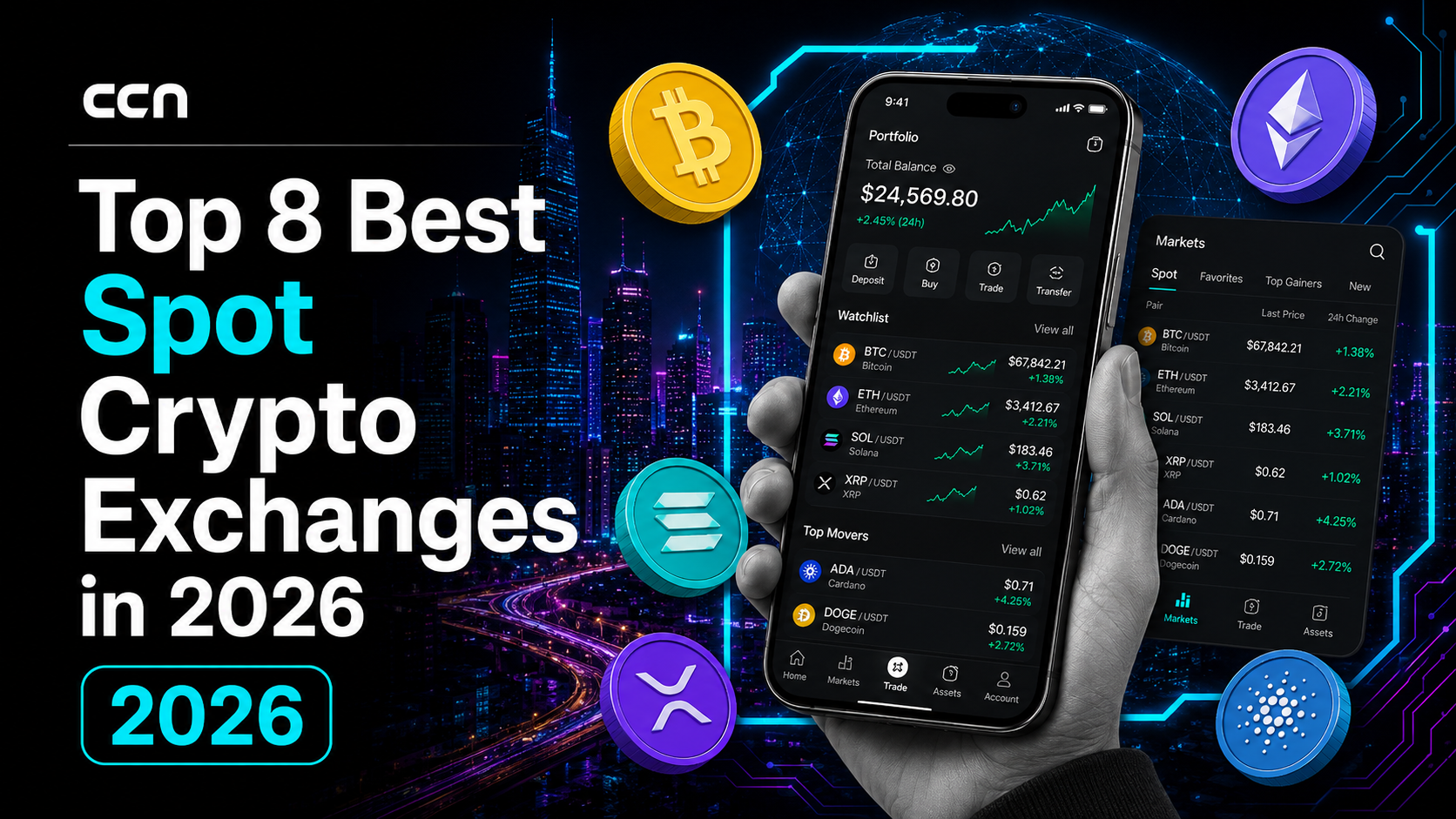
Top 8 best spot crypto exchanges in 2026, featuring mobile trading tools, real-time market prices, and simple crypto buying and selling features.
Frequently Asked Questions
What is spot trading in crypto?
Spot trading is buying or selling a cryptocurrency at its current market price, also known as the “spot price,” with immediate settlement. When you complete a trade, your account will be credited with an asset immediately, letting you withdraw, sell, or use it however you’d like.
How does spot trading differ from futures?
The first difference between spot and futures trading is what exactly you’re trading. When spot trading, you’re trading a token directly for another token or fiat. When trading options, you’re trading contracts that “bet” on which way an asset will move.
The consequence is that spot trading involves direct ownership of the token, while futures trading doesn’t. Trading futures is also more complex, with funding rates, leverage, and liquidation risk introducing variable fees, increased risk, and forced exits.
Which exchange has the most spot pairs?
Spot trading pair counts vary widely across exchanges, with the exact numbers changing as tokens are listed and delisted. When it comes to centralized exchanges, the exchanges with the most trading pairs are MEXC and Gate.io, each with over 1,700 tokens. Decentralized exchanges blow these numbers out of the water, with Uniswap and Jupiter alone having over 10,000 tokens each.
What order types are available on spot exchanges?
It depends. Some of the best spot trading exchanges for beginners only support simple market orders. However, the best spot crypto exchanges overall support many more, including:
Limit
Stop-loss
Stop-limit
Take-profit
Trailing Stop
One Triggers the Other
Iceberg
Time-weighted average price
These more advanced order types allow you to execute more sophisticated trading strategies or give you more direct control over your risk exposure.
Do I own the actual crypto when I spot trade?
Yes. When you’re spot trading crypto, that means you own the token you’re trading until the trade fills. However, there is some nuance to this. When using a custodial exchange, the exchange holds your tokens, even if you own them.
Because of this, we recommend that you hold most of your funds in a non-custodial crypto wallet, so your tokens are held only by the exchange during active trading.
Are spot trading fees lower than futures fees?
Usually no, at least when looking at it on a per-trade basis. The trading fees at the best futures crypto exchanges are well below standard spot trading fees. That said, futures carry liquidation risk, and funding rates can make the effective fee of holding a position exceed spot trading fees. Spot trading, despite higher initial fees, carries neither of these risks.
Rundown of the Top 8 Best Spot Crypto Exchanges in 2026
Ilija is a CCN writer with 7 years of experience covering all things crypto. Ever since a fateful run-in with Litecoin in 2013, he's been an avid investor and writer in the space. When he's not maniacally hacking away at his keyboard, Ilija spends his time either hiking in nature or holed up in his apartment gaming.