To find the best of the best, we’ve tested the top futures crypto exchanges and compared them head-to-head on objective metrics. We looked at factors like execution speed, funding rate/trading fee competitiveness, availability of risk control measures, and more.
Today, we’ll be looking at the results of these tests, what crypto futures are, and what factors you should look at to find the best crypto futures exchange for you.
Key Takeaways:
Perpetual crypto futures account for 70% of total crypto trading volume, putting perpetual futures exchanges at the forefront in 2026.
Between funding rates and maker/taker fees, finding the most capital-efficient exchange to trade futures on can make a significant impact on your performance.
Trading crypto futures, especially at high leverage, is riskier than trading in spot markets but can yield outsized returns.
Your exchange’s insurance fund, risk controls, and liquidation engine play a significant role in helping you avoid forced liquidations.
As a beginner, using isolated margin positions can help you avoid losing too much on any one trade.
Best Crypto Futures Exchanges in 2026 are:
Filters
Crypto accepted
Disclosure
We sometimes use affiliate links in our content, when clicking on those we might receive a commission at no extra cost to you. By using this website you agree to our terms and conditions and privacy policy.
Established in 2011, Kraken is a trusted cryptocurrency exchange renowned for its longevity and diverse trading interfaces, catering to a broad user base.
Promotions
Get $10 In Bitcoin When You Register Through A Referral Link From An Existing Member.
Visa, MasterCard, SEPA (Single Euro Payments Area)+6
Visa
MasterCard
SEPA (Single Euro Payments Area)
GiroPay
EPS
Sofortuberweisung
Neteller
Skrill
Ellipsis
Languages
English, German, French+4
English
German
French
Turkish
Italian
Polish
Spanish
KYC / AML
Bitpanda Does Not Allow Anonymous Trading, And Customers Are Required To Leave Their First And Last Name During The Registration. The Platform Also Requires Account Verification Before You Start Trading.
KuCoin, founded in 2017, is a dynamic cryptocurrency exchange offering diverse trading options and a user-friendly interface. KuCoin maintains a positive reputation for innovation and commitment to user safety.
Promotions
Claim 100 USDT Token + 400 USDT Coupon + 10500 USDT Futures Trial Fund When You Sign Up.
BitMEX is a derivatives trading platform that specializes in cryptocurrency futures and swaps, offering high leverage trading for Bitcoin and other digital assets.
Promotions
Earn Up To 5,050 USDT, When You Complete Tasks Within 14 Days Of Signup.
Disclaimer: Investing in cryptocurrencies carries significant risk. Values are highly volatile. Never invest more than you can afford to lose. This site does not provide financial advice. Act based on your own research and consult with a financial professional before making decisions. Don’t invest unless you’re prepared to lose all the money you invest.
Affiliate disclosure: This website may contain affiliate links, which means we may earn a commission if you click on a product link and make a purchase/register.
Why Trust Us?
Here at CCN, we prioritize transparency and objectivity above all else, getting into the weeds of Web3 software so you don’t have to.
Our team of seasoned Web3 veterans is responsible for all 100+ reviews and guides on CCN. Each of these pieces was meticulously crafted by a team of testers, writers, and editors, using our own testing, metrics, and benchmarks rather than 3rd-party data.
To ensure our 1M+ monthly readers are well-informed, we make sure to update every piece regularly, from the best crypto wallets to guides on crypto trading best practices.
What is Crypto Futures Trading?
Crypto futures trading involves trading derivative contracts that speculate on a token’s future price. Futures contracts are intrinsically leveraged, meaning your gains and losses are multiplied depending on how the underlying tokens perform.
Common terms you’ll run into when trading futures contracts are longs, positions that speculate on a token or contract going up, and shorts, which speculate that a token or contract will go down.
To open and maintain a position, you’ll need to fulfill its margin requirements, which determine how much collateral you need for the position. If your margin ever falls under these requirements, your position is liquidated.
In 2026, over 70% of all crypto trading volume consists of futures contracts. To accommodate this demand, many of the best crypto exchanges on the market have begun supporting futures trading or expanded their offerings of futures-focused features.
How to Choose a Crypto Futures Exchange
There’s no single best crypto futures exchange, as the best exchange for you will vary based on your risk tolerance, trading habits, goals, and more. Below, we’ll look at some of the biggest factors for you to look at and evaluate their importance to you.
Maximum Leverage Offered
Leverage determines the size of a position you can hold with a given margin. For example, 20x leverage means you can control a position that is 20 times your margin. However, the effects of leverage apply to gains and losses equally. For that 20x leverage position to wipe out your margin, the contract’s value only needs to drop 5%.
For high-risk traders, maximizing leverage is one of the most important factors when choosing a crypto futures exchange. Some of the top futures crypto exchanges offer leverage up to 110-120x, letting you control large positions with relatively little margin.
Funding Rate Structure
The funding rate is a periodic payment made from the more popular position (long/short) to the less popular one to keep the system tied to the spot market. The way the funding rate is set up varies from exchange to exchange, with 8-hour reevaluation periods standard, though some exchanges use shorter timeframes.
A well-calibrated funding rate structure minimizes cost drag and ensures price parity. Funding rate caps, meanwhile, help the best-performing exchanges stay accessible to retail traders, but exchanges without caps can be more favorable if you’ve got a large edge.
Margin Modes (Isolated vs Cross)
There are two main types of margin:
Isolated Margin: Limits the risk to your portfolio to the collateral assigned to a single position. This means one trade being liquidated won’t affect the rest of your funds.
Cross Margin: Uses your entire account balance as unified collateral across all positions. This increases your flexibility and lowers your risk of liquidation due to temporary market shifts, but exposes more of your portfolio to risk.
The best crypto futures exchanges will let you choose between these options, but beginners should rely largely on isolated margin positions. Generally, you should steer clear of cross margin unless you have an extremely high conviction in your position.
Perpetual vs Delivery Futures
Perpetual futures, also known as perps, account for 70% of total crypto trading volume. These futures contracts have no expiration date and use a funding rate fee mechanism to balance positions and the spot market. The flexibility to hold a position indefinitely and the availability of excellent dedicated crypto perps platforms make this type of futures contract more common in Web3.
Delivery or dated futures are futures bought and sold with a fixed expiry date, with the payout determined at expiry. These futures can diverge from the spot price significantly based on time premiums or discounts. Because of their narrow nature, they’re most commonly used by institutional or professional traders as a part of a complex trading strategy or hedge.
Perps will be enough for most traders looking to dip their toes into the futures market, but more sophisticated traders may want delivery futures availability on their crypto futures trading platform of choice.
Liquidation Engine & Insurance Fund
There’s a lot of math that goes into balancing futures order books, so exchanges rely on automated risk-management systems called liquidation engines to ensure they stay solvent.
An insurance fund is a reserve of funds or tokens used to cover excessive losses from bankrupt positions and to ensure that profitable positions receive their maximum payout. The higher the insurance fund, the more secure you can be in your gains in volatile markets.
The more sophisticated the exchange’s features, the more intricate its liquidation engine needs to be. The best-performing exchanges use a variety of technologies and algorithms to monitor the health of all orders on the platform and minimize the likelihood of liquidation.
Notably, most exchanges will liquidate positions slightly before they reach insolvency (e.g., liquidating a 100x-leveraged position after a 0.8% drop). It’s worth checking when your exchange liquidates positions, as a little more wiggle room can make the difference between a winning trade and going to zero.
Trading Fees (Maker/Taker)
Trading fees are charged on every transaction with futures trading, split into two types:
Maker fees - For positions that add to order book liquidity.
Taker fees - For positions that subtract from order book liquidity by matching with a pre-existing order.
Generally, maker fees are lower than taker fees, so that exchanges can incentivize adding to their order books. Many of the best low-fee exchanges support futures, making it worthwhile to compare fees across exchanges to maximize your profits.
When comparing fees, consider your expected trading activity and your exchange’s trading volume/VIP incentives.
Available Trading Pairs
The best crypto futures exchange should support futures trading for all of the tokens you’re interested in. The number of trading pairs available also makes it easier to get into new tokens and facilitates more diverse trading strategies.
If you want to be able to pivot your portfolio to other tokens in response to market movements, or simply want to be able to cast a wide net while trading and capture opportunities in less popular tokens, trading pair count should be a priority.
On the other hand, if you want to dedicate yourself to trading futures on a popular token like BTC or ETH, this factor’s impact will be negligible.
Risk Controls (Auto-Deleveraging)
Auto-deleveraging (ADR) is an automatic mechanism that keeps the exchange solvent during times of extreme volatility. ADR is triggered when the exchange’s insurance fund is insufficient to support a bankrupt futures position.
When this happens, the position that triggered it is automatically closed, the exchange’s insurance fund absorbs the hit, and the most profitable opposing positions see their leverage forcibly decreased. Because of this, it’s worth avoiding on both sides of the trade.
How often auto-deleveraging happens tells you a lot about an exchange’s liquidity, and how safe your trades will be once they’re placed. To avoid it, you should also look for exchanges that offer risk controls such as limit orders, immediate-or-cancel orders, and more.
Generally, it’s also advisable to trade USD-margined contracts if you’re concerned about ADR, as the lower insurance fund on token-margined contracts increases the likelihood of ADR.
Frequently Asked Questions
What are crypto futures?
Crypto futures are a type of crypto derivative contract that allows you to speculate on a token’s price at some point in the future. By taking a long position, you can bet the token will go up in price, or that it’ll go down by taking a short position.
Part of why crypto futures are so popular is that they tend to offer the most leverage, potentially letting you reap outsized returns on your positions.
What's the difference between perpetual and delivery futures?
Perpetual futures contracts are a type of futures contract that have no expiration date and use the funding rate to stay anchored to the underlying spot market. These are often traded on dedicated crypto perp platforms and are more popular among retail traders than delivery futures.
Delivery futures contracts are a type of futures contract with a fixed expiration date, after which contracts are automatically closed. While less popular among retail traders, delivery futures let you avoid funding rate costs and enable basis trading strategies
What is the funding rate?
The funding rate is a type of fee unique to perpetual contracts. It describes a type of fee that holders of a more in-demand position pay to the holders of the contrary position. So, for example, if long futures contracts are more in demand at a given moment, the funding rate would be positive, and long holders would pay short holders.
The purpose of the funding rate is to anchor the futures contract price to the spot price of the underlying asset. A high, positive funding rate signals a long-skewed market, while a negative funding rate signals a short-skewed one.
What is the maximum leverage on crypto futures?
The maximum leverage for crypto futures trading varies by exchange and the underlying tokens. Generally, the best futures exchanges offer leverage of 20x to 100x or more on popular tokens.
However, these higher leverage ranges are extremely risky, and you should only use them if you’re extremely sure of your approach. This list focuses on the best futures exchanges all around, but if you want to maximize your potential upside, you should consider our list of the best exchanges with leverage.
What happens during liquidation?
Liquidation happens when your margin trading balance goes below the margin requirement for a position you’re holding. This, in turn, causes your position to be closed immediately at the best available price. This means you lose your entire margin balance.
Notably, if the market moved too fast for the position to be closed at an appropriate price, any losses over your margin balance are incurred by the exchange.
Are futures available to US traders?
Many of the best crypto futures exchanges aren’t available in the United States. Availability varies widely across states based on legislation and how well exchanges can adapt to it.
Some top crypto futures exchanges, like Coinbase, have adapted to this by offering only CFTC-regulated futures contracts. However, most US exchanges that offer futures trading do so with limitations, whether on the futures available or on position size/leverage.
With that being said, there are decentralized crypto futures exchanges like Hyperliquid that allow you to trade futures with no restrictions, though fiat on/off-ramping with these exchanges can be difficult.
Are crypto futures riskier than spot trading?
Generally yes. Futures trading includes leverage by default, amplifying the effects of both winning and losing trades. For example, with 10x leverage, a position moving 10% against you will force you to liquidate, even if the underlying token doesn’t go to zero.
Futures trading is also more complex, requiring you to consider funding rates and margin requirements. This, in turn, introduces more risk of making a mistake.
However, futures can also be used to minimize risk by hedging a preexisting spot position.
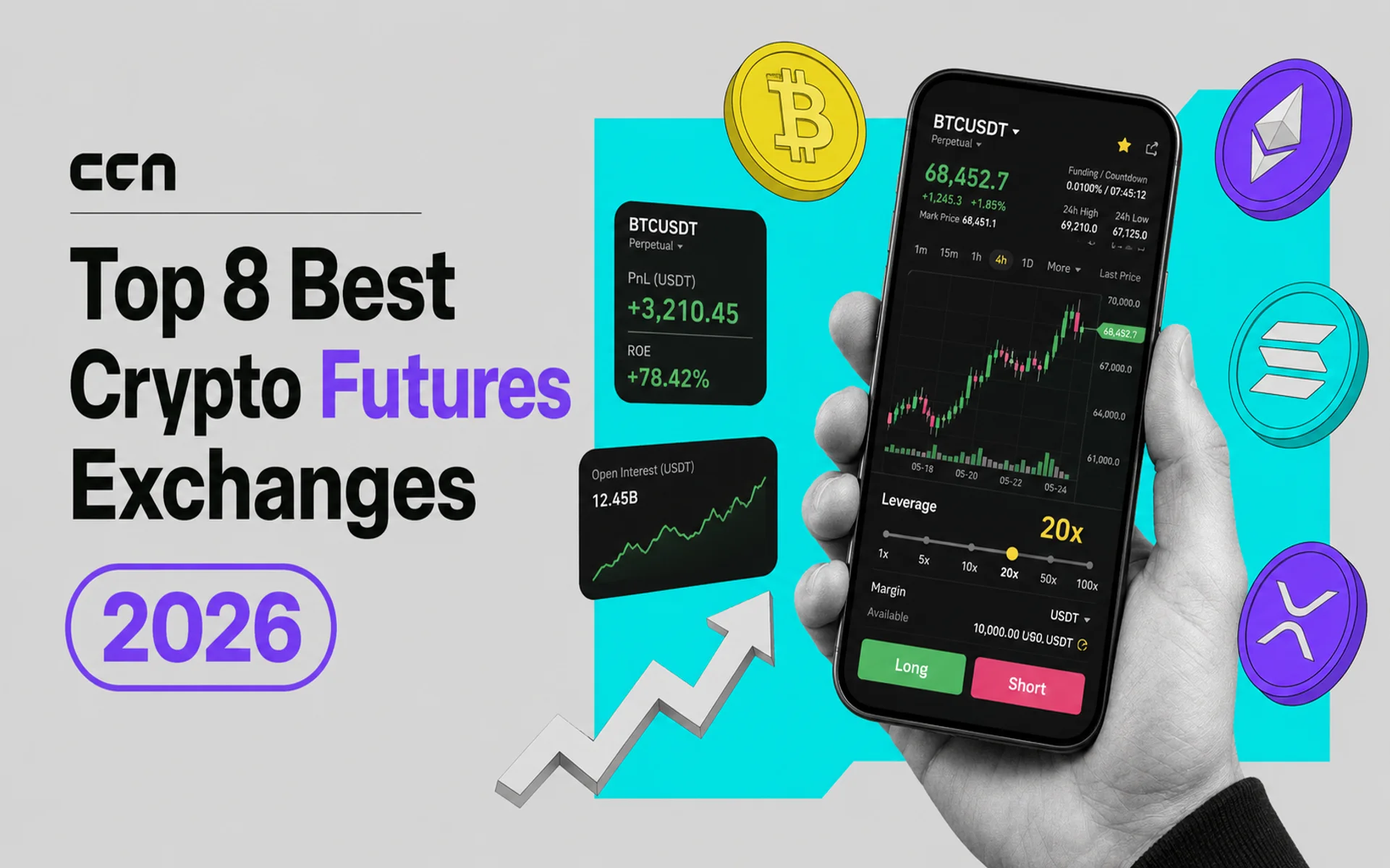
Top 8 best crypto futures exchanges in 2026, featuring leveraged trading tools, perpetual contracts, and mobile futures platforms.
Ilija is a CCN writer with 7 years of experience covering all things crypto. Ever since a fateful run-in with Litecoin in 2013, he's been an avid investor and writer in the space. When he's not maniacally hacking away at his keyboard, Ilija spends his time either hiking in nature or holed up in his apartment gaming.