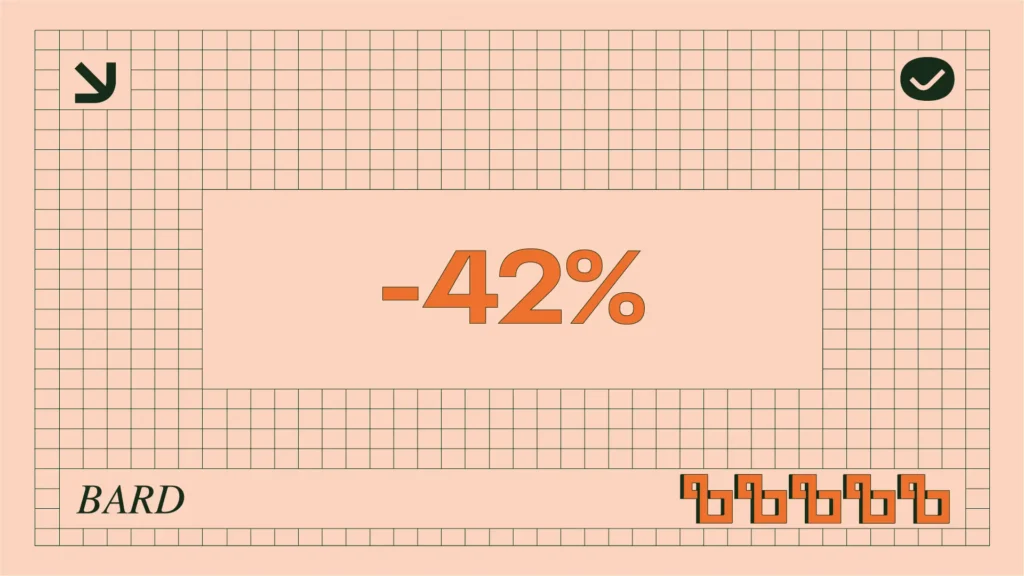
Despite launching on Sept. 18 with listings on major exchanges, BARD’s price crashed 42%.
Early selling by recipients fueled heavy sell pressure, driving down the Lombard crypto price.
BARD is still in price discovery; extended sell-offs could push it toward the $0.63 support.
BARD, the native token of Lombard—a project focused on building on-chain Bitcoin capital markets- has stumbled out of the gate.
The token officially launched yesterday, Sept. 18, with listings on several tier-1 crypto exchanges. Yet, in 24 hours, Lombard’s price has crashed 42%, erasing much of the initial hype.
So, what went wrong? Here’s everything you need to know about Lombard, why BARD crashed, and what could lie ahead for its price.
Lombard Launch, Tokenomics
Although Lombard’s token only launched yesterday, the project had already unveiled its tokenomics on Sept. 16. According to the release, BARD carries a maximum supply of 1 billion tokens.
At the Token Generation Event (TGE), just 22.5% of that supply—about 225 million tokens—entered circulation. This controlled release structure aims to limit immediate dilution while still providing liquidity for trading.
Get These Top Crypto Casino Offers Now!
Sponsored
Disclosure
We sometimes use affiliate links in our content, when clicking on those we might receive a commission at no extra cost to you. By using this website you agree to our terms and conditions and privacy policy.
On the governance side, BARD is the backbone of Lombard’s ecosystem, securing cross-chain transfers of Lombard Staked Bitcoin (LBTC).
“At the centre of this effort is BARD, the native token of the Lombard protocol. More than just a token, BARD is an economic coordination mechanism: powering growth, governing the protocol, and enabling access to Lombard’s products and infrastructure,” The project disclosed.
The protocol is built atop Chainlink’s Cross-Chain Interoperability Protocol (CCIP) and Symbiotic infrastructure, ensuring reliability and decentralization for its Bitcoin capital market vision.
Volume Spikes on Exchange Listings
Meanwhile, BARD secured listings on major exchanges, including OKX, Bithumb, Upbit, and Coinbase. Sometimes, this rollout fuels strong upside momentum for new tokens.
This time, however, the excitement didn’t last. Instead of rallying, Lombard’s price slipped, falling from a swing high of $1.61 down to $0.93 within 24 hours of launch.
As BARD’s price tumbled, trading volume spiked to $685 million. Rising volume during a price decline typically signals heavy sell pressure, as early holders or airdrop recipients rush to take profits.
According to CCN’s findings, the airdrop allocation—40 million BARD out of the circulating supply—played a major role in the decline. Many recipients appear to have sold their tokens shortly after the launch, creating immediate sell pressure.
If this trend continues, with Lombard’s price sliding while trading volume rises, it could signal that more tokens are being offloaded into the market, adding further downward pressure on BARD in the short term.
If selling pressure extends, the 15-minute chart suggests BARD’s market value could slip further, potentially testing support around $0.63. However, if the token finds stability and buyers regain confidence, the trend could shift.
BARD/USDT 15-Minute Chart | Credit: TradingView
In that case, BARD’s price may climb as high as $1.37, reclaiming a portion of its launch-day losses.
Disclaimer:
The information provided in this article is for informational purposes only. It is not intended to be, nor should it be construed as, financial advice. We do not make any warranties regarding the completeness, reliability, or accuracy of this information. All investments involve risk, and past performance does not guarantee future results. We recommend consulting a financial advisor before making any investment decisions.
Victor Olanrewaju is a crypto analyst and reporter at CCN with deep roots in on-chain research and technical analysis. His crypto journey began in 2017, but it was the 2020 Uniswap airdrop that sparked a full-time pivot into the space.
With a foundation in copywriting, Victor honed his craft creating high-converting content for leading crypto brokers — most notably an XRP price prediction that ranked #1 on Google during the 2021 bull run.
He later joined AMBCrypto in 2022, where he combined storytelling with technical and on-chain analysis to cover key market narratives.
In 2024, he expanded his expertise at BeInCrypto, collaborating with analysts and using tools like Glassnode, Santiment, and IntoTheBlock to break down Bitcoin and altcoin trends.
At CCN, Victor covers the top cryptocurrencies, memecoins, macro shifts, blending real-time insights with deep-dive metrics.
He holds a Bachelor’s degree in Physics from the University of Ibadan, equipping him to simplify complex data for a wide audience. Follow his work or connect on LinkedIn or X.