This can magnify your profits immensely, sometimes up to 125x. However, it’s also extremely risky, as losses are amplified proportionately. With high leverage, even normal volatility can lead to liquidation. The highest leverage crypto exchanges allow you to control massive positions with relatively little funding.
Our team has thoroughly tested the exchanges with the highest leverage on the market. We looked at high-leverage trading conditions, risk control features, insurance fund coverage, and more to find the best of the best.
In this guide, we’ll cover the results of this testing, the risks and benefits of high leverage, and what factors you should look at to find the best high-leverage trading platform for you.
Key Takeaways:
Using leverage is extremely risky. While it can provide outsized gains, avoid using leverage with funds you aren’t comfortable with losing.
The crypto market is volatile. At 100x leverage or more, regular market volatility
Leverage caps and availability vary by jurisdiction. Check what your exchange offers in your area before committing.
Auto-deleveraging can force-close profitable positions if the exchange’s insurance fund isn’t deep enough.
When trading perpetuals, be careful of funding rates. The funding rate scales with your leverage and can wipe out your position even without significant market movements.
Highest Leverage Crypto Exchanges in 2026
Filters
Crypto accepted
Disclosure
We sometimes use affiliate links in our content, when clicking on those we might receive a commission at no extra cost to you. By using this website you agree to our terms and conditions and privacy policy.
Initially established in 2011 and officially launched as a crypto exchange in 2013, Kraken is a crypto trading platform headquartered in San Francisco, California. It is one of the most popular exchanges on the market and consistently generates billions of daily trading volumes.
Kraken offers its services to all but two states in the US and holds the necessary permits to operate globally.
Kraken supports over 300 cryptocurrencies. Its service offerings include spot trading, margin trading with up to x5 leverage, and derivative trading with up to x50 leverage. The platform also offers earning opportunities for a select group of cryptocurrencies.
On Kraken, users can make fiat deposits with six major fiat currencies using several different payment methods. Kraken’s trading fee structure is tiered and offers discounted rates to users who generate large monthly trading volumes.
Promotions
Get $10 In Bitcoin When You Register Through A Referral Link From An Existing Member.
Bitunix, founded in 2021 in Hong Kong, is a crypto exchange designed for convenience, security, and social trading.
The platform supports over 700 crypto trading pairs across over 100 countries. The app is efficient, lightweight, and easy for beginners to jump into.
Bitunix is a jack of all trades, with easy access to P2P trading, futures, and staking. Bitunix’s copy trading feature lets users automatically copy the trades of successful traders on the platform.
The Bitunix academy education platform leans toward beginner and intermediate traders, teaching them all they need to know about the space with L2E(learn-to-earn) rewards.
It also has a variety of rewards programs, ranging from trading volume tournaments to Bitunix Splash, giving rewards to users investing in new tokens.
Promotions
Receive Up To $100,000 Worth Of Exclusive Gifts For Newcomers Upon Registration.
Launched in 2018, MEXC is one of the world’s most popular crypto exchanges, with over 10 million users worldwide. Despite its global presence, the exchange does not publicly disclose the location of its headquarters and any licensing information. While it operates in the EU, it does not accept users from the US.
MEXC supports over 2,500 cryptocurrencies, direct crypto purchases, spot trading pairs, futures trading with up to x200 leverage, margin trading with up to x10 leverage, loaning, borrowing, saving, earning, and more.
MEXC also accepts fiat deposits with credit and debit cards with a small number of currencies. Its fee structure is competitive and transparent. The exchange charges no maker fees, and 0.20% taker fees on all spot and futures trades.
Promotions
Sign Up: Get $10. Download App: Get 5$. 10,000 USDT Perk Awaits.
Initially launched as OkCoin in 2013, and then rebranded as OKEx in 2022, OKX is one of the largest crypto platforms in the world. With offices and licenses for operation all across the world, it has a global presence in the industry.
Even though it does not accept US users at the moment, OKX is registered as an MSB with FinCEN and is working on creating a US version of the platform.
OKX supports over 350 cryptocurrencies and over 500 trading pairs, and offers a wide range of services, including spot trading, P2P trading, futures and options, margin trading, earning and staking, bot trading, crypto loans, and much more. It is a one-stop comprehensive crypto platform.
The exchange also supports a long list of fiat currencies and accepts deposits in various payment methods. OKX’s fee structure is tiered and offers discounts for active traders who generate large monthly trading volumes.
Promotions
Get Up To 100 USDT When You Sign Up, Verify And Buy Or Sell Crypto For At Least 50 USDT.
BTCC Crypto Exchange, originating in China in 2011, is one of the longest-standing platforms in the cryptocurrency industry, offering a diverse range of trading pairs and financial services. BTCC prioritizes privacy by implementing strict security measures, including advanced encryption protocols and secure storage solutions.
Promotions
Get Up To 10,055 USDT When You Register, Verify, And Make The First Deposit And The First Trades.
Disclaimer: Investing in cryptocurrencies carries significant risk. Values are highly volatile. Never invest more than you can afford to lose. This site does not provide financial advice. Act based on your own research and consult with a financial professional before making decisions. Don’t invest unless you’re prepared to lose all the money you invest.
Affiliate disclosure: This website may contain affiliate links, which means we may earn a commission if you click on a product link and make a purchase/register.
Why Trust Us?
Here at CCN, we base all of our articles on first-party testing and collaboration among experts across teams to provide you with the most objective information available.
Each guide and review on our platform puts test results first. Before any writing is done, our team of testers stress-tests each tool and ranks them on objective metrics. Then, our writing team wraps these results into an easily digestible format, before our editors fact-check and polish each piece.
We’re taking this approach to become the one-stop shop for crypto information for our 10+ million monthly readers. Whether you’re looking for the best crypto tax software or ways to automate your crypto trading, you can find it at CCN.
How to Trade Safely on High-Leverage Exchanges
Finding the highest leverage crypto exchange is only part of the battle. There are multiple other factors that you should consider before diving into leverage that may affect your risk or upside potential. Let’s take a look at the main ones so you can pick the right high-leverage crypto exchange for you
Maximum Leverage Available
The highest-leverage crypto exchanges offer extremely high leverage. Most of these exchanges let you take 100x leverage on crypto trades, with some going as high as 125x.
Having options in the amount of leverage you use gives you extra flexibility in creating your trading strategy. While using extremely high leverage is risky, it can make outstanding returns for well-placed trades.
Liquidation Mechanism Quality
When trading at max leverage in crypto, the margin between an incredible trade and a liquidated one can be extremely thin. This is why the best high-leverage exchanges use optimized liquidation mechanisms with measures in place to ensure the fairest trading experience possible.
The first thing you should be looking for is liquidations based on external spot exchange pricing, rather than the exchange’s last traded price. This is because using the exchange’s last traded price can leave you vulnerable to order book manipulation and other market attacks.
We also prioritized exchanges that offer partial liquidations. With partial liquidation, your position is only partly liquidated to the degree needed to satisfy margin requirements, rather than all at once. This gives your positions some extra room to breathe as they wait for a reversal.
Isolated vs Cross Margin
An isolated margin means using fixed collateral to back a position. If said position is liquidated, you only lose the collateral assigned to it. Cross margin, on the other hand, uses your entire account balance as collateral across your open positions.
Both of these margin types are useful in crypto leverage trading. An isolated margin is usually better for riskier positions, but it makes each position easier to liquidate. Cross-margin makes it harder to liquidate individual positions, but it also risks your entire balance. For this list, we prioritized platforms that give you access to both for added flexibility.
Insurance Fund Coverage
Sometimes, positions are forced to liquidate under bankruptcy prices. The exchange’s insurance fund exists to ensure the positions on the opposite side can still be paid out. A larger insurance fund, therefore, makes for a safer trading experience for everyone.
When comparing insurance fund coverage, you should look at the balance as well as the exchange’s past behavior in high-volatility markets. Ideally, the exchange should publish this data itself, with real-time tracking for available insurance funds.
Auto-Deleveraging Policy
Auto-deleveraging (ADL) happens when the exchange’s insurance fund isn’t enough to cover a liquidation. When this happens, the exchange will forcibly close winning positions on the opposite side of the liquidated trade at bankruptcy prices. This, in turn, can significantly lower your profits on winning trades.
Generally, ADL occurs via a queue, where positions are ranked by profit and leverage, with the largest winners closing first. To help you minimize ADL, the best high-leverage exchanges should display ADL indicators and your position in the ADL queue.
Funding Rate Volatility
Funding rates are an exchange’s mechanism to keep perpetual contracts tied to spot markets. When the funding rate is positive, long positions pay short positions and vice versa. The funding rate is settled at regular intervals, usually every 8 hours, with some exchanges settling faster, at intervals of 1 hour or less.
Notably, funding rates are paid based on your full exposure, rather than your margin. When using the highest-leverage crypto exchanges, funding rates can eat into a significant chunk of your collateral because they’re multiplied as leverage increases.
Because of this, you should always look at the funding rate history for the contracts you plan to trade. If you see many spikes, that signals your high-leverage position can be wiped out by funding rates even if the market’s movements don’t liquidate it.
Position Size Limits
Even the highest-leverage crypto exchanges often come with caps on the total exposure you can have in a contract. Effectively, this means your available leverage decreases as your margin increases.
On some exchanges advertising 100x+ leverage, that leverage may be restricted to extremely small positions. On others, position size limits may vary by verification tier.
Regulatory Standing & Geographic Restrictions
The highest-leverage crypto exchanges are subject to significant regulatory scrutiny across jurisdictions. You want to choose an exchange in good regulatory standing where you live, with a history of regulatory compliance, to ensure you can keep using it as new regulations are introduced.
Note, however, that the availability of leverage products and maximum leverage may vary based on jurisdiction. In restricted markets like the US or EU, most exchanges won’t be able to offer the 100x leverage on crypto like they can in other markets.
Before picking an exchange, check what it can offer in your location, rather than just looking at what the website says at first glance.
Risk Disclosure
Trading crypto at high leverage is extremely risky. The highest leverage crypto exchanges do offer an opportunity to multiply your gains, but you have to keep in mind that potential losses grow proportionally.
Crypto’s innate volatility makes it difficult to predict the small market movements that can wipe out a high-leverage position.
Funding rates and trading fees erode your margin requirement, and auto-deleveraging (ADL) can forcibly close profitable positions in certain circumstances. With cross-margin, this risk extends even further; a single position can liquidate your entire account balance.
Always be careful when using leverage, and never use it on funds you aren’t prepared to lose.
Liquidation Risk
When trading at, say, 100x leverage, your margin will sit at around 1%. The maintenance margin will vary slightly but is usually around 0.5%. This means it only takes a 0.5% move against your trade to completely wipe out your position.
The crypto market is notoriously volatile, and 0.5% movements can happen within minutes or even seconds. Because of this, 100x leverage should be employed extremely conservatively, and only if you’re extremely confident in your position.
This comes down to a variety of factors. Leverage amplifies losses, and auto-deleveraging can hurt winning trades. Furthermore, platform fees and funding rates can eat into traders’ profits. At high leverage, even a well-thought-out position can end up losing due to ordinary market volatility.
Of course, traders’ skill levels and risk management approaches also factor into this. You should never use leverage to trade funds you can’t afford to lose, and avoid high leverage unless you’re extremely confident in a position.
Frequently Asked Questions
What is the highest leverage available in crypto?
On select trading pairs on certain platforms, you may be able to see as much as 1000x leverage(usually on specialized perps DEXs). That said, these exchanges tend to have low liquidity, and most traders find this type of leverage excessive.
Most centralized high-leverage crypto exchanges offer a more manageable(but still extremely high) leverage of 100-125x. However, these numbers can vary based on trading pair liquidity and position size.
Is 100x leverage safe?
No. Using 100x leverage in crypto is one of the riskiest approaches you can take, as it maximizes both your effective upside and downside. At 100x leverage, your margin will be around 1% of the position’s value, while your maintenance margin will be around 0.5%. This means that the market moving even slightly against you can liquidate your entire position.
For experienced traders, there are ways to incorporate 100x leverage into your strategy safely. Usually, this is done with minimal position sizes, stop losses to mitigate liquidation risk, and extremely predictable scalping ranges.
What is the difference between isolated and cross margin?
Isolated margin limits your downside to the collateral assigned to one specific position. This means one position being liquidated won’t affect the rest of your portfolio.
Cross margin, meanwhile, uses your entire account balance as collateral for all of your positions. This, in turn, lowers your risk of liquidation but also exposes you to greater risk across your portfolio.
High-leverage crypto exchanges generally support both types. However, beginners are usually better off sticking to isolated margin. Risking your entire account balance with cross margin should wait until you’re extremely comfortable with leverage trading.
How does liquidation work with high leverage?
The higher your leverage is, the less volatility is needed to trigger liquidation.
What is auto-deleveraging (ADL)?
Auto-deleveraging (ADL) happens in derivatives markets when a liquidated trader’s position cannot be closed, and the exchange’s insurance fund doesn’t have enough to cover the losses. When ADL happens, profitable counterparty positions are forcibly closed at the bankruptcy price.
The order in which positions are force-closed is based on a queue, usually with the highest-profit, highest-leverage positions closed first. This means profitable positions with high leverage are at the highest risk of being forcibly closed.
That said, ADL is rare on the best futures trading platforms. To avoid ADL when using high leverage, take partial profits periodically, and pay close attention to your exchange’s ADL indicators.
Are high-leverage crypto exchanges legal?
It depends on your jurisdiction. In some locations, crypto leverage exchanges operate without restrictions, while in others, such as the US, they are strictly regulated. There are few, if any, countries where high-leverage crypto exchanges are outright illegal, albeit their leverage offerings may be restricted.
In restricted markets like the US, the leverage they can offer to retail traders is quite limited. High-leverage retail trading has a history of being persecuted in the US, with BitMEX losing a $100 million lawsuit for providing crypto at 100x leverage. The EU is even stricter, with retail traders usually restricted to 2x leverage under MiFID II.
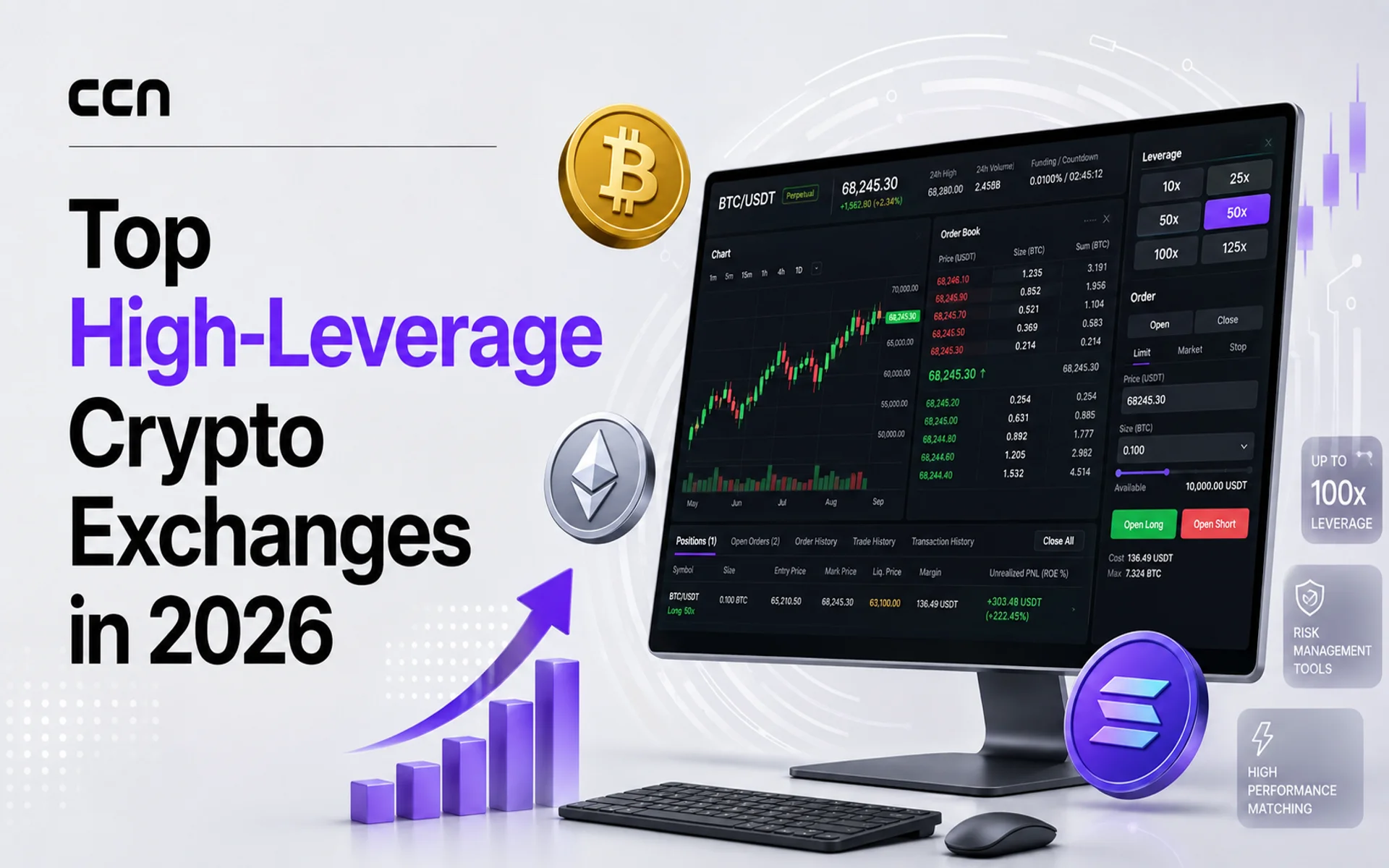
Top high-leverage crypto exchanges in 2026, featuring desktop futures trading platforms, 125x leverage, deep liquidity, risk controls, and advanced trading tools.
Ilija is a CCN writer with 7 years of experience covering all things crypto. Ever since a fateful run-in with Litecoin in 2013, he's been an avid investor and writer in the space. When he's not maniacally hacking away at his keyboard, Ilija spends his time either hiking in nature or holed up in his apartment gaming.