Top 8 Best Multi-Asset Crypto Trading Platforms in 2026
Multi-asset crypto trading platforms allow you to consolidate your trades across markets onto one exchange. Having access to spot, futures, options, and staking on the same platform brings more than just convenience. It helps you access lower fees and can increase your capital efficiency by taking advantage of unified or portfolio margin.
Our team has thoroughly tested the top unified crypto exchanges on the market. We’ve analyzed their performance across market types and ranked them on objective metrics. We delved deep into each exchange’s asset variety, margin types, liquidity, security, and more to find the best of the best.
In this guide, we’ll look at each exchange’s performance on these tests and factors you should consider to find the best multi-asset crypto trading platform for you.
Key Takeaways:
The best multi-asset crypto platforms offer spot, perpetuals, dated futures, options, margin trading, and real-world assets (RWA), alongside passive income options such as staking and yield products.
Asset availability can vary by jurisdiction and verification tier. Check what assets are available in your country before committing to an exchange.
You can lower your fees by using a single exchange for all your trading, maximizing any trading volume/VIP bonuses.
Unified and portfolio margin can help you increase capital efficiency and lower margin requirements when trading across market types.
Different types of trading are taxed differently. Use an exchange that easily integrates with your crypto tax software to avoid headaches come tax season.
Best Multi-Asset Crypto Trading Platforms in 2026 Are:
Disclosure
We sometimes use affiliate links in our content, when clicking on those we might receive a commission at no extra cost to you. By using this website you agree to our terms and conditions and privacy policy.
Coinbase, a major player since its inception in 2012, is a user-friendly cryptocurrency exchange offering a secure platform for buying, selling, and managing a variety of digital assets.
Promotions
Earn $10 In Ethereum (ETH) When You Stake $100 In ETH For The First Time, Up To $30 In Rewards
Fees (Maker/Taker)
Stablecoins Pairs Fees, Trading Fees, Fiat Deposit Fees+12
Stablecoins Pairs fees
Trading Fees
Fiat Deposit Fees
Fiat Withdrawal Fees
Wire Transfer Deposit (USD)
Wire Transfer Withdrawal (USD)
ACH Deposit
ACH Withdrawal
SEPA (EUR) Deposit
SEPA (EUR) Withdrawal
Swift (GBP) Deposit
Swift (GBP) Withdrawal
Crypto Deposit Fee
Crypto Withdrawal Fee
Conversion Fee
Products
Spot Trading, Derivatives Trading, OTC Trading+6
spot trading
derivatives trading
OTC trading
P2P trading
staking
loans
NFTs
wallet
pay
Cryptocurrencies
Bitcoin, Ethereum, Tether+68
Bitcoin
Ethereum
Tether
Build'N'Build
USD Coin
Solana
Ripple
Dogecoin
Cardano
Toncoin
Shiba Inu
Avalanche
Chainlink
Polygon Ecosystem Token
Polkadot
Litecoin
Dai
NEAR Protocol
Bitcoin Cash
Stellar
Cosmos
Filecoin
Ethereum Classic
Aptos
Hedera Hashgraph
Immutable
Optimism
Arbitrum
VeChain
The Sandbox
Decentraland
Axie Infinity
Injective Protocol
Render Token
The Graph
Aave
Chiliz
Helium
PAX Gold
Compound
Lido DAO Token
Stacks
Sui
Uniswap
Pepe
Ondo
Bittensor
Celestia
Artificial Superintelligence Alliance
Quant
Worldcoin
Bonk
Flare
Sei
JITO
JasmyCoin
PancakeSwap
Floki Inu
Ethereum Name Service
SushiSwap
Kava.io
1inch Network
Tezos
Algorand
Flow
Curve DAO Token
MultiversX
Zcash
Basic Attention Token
Ethena
Jupiter
Payment Methods
Bank Transfer, Bank Wire Transfer, Visa+88
Bank transfer
Bank Wire Transfer
Visa
MasterCard
Maestro
American Express
Discover
UnionPay
Revolut
Wise Token
PayPal
Apple Pay
Google Pay
FPS (Faster Payments Service)
SEPA (Single Euro Payments Area)
ACH (Automated Clearing House)
Sofort (by Skrill)
iDEAL
Bitcoin
Ethereum
Tether
Build'N'Build
USD Coin
Solana
XRP
Dogecoin
Cardano
Toncoin
Shiba Inu
Avalanche
Chainlink
Polygon Ecosystem Token
Polkadot
Litecoin
Dai
NEAR Protocol
Bitcoin Cash
Stellar
Cosmos
Filecoin
Ethereum Classic
Aptos
Hedera Hashgraph
Immutable
Optimism
Arbitrum
VeChain
The Sandbox
Decentraland
Axie Infinity
Injective Protocol
Render Token
The Graph
Aave
Chiliz
Helium
PAX Gold
Compound
Lido DAO Token
Stacks
Sui
Uniswap
Pepe
Ondo
Bittensor
Celestia
Artificial Superintelligence Alliance
Quant
Worldcoin
Bonk
Flare
Sei
JITO
JasmyCoin
PancakeSwap
FLOKI
Ethereum Name Service
SushiSwap
Kava.io
1inch Network
Tezos
Algorand
Flow
Curve DAO Token
MultiversX
Zcash
Basic Attention Token
Ethena
Interac Online
PIX
Jupiter
Languages
English, German, French+9
English
German
French
Spanish
Italian
Dutch
Polish
Portuguese
Japanese
Russian
Thai
Turkish
Licenses
United States (IRS), Canada (CRA), United Kingdom (HMRC)+4
Established in 2011, Kraken is a trusted cryptocurrency exchange renowned for its longevity and diverse trading interfaces, catering to a broad user base.
Promotions
Get $10 In Bitcoin When You Register Through A Referral Link From An Existing Member.
KuCoin, founded in 2017, is a dynamic cryptocurrency exchange offering diverse trading options and a user-friendly interface. KuCoin maintains a positive reputation for innovation and commitment to user safety.
Promotions
Claim 100 USDT Token + 400 USDT Coupon + 10500 USDT Futures Trial Fund When You Sign Up.
Disclaimer: Investing in cryptocurrencies carries significant risk. Values are highly volatile. Never invest more than you can afford to lose. This site does not provide financial advice. Act based on your own research and consult with a financial professional before making decisions. Don’t invest unless you’re prepared to lose all the money you invest.
Affiliate disclosure: This website may contain affiliate links, which means we may earn a commission if you click on a product link and make a purchase/register.
Why Trust Us?
Here at the Crypto Citizens Network, we put transparency and objectivity at the heart of everything we do.
Each of the hundreds of reviews and guides on CCN is the product of meticulous work by three different teams. First, the testers evaluate each tool and rank them based on objective metrics. Then, the writing team shapes this data into an actionable guide before the editors polish and fact-check the article.
We routinely update all of our guides to ensure our community of 10M+ monthly readers always has access to up-to-date information. Whether you’re looking for the best crypto wallets, a guide on trading automation, or the latest Web3 news, CCN has got you covered.
How to Choose a Multi-Asset Crypto Platform
There’s no single best multi-asset crypto trading platform. Rather, you should consider multiple factors and how they fit your trading needs. Let’s take a look at some of these factors and how you should prioritize them.
Range of Product Types Offered
A multi-asset crypto trading platform needs to offer a large variety of product types. Firstly, look at what markets are available. Spot, perpetual futures, and options markets can broaden your trading horizons, while staking, yield, and lending products offer opportunities to earn passive income.
In terms of assets, you want stablecoins, meme coins, altcoins, and real-world assets (RWA) under one roof. This way, you can trade across markets and asset classes with ease.
One thing you should always check is how this availability varies across jurisdictions and verification levels. Derivative products may be unavailable in restricted markets like the EU and the US. Similarly, many of the world’s best real-world asset exchanges lock a lot of their offerings behind extensive know-your-customer(KYC) verification.
Unified Margin / Portfolio Margin
For traders interested in futures/options and leveraged trading, having multiple margin types available gives you more flexibility and helps maximize capital efficiency.
Unified margin means you can use your account balance to back all of your positions. This means you could have the same collateral pool back a long options position, a dated future, and a perpetual future. This makes each of those positions more difficult to liquidate, but it also risks your entire account balance on each one.
Portfolio margin is a little more complex. With portfolio margin, the exchange runs a risk-assessment algorithm across your whole portfolio and calculates the margin requirement based on the net risk. This allows you to use less collateral if your portfolio is well-hedged.
Cross-Product Fee Discounts
One of the biggest draws of an all-in-one crypto platform is being able to maximize loyalty/VIP bonuses and fee discounts.
Generally, these discounts are tied to your trading volume on an exchange, so using two or more exchanges will leave you with middling bonuses on both.
Make sure to check how your exchange integrates trading volumes across different markets. A well-structured multi-asset crypto trading platform will take all of your on-exchange activities into account.
With these discounts taken into account, a multi-asset crypto trading platform can end up effectively cheaper than even the lowest-fee exchanges on the market.
Liquidity Across Each Product
The number of available products won’t do much for you if the liquidity on most of those is paper-thin. Many platforms that advertise themselves as multi-product crypto exchanges have substantial liquidity only in a few of those products.
This is especially important if you’re a high-volume trader, for whom thin liquidity can take out your entire edge on spread. For lower-volume traders, low liquidity still makes funding rates inconsistent and results in slower settlements.
Before choosing an exchange, you should look at the liquidity in the markets you plan to participate in. If your trading is highly varied, you’ll want to look for liquidity aggregation features to help you access deeper liquidity in smaller markets.
Unified Account & Wallet Structure
A unified account & wallet structure means having your spot, futures, margin, and other balances all in one place. This, in turn, means you can move funds extremely quickly across positions and collateral. Due to a disjointed structure, it can take time for your funds to clear, and there may even be transfer fees.
Here, you also want to look for features such as a unified portfolio view that provides a comprehensive overview of all your trading activity. It can also be helpful to have sub-account features for the times when you do want to keep your funds separate.
Risk Management Tools
Crypto is a risky market in and of itself. When you add options trading or leverage to that, risk management becomes just as important as choosing the right positions. The more your exchange can help with this, the better.
First off, you want an informative, clear dashboard showing your margin across your portfolio and liquidation estimates for your positions. You should be able to set alerts on both margin and price, so you’re immediately notified of market shifts.
In terms of order types, you want take-loss and take-profit orders available across markets. For leveraged markets, you want to see an ample insurance fund to avoid auto-deleveraging (ADL), along with ADL indicators you can track.
Reporting & Tax Aggregation
Trading multiple product types on an all-in-one crypto exchange usually means a complicated tax bill. In most jurisdictions, income from staking will be taxed differently than income from trading derivatives, which is then treated differently from selling a token you’ve held for years.
This means that even with the best crypto tax software, you’ll want an exchange with quality reporting to prevent headaches.
Ideally, your exchange should be able to produce detailed breakdowns that include all trading fees, realized and unrealized PnL, staking rewards, and funding rates, with all necessary timestamps. You want to be able to download this report as a CSV file in just a few clicks, so you can upload it to your tax software quickly.
Frequently Asked Questions
What is a multi-asset crypto trading platform?
A multi-asset crypto trading platform is a crypto exchange offering a variety of distinct crypto asset classes and trading markets. In terms of asset classes, a platform might offer Bitcoin, altcoins, meme coins, and stablecoins alongside real-world assets (RWAs). The same platform can then offer spot, futures, and options markets on these assets, alongside staking and lending products.
This model has multiple benefits. First off, it lets you consolidate your trading into one account, so you can reap the maximum benefits from VIP/trading volume bonuses. Many of these exchanges also offer unified or portfolio margin, letting you maximize capital efficiency while minimizing margin requirements and liquidation risk.
What is unified or portfolio margin?
Unified margin means having a single collateral pool backing all your positions, rather than funding each position separately. This increases capital efficiency and dramatically reduces your liquidation risk.
Portfolio margin is an evolution of this, where the exchange runs a risk-assessment algorithm across your entire portfolio and calculates margin requirements based on its net risk rather than on each individual position. This can oftentimes mean a lower margin requirement, especially with a well-hedged portfolio.
Can I trade options and futures on the same platform?
Yes, most multi-market crypto exchanges offer options and futures trading. Many of these platforms go one step further and allow margin sharing between futures and options. This means you can use a futures position to drop the collateral requirement for an option you take with it.
This consolidation opens up trading strategies that would be impractical or inefficient to run on two separate exchanges(as you’d have to fund both positions separately).
Are all-in-one platforms safer than specialized ones?
Inherently, all-in-one crypto exchanges aren’t any safer than specialized ones. However, using one of the safest exchanges for all your trading needs consolidates your risk into one, well-secured place.
To assess the security of an exchange, you should look at factors like:
Security incident history.
Percentage of user funds in cold storage.
Proof-of-Reserves statements and audits.
The availability of portfolio insurance.
However, no matter what exchange you choose, you should maximize your account security. You can do this by enabling 2FA, storing non-trading assets in a cold wallet, and following other crypto security best practices.
Do multi-asset platforms offer better fees?
It varies, but multiple multi-asset crypto trading platforms are among the lowest-fee exchanges out there. Part of this stems from the fact that trading volume incentives are easier to meet on exchanges that support both spot trading and derivatives.
Trading consolidation also helps lower effective fees. Switching platforms to trade different assets reduces the benefits of your VIP/trading volume on each exchange. For traders trading across markets, this means an exchange with higher headline fees can work out cheaper than one with lower fees on paper.
Which platform offers the widest range of crypto products?
It depends. In a vacuum, Gate.io is the multi-asset crypto trading platform with the most products, featuring spot, futures, and options trading alongside a plethora of passive income products and real-world assets.
However, product availability will vary based on your jurisdiction. For example, OKX has broader offerings than Gate.io available to EU users. Make sure to check what your platform of choice actually offers in your jurisdiction and at the verification level you’re comfortable with.
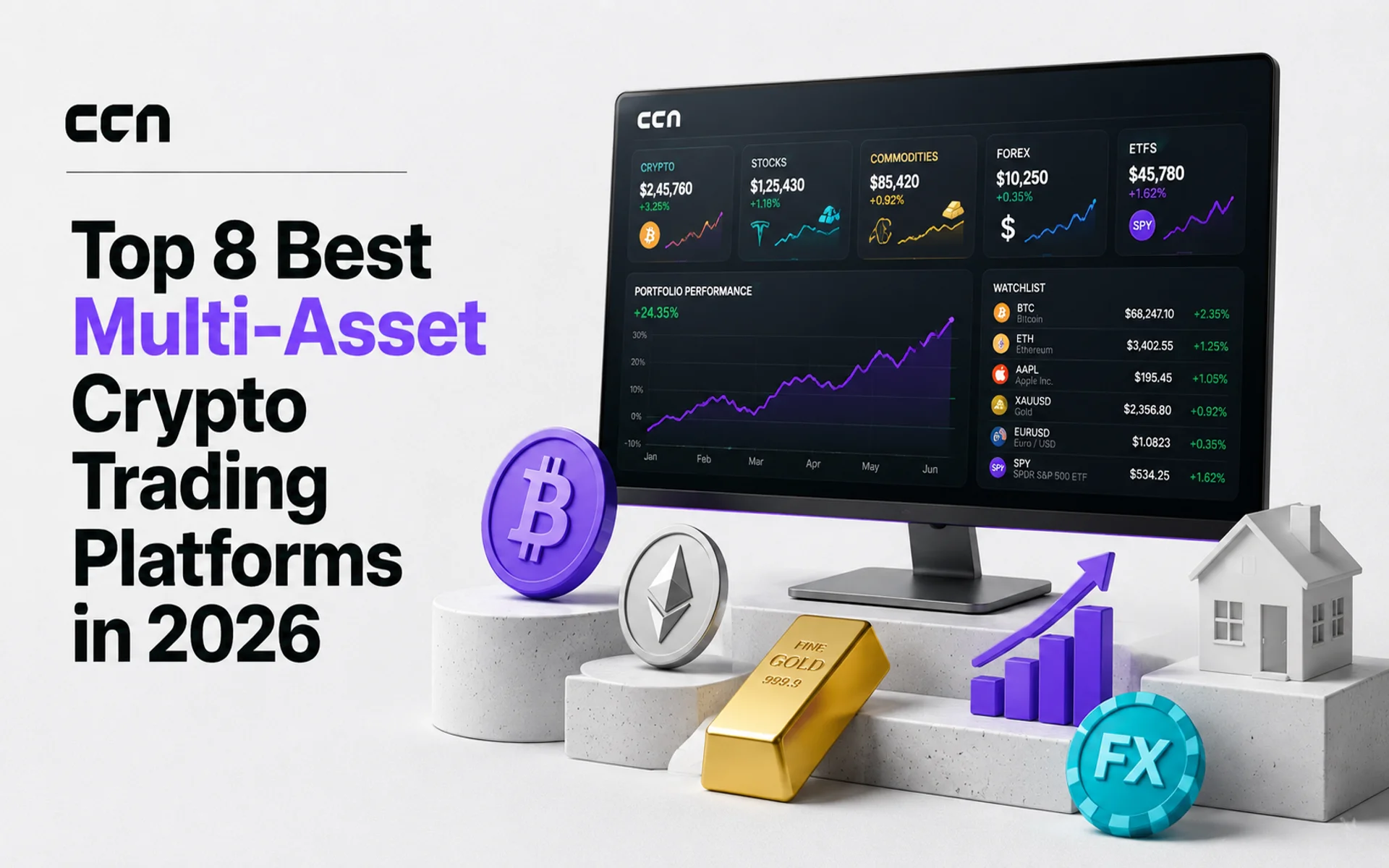
Top 8 best multi-asset crypto trading platforms in 2026, featuring crypto, stocks, commodities, forex, ETFs, and portfolio tracking tools.
Rundown of the Top 8 Best Multi-Asset Crypto Trading Platforms in 2026
Ilija is a CCN writer with 7 years of experience covering all things crypto. Ever since a fateful run-in with Litecoin in 2013, he's been an avid investor and writer in the space. When he's not maniacally hacking away at his keyboard, Ilija spends his time either hiking in nature or holed up in his apartment gaming.