

Use Cases That Matter
Where crypto hits real life in :
- Sovereign blockchain infrastructure (LTIN): In October 2025, Liechtenstein launched the Liechtenstein Trust Integrity Network, a state backed blockchain led by Telekom Liechtenstein. LTIN operates under the TVTG, is aligned with EU MiCA, and is designed for institutional and public sector blockchain use. It supports compliant digital trust services, validation, and token infrastructure and is powered by renewable energy sources.
- Government payments using crypto: Liechtenstein allows selected crypto assets including Bitcoin and Ether to be used for certain public sector payments such as government fees and registration related charges. Crypto is not legal tender, but this represents direct, real world transactional use with state authorities.
- Company formation funded with crypto: Cryptoassets such as Bitcoin and Ethereum can be used as non cash capital contributions when incorporating companies in Liechtenstein. This allows founders to legally fund statutory share capital with crypto, embedding digital assets directly into business formation processes.
- Cross border business payments and treasury use: Liechtenstein based firms, particularly in finance, tokenization, and blockchain services, use crypto and stablecoins for cross border settlements and treasury management. Crypto acts as an efficient settlement layer alongside CHF and EUR banking rails for international transactions.
- Regulated crypto banking and custody: Licensed financial institutions such as Bank Frick offer regulated crypto custody, trading, and settlement services. Individuals and institutions can hold and transact crypto within a traditional banking environment, integrating blockchain assets into everyday financial operations.
- Tokenized assets and digital securities: Liechtenstein enables the tokenization of real world assets such as securities, claims, and contractual rights under the TVTG framework. These tokenized assets are legally recognized and used by regulated entities for compliant digital finance and investment products.
- Voluntary merchant and professional service acceptance: Some private enterprises and professional service providers accept cryptocurrencies such as Bitcoin and stablecoins for payment on a voluntary basis. These payments are typically settled via direct wallet transfers and often converted to fiat immediately.
Citizen Voices
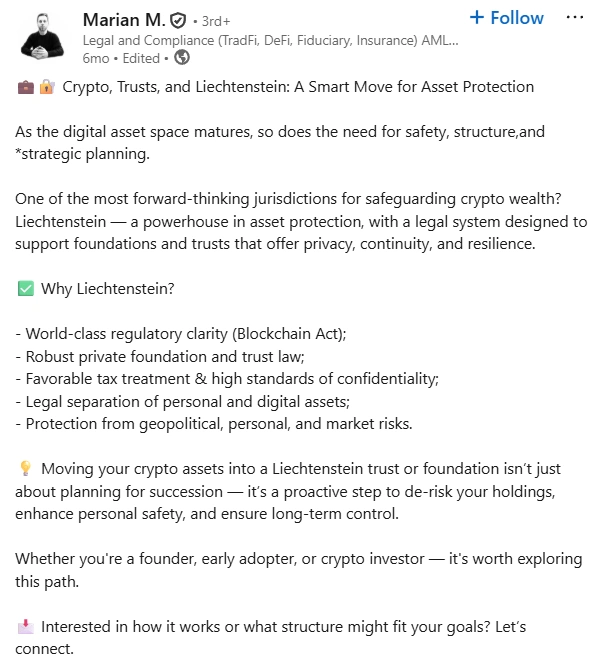
Marian M., legal and compliance professional
The user highlights that residents value Liechtenstein not for hype or fast gains, but for its strong Blockchain Act, trust and foundation laws, and high confidentiality standards. Crypto is seen as long-term wealth that benefits from legal separation, succession planning, and protection against market or geopolitical risks, rather than a tool for speculation.
A Reddit user
The above user highlighted Liechtenstein’s own exchange LCX as a “hidden gem of an ecosystem” with a focus on tokenization and liquidity protocols, reflecting grassroots excitement about local infrastructure being globally competitive.
@MultiversX on X
Community posts noted that Liechtenstein has begun to support EGLD, BTC, and other tokens via payment rails, signalling resident awareness and appreciation of increasing real-life utility for digital assets in the country.
Crypto cost of living: What 1 BTC buys here
A glimpse into the lifestyle economy — measured in sats, not cents.
Core Lifestyle Benchmarks
Assumptions:
- BTC price: USD $89,000 (as on Dec 14, 2025)
- FX: USD/CHF = 0.88–0.90 → 1 BTC = CHF 78,000–80,000
- Prices benchmarked to Vaduz region
Even in a high-cost European microstate, 1 BTC translates into significant everyday buying power, but housing costs remain a substantial ticket item due to limited supply and high demand.
BTC-to-Housing: The Long View
How far 1 BTC has gone over time in the housing market
How prices were estimated:
- BTC historical price data translated via average USD/CHF over time
- Housing estimate based on current rent and approximate value of small apartments
Regulatory + Economic Snapshot
Liechtenstein has been openly pro-tokenization, but in a rules-first way. Its “Blockchain Act,” the Token and TT Service Provider Act (TVTG), has been in force since 1 January 2020, with the FMA Liechtenstein responsible for registration and (event-driven/ad-hoc) supervision of TT service providers, including AML/CFT expectations aligned with FATF recommendations. From 1 February 2025, Liechtenstein implemented the EU’s Markets in Crypto-Assets Regulation through the EEA MiCA Implementation Act, bringing MiCA-style authorization/requirements into force locally.
For income-like crypto activity (e.g., trading as a business, employment income, or other taxable income), standard income-tax rules apply; Liechtenstein individual income tax rates are progressive with a top rate around 24% (depending on municipality). For companies, Liechtenstein has a flat 12.5% profit tax.
Liechtenstein uses the Swiss franc (customs/economic area ties with Switzerland), so CBDC developments largely follow the Swiss monetary sphere.
Liechtenstein’s banking sector is one of crypto’s most “institution-ready” in Europe. Bank Frick has been approved by SIX as a crypto-asset custodian (for crypto ETP custody) as of Oct 11, 2024. The broader pattern is bank-grade custody, tokenization and regulated market plumbing rather than mass retail payments.
The FMA framework emphasizes registration + AML/CFT supervision for token/virtual-currency-related service providers (TVTG, Due Diligence Act links), rather than a consumer-marketing crackdown narrative. A notable enforcement-adjacent market event: Bittrex Global GmbH (Liechtenstein) wound down and entered liquidation; the FMA publicly noted the lapse/renunciation of its TVTG registrations in Aug 2024.
The country’s Blockchain Act (TVTG) was politically supported under former Prime Minister Adrian Hasler and architected by legal scholar Christian Wolf, whose token-container model underpins Liechtenstein’s tokenization regime. Today, implementation is overseen by the Ministry of Finance under Markus Büchel, while bank executives such as Roland Risch (Bank Frick) operationalize crypto through regulated custody and market infrastructure.
Risk Barometer
Gives time-sensitive readers a feel for how volatile or stable the legal landscape is.
Crypto Adoption Timeline
-
2020
TVTG (Token and TT Service Provider Act) and ordinance enter into force (1 Jan 2020); FMA begins registration/supervision framework.
-
2024
FMA announces TVTG/TVTV amendments effective 1 Feb 2024.
-
2024
Bank Frick approved by SIX as crypto-asset custodian for crypto ETP custody (Oct 11, 2024).
-
2024
Bittrex Global GmbH (LI) liquidation process progresses; FMA publishes lapse of TVTG registration (Aug 7, 2024).
-
2025
EEA MiCA Implementation Act enters into force in Liechtenstein (1 Feb 2025).
-
2025
SNB Project Helvetia continues wholesale-CBDC pilot on SDX (June 2025 updates).
Meet Your Fellow Crypto Citizens
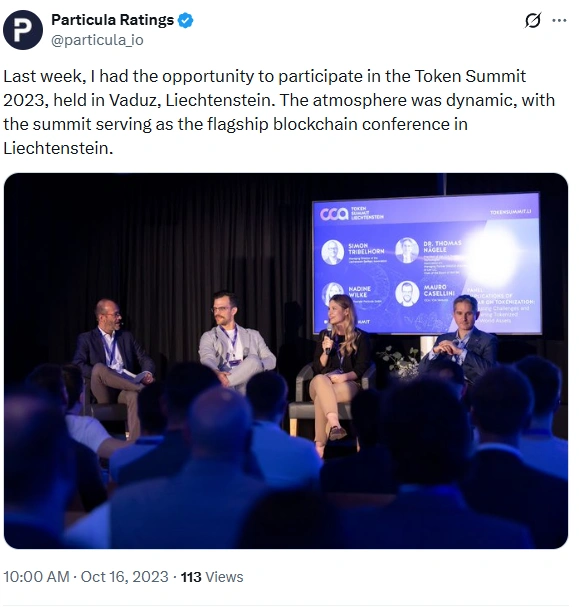
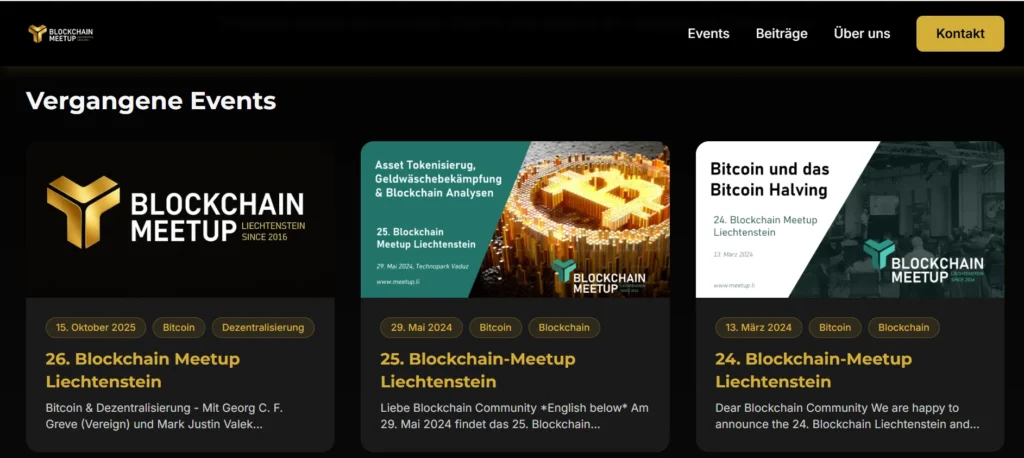
Liechtenstein’s blockchain and fintech scene may be boutique, but it’s active – with recurring meetups, expert conferences, and ecosystem gatherings throughout 2025 that bring together builders, regulators, founders, and institutional innovators.
Key Crypto and Fintech Events
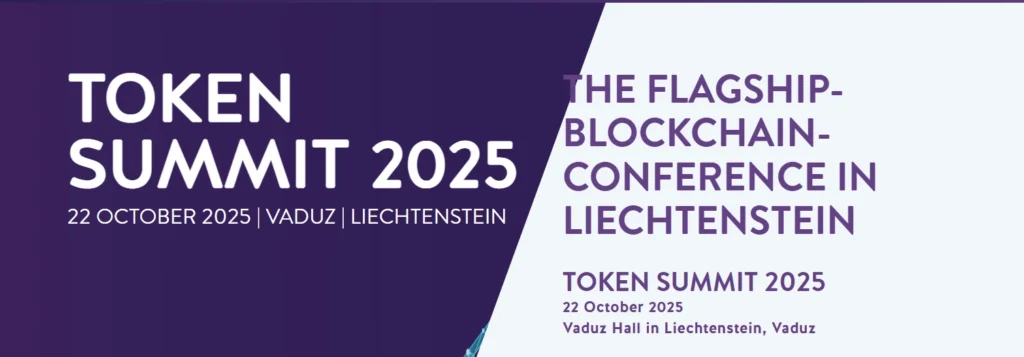
 22 Oct 2025
 Vaduz
15 Oct 2025
Vaduz
2025
Liechtenstein
28 Apr 2026
Vaduz
Vaduz
15 Oct 2025
Vaduz
2025
Liechtenstein
28 Apr 2026
Vaduz
Top 5 Trends to Watch
1. Regulated stablecoins underpin institutional settlement
- Under MiCA (effective locally from February 2025) and Liechtenstein’s long-standing TVTG framework, regulated stablecoins (such as USDC-class EMTs) are increasingly used for trading, treasury management, and settlement within EEA-compliant workflows.
- The emphasis is on bank-to-bank and market infrastructure use, not retail payments, aligned with AML and disclosure requirements.
2. Tokenized finance moves from pilots to production
- Liechtenstein’s private banks are already live: Bank Frick provides regulated crypto custody (including SIX-recognized ETP custody), while VP Bank runs production tokenization of client assets such as art and collectibles.
- Expect expansion into tokenized funds, structured products, and deposits distributed across the EEA under MiCA passports.
3. Real-world asset (RWA) tokenization scales across borders
- The Blockchain Act’s token-container model continues to attract issuers for RWA tokenization, including art, collectibles, and financial claims.
- With MiCA alignment, Liechtenstein increasingly acts as a launchpad for assets intended for EU-wide distribution, prioritizing compliance before liquidity.
4. Exchange and issuance infrastructure professionalizes
- Regulated venues and service providers, such as LCX as an FMA-registered TT service provider, focus on compliant issuance, listing, custody, and market services rather than high-leverage retail trading.
- Deeper integration with custodians, auditors, and EEA settlement rails is expected.
5. Compliance technology meets on-chain operations
- Rather than consumer-facing AI applications, the next wave centers on regtech, including automated compliance checks, transaction monitoring, and smart-contract controls that satisfy FMA and MiCA requirements.
- Liechtenstein’s small but sophisticated ecosystem is well suited to audit-friendly, institution-grade on-chain tooling.
Neighbour Watch: What’s Happening Next Door?
Around Liechtenstein, the dominant pattern is “legal, institutional, and harmonised.” Neighbouring jurisdictions either anchor Europe’s institutional crypto stack (Switzerland, Germany) or are transitioning fully into the EU’s MiCA regime (Austria, Italy). Liechtenstein sits between these systems, benefiting from both Swiss financial rails and EEA market access.
🇨🇭 Switzerland — Institutional, bank-led crypto hub
- Regime: Legal and regulated under FINMA; crypto treated as assets/property. No retail CBDC.
- Access: Strong institutional access via banks, crypto ETPs, and custody providers; retail trading legal but conservative.
- What’s next: The Swiss National Bank continues Project Helvetia (wholesale CBDC) on SIX Digital Exchange, supporting settlement of tokenized bonds and funds, reinforcing Switzerland’s role as Europe’s institutional crypto backbone.
🇦🇹 Austria — MiCA-aligned, retail + funds
- Regime: Legal; supervised by Austria’s Financial Market Authority (FMA) under EU MiCA.
- Access: Retail trading and custody allowed via MiCA-licensed CASPs; clear disclosure and governance rules.
- What’s next: Increased participation by investment funds and banks as MiCA licences roll out; Vienna remains a regional retail trading and fintech hub.
🇩🇪 Germany — Compliance-heavy, institutional scale
- Regime: Legal; BaFin-regulated crypto custody and trading under MiCA and existing German law.
- Access: Strong institutional access; banks and asset managers can custody and issue crypto products.
- What’s next: Expansion of MiCA-licensed custodians and euro-denominated stablecoin and tokenized-asset pilots, positioning Germany as the EU’s largest regulated crypto market.
🇮🇹 Italy — Legal, cautious, MiCA transition
- Regime: Legal; transitioning fully into MiCA supervision via Consob and the Bank of Italy.
- Access: Retail trading allowed; banks increasingly offer crypto custody and ETP exposure.
- What’s next: Gradual normalization through bank-led products and clearer marketing rules; less aggressive adoption than northern Europe.
References
- FMA Liechtenstein. TVTG (Token and TT Service Provider Act)
- Bank Frick. Bank Frick Authorised Six New Crypto Asset Custodians
- DataReportal. Digital 2025: Liechtenstein
- LCX. LCX Receives 8 Blockchain Registrations From FMA Liechtenstein
- Coin ATM Radar. Bitcoin ATMs in Liechtenstein
- FMA Liechtenstein. Register of Licensees
- Stripe. Payments in Liechtenstein
- Global Legal Insights. Blockchain and Cryptocurrency Laws and Regulations: Liechtenstein
- ISP Law. Incorporating a Company in Liechtenstein With Crypto Assets (Requirements and Legal Aspects)
- finance.li. Tokenisation as a Key Future Driver in Liechtenstein
- Chainwire. LTIN Launches as Liechtenstein’s Sovereign Blockchain Infrastructure Network (Oct 22, 2025)
- Bank Frick. Blockchain Banking Solutions
- Phemex. Ondo Finance Gains EU Approval for Onchain U.S. Stocks and ETFs
- Bank Frick. Bank Frick and Stablecoin Standard Forge Strategic Partnership
- GFT. Success Story: Blockchain-Based Asset Management
- Liechtenstein.li. Artmeta Digitalisiert Kunst mit VP Bank
- Bank Frick Careers. Official Website
- Crypto-Jobs.ch. Liechtenstein Jobs
- Facebook. CryptoCountry.li Page
- University of Liechtenstein. CAS Blockchain and FinTech
- TT Association. CCA (English)
- Token Summit. Home
- Pontinova Law. DAO and Liechtenstein Foundation
- Meetup. Blockchain Meet-up Liechtenstein
- Philatelie Liechtenstein. Crypto Stamps (NFT)
- Bitcoinist. Liechtenstein’s Official Post Service Issues Innovative NFT Postage Stamp
- Medium. Artmeta at CCA Token Summit in Liechtenstein
- Swiss NFT Association. Crypto Art VR Light Festival (Event)
- X (Twitter). objktcom Post (ID 1659576163868504065)
- Ledger Insights. Liechtenstein Launches Sovereign Blockchain Infrastructure
- LinkedIn. TatraStrategy Post (Activity 7343656871813132290)
- Reddit. “Why Liechtenstein Cryptoassets Exchange LCX Could Challenge Binance”
- X (Twitter). MultiversX Profile
- LivingCost.org. Cost of Living in Liechtenstein
- LivingCost.org. Cost of Living in Vaduz
- FMA Liechtenstein. TT Service Providers (Client Protection)
- FMA Liechtenstein. Activities Under MiCAR
- PwC Tax Summaries. Liechtenstein Corporate Taxes
- EDA (FDFA). Switzerland, Liechtenstein Travel Advice
- CMS. Expert Guide to Crypto Regulation: Liechtenstein
- Bittrex Global Zendesk. Important Information for Liechtenstein Customers
- Token Summit. Official Website
- meetup.li. Events